

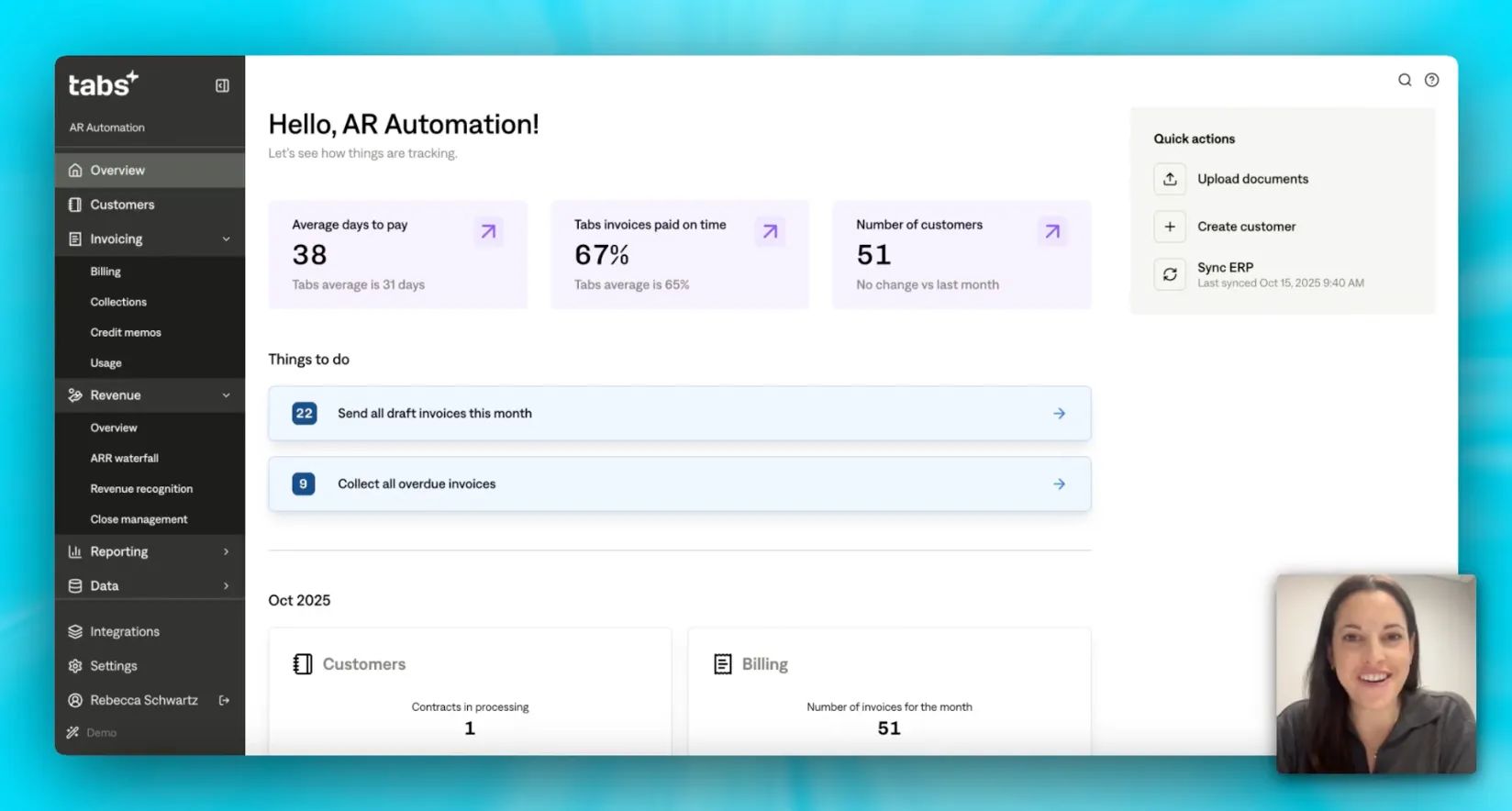
Today, we are introducing Tabs as the AI Operating System for Revenue, built to fundamentally change how finance and accounting teams work. We have been building toward this for the last year. Reaching this milestone has made me reflect on where we started, how much has changed, and where we’re going next.
When we started Tabs, we had a simple belief: finance teams shouldn’t have to keep pushing revenue forward by hand.
Finance software had already transformed the spend side. But accounts receivable and revenue remained much more manual. The accounting complexity and risk made the work harder to automate, so companies kept relying on people where software stopped short. We believed AI could change that.
So from the beginning, we built Tabs as an AI native revenue platform. The idea was simple: use AI and agents to take on the repetitive, manual work finance teams deal with every day, so they could move faster without having to keep adding people and process as the business grew.
What we couldn’t have predicted was how quickly AI itself would change how businesses operate. AI has moved from helping people complete tasks to increasingly being able to take responsibility for the work itself. And AI isn’t just changing software. It’s changing how companies make money. Across industries, businesses are figuring out how to price entirely new products and business models, from usage and credits to consumption and outcomes.
That creates a new level of complexity for how revenue gets contracted, billed, collected, and recognized. And if revenue is becoming more dynamic, and AI is becoming capable of doing more of the work, then the software that runs revenue has to evolve too.
It requires a system where agents can understand the business, coordinate the work, and execute across the revenue lifecycle, with the context and controls finance requires.
An LLM is not an operating system
LLMs have given us an incredible new intelligence layer. But intelligence alone is not enough to run finance.
Ask an LLM to read a contract and it can tell you what the payment terms say, but running the revenue behind that contract is different. It requires accounting expertise, financial judgment, and the ability to navigate the nuance, controls, and compliance behind every decision.
Finance is not general purpose work. Revenue is even more specialized. It requires deep domain expertise and an understanding of how every commercial decision flows from contract to cash to accounting. And revenue complexity has a real cost: finance teams have had to scale with headcount. As revenue grows, so do the exceptions, judgment calls, and manual work required to support it which creates increasingly inefficient workflows that depend on people to keep everything moving.
LLMs can now handle much of the reasoning that historically required people. But reasoning alone isn’t enough.
To actually execute financial work, AI needs tools, integrations, memory, permissions and controls, and most importantly, human checkpoints. General purpose LLMs do not provide those things. They provide intelligence, but the system around them has to provide the expertise, context, controls, and infrastructure to put that intelligence to work.
This is why we have built two foundational layers into Tabs.
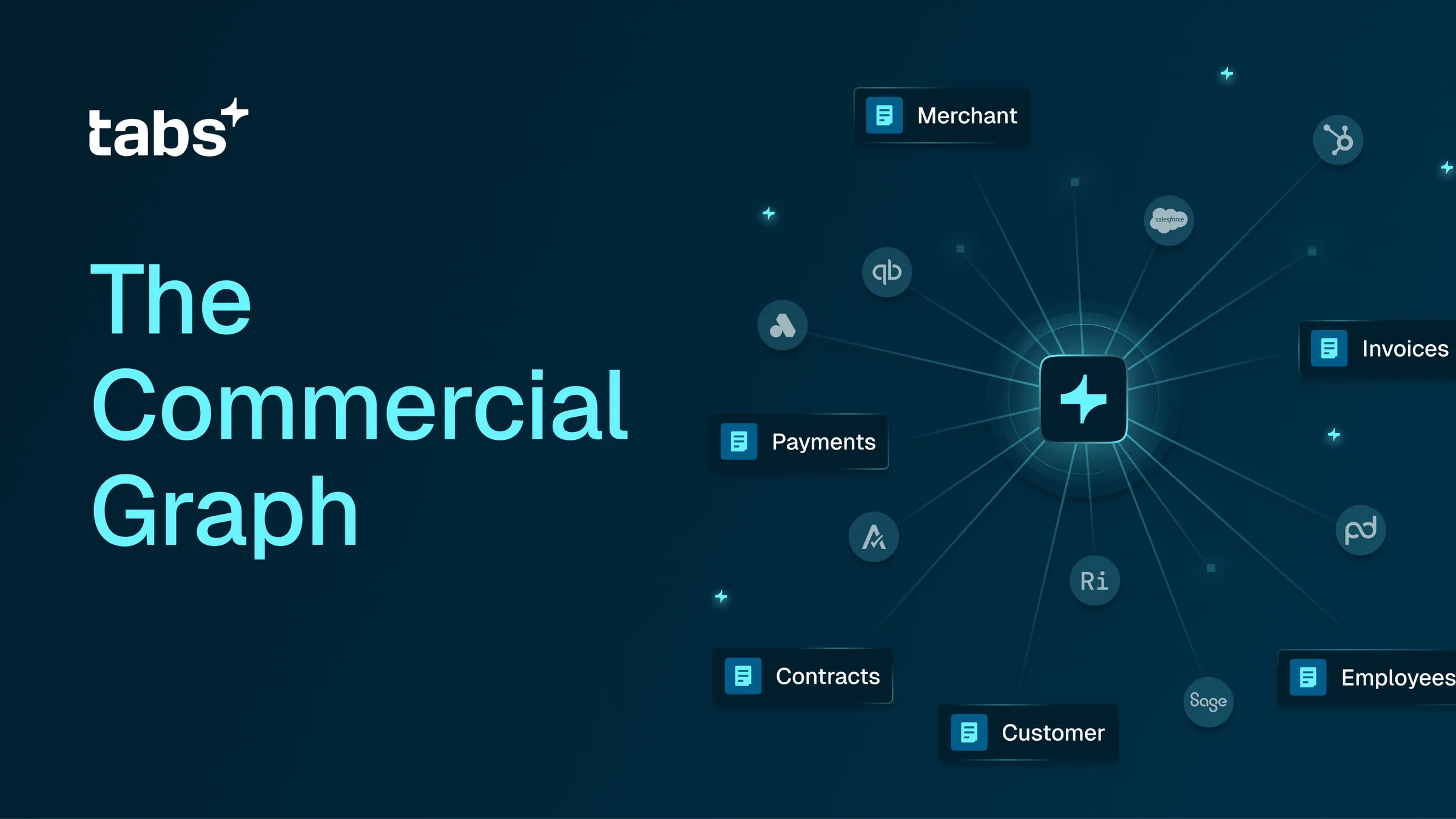
- The Commercial Graph gives Tabs a persistent, connected understanding of each commercial relationship across customers, contracts, products, pricing, invoices, payments, and revenue.
- Our agentic harness gives agents and humans the controls they need to operate on that understanding: memory, planning, tools, integrations, permissions, policies, deterministic logic, observability, and human oversight.
The Commercial Graph gives agents an understanding of the business. The agentic harness gives them the ability to operate within it with the right level of controls and context.
Together, they turn general purpose intelligence into specialized execution for revenue.
Agents that go deeper on the revenue work
That foundation changes what an agent can do. Instead of building an agent around a prompt or isolated task, we can build agents that deeply understand a specific revenue job and have the context and tools to increasingly carry that work forward themselves.
This September, Tabs’ agents are getting more powerful and more specialized, taking on more complex revenue work with the context and controls to execute it end to end.
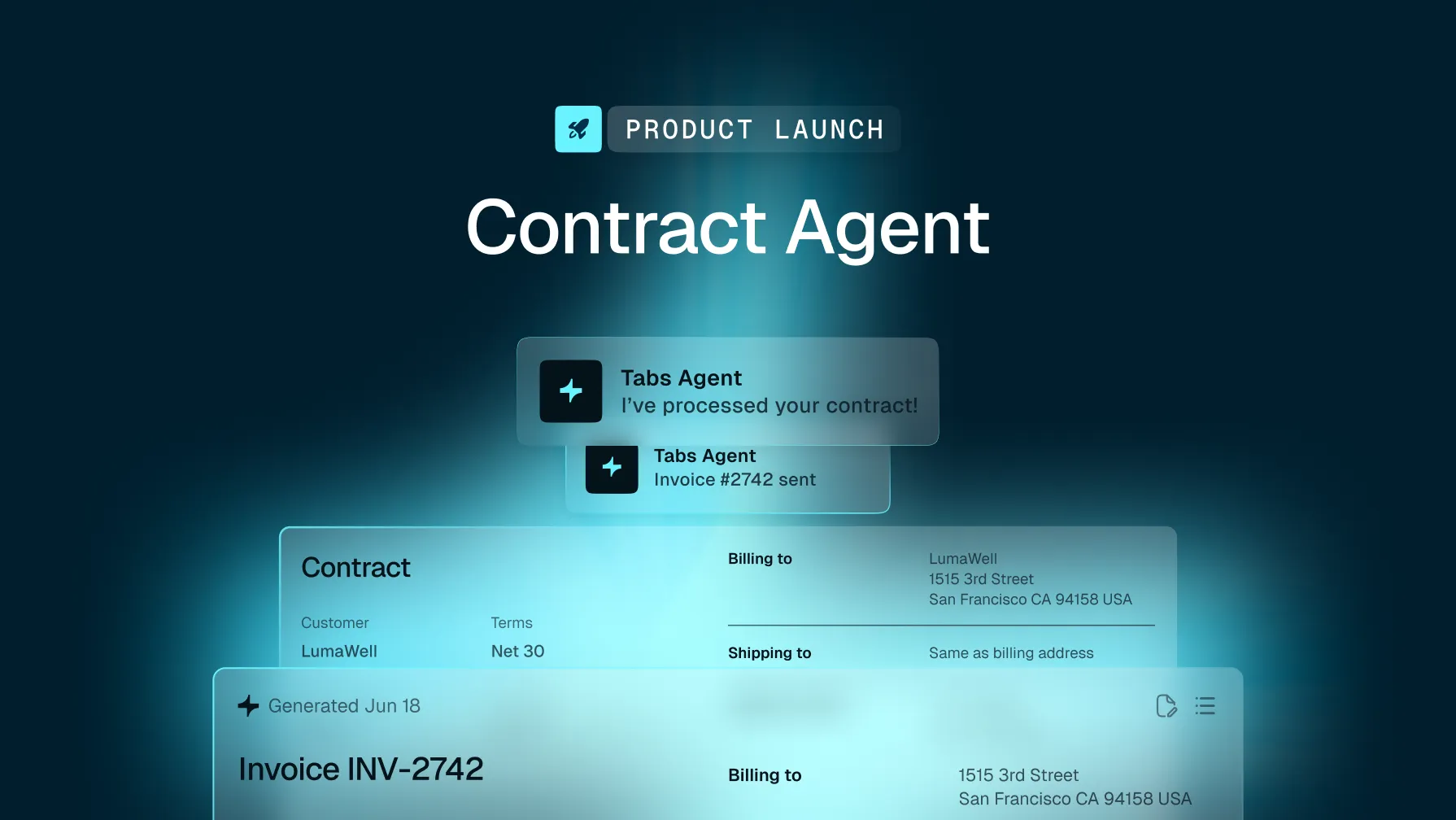
- Contract Agent turns growing contract complexity into trusted revenue automation. Our first version of Contract Agent started by reading agreements and extracting the terms that drive revenue. Now, it learns from how your team reviews and corrects that work by continuously carrying those learnings forward as new contracts, and pricing models appear. The result: an agent that continuously learns, and gets more accurate and more specific to your business over time.
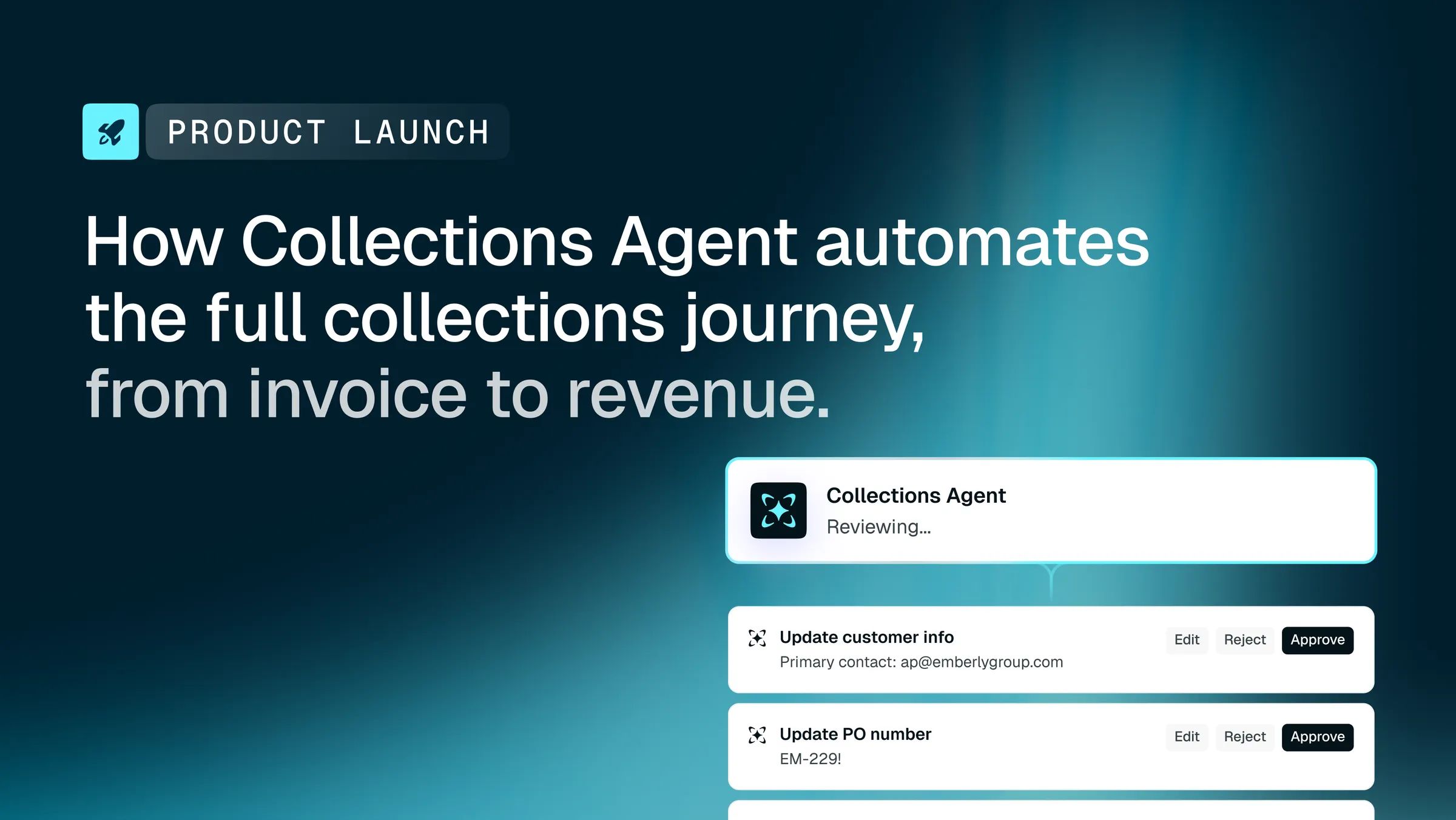
- Collections Agent takes on more of the work required to get paid. Rather than simply sending sequences of reminders, it understands each customer and what is actually happening across the relationship.
- It can use invoice activity, payment behavior, portal status, disputes, and other customer level context to make collections more granular and personal, determining the right action for that customer instead of running everyone through the same workflow.
- And now with automated AP portal submissions, it can also submit invoices through customer portals, monitor status, and surface blockers before they become payment delays.
- Revenue Agent takes revenue recognition out of spreadsheets without taking it out of your control. It automates complex ASC 606 accounting across subscription, usage based, and hybrid models, from transaction price allocation and revenue schedules to deferred revenue rollforwards, revenue calculations, journal entries, reconciliation, and audit. It can reason across contract modifications and changing commercial terms, while preserving the methodology, approvals, source detail, and audit trail behind every number.
You get more automation without giving up the control and auditability finance requires. Each agent goes deep on a different revenue job, but the more important point is that they do not operate in isolation. As AI takes on more work, speed without shared context becomes a risk. If every agent is acting on a different version of the business, the system breaks down fast.
This is the shift I believe matters most. The future of AI in finance is not an AI assistant sitting next to every workflow waiting for someone to prompt it. It is a system that increasingly does the work itself, with finance setting the policies, approving the decisions that matter, and stepping in when judgment is required.
An operating system should be something you can build on
There is one more piece of this that I think is fundamental. If Tabs is going to be the operating system for revenue, we cannot assume we will build every application, workflow, or agent our customers will ever need. We should not.
Companies are already building their own internal software and agents, and that will only accelerate. Those systems need the same thing Tabs’ agents need: access to trusted commercial context and a safe way to act on it.
That is why we are making the AI OS extensible. Through APIs and MCP, customers and partners can build their own workflows and agents on the same commercial infrastructure that powers Tabs’ operating system, giving them access to the same understanding of the business and the ability to participate in the same revenue workflows.
A deal desk agent could ask Tabs whether a proposed contract structure can actually be billed. An internal finance agent could pull the complete commercial history of a customer before explaining a forecast variance. A support agent could understand why a customer's invoice changed without recreating billing logic somewhere else.
Those agents can access the same understanding of the business that Tabs' own agents use, subject to the same permissions, policies, and controls. That is important because the future is not just about Tabs building better agents. It is about creating the foundation for an ecosystem of agents and applications to operate revenue.
Over time, I believe this changes the role of finance teams. Instead of spending so much time moving information between systems, coordinating handoffs, chasing down what happened, and manually pushing processes forward, teams can increasingly direct a system that does more of that work for them. The agents handle more of the execution. Finance makes the calls that matter.
When we started Tabs, we set out to use AI to take manual work off finance teams’ plates and build a better way to run revenue. The technology has changed. The businesses we serve have changed. And what is possible has become much bigger.
Our vision for Tabs has evolved with it. A system with a shared understanding of your business. Specialized agents that can execute the work. Controls finance can trust. And a foundation anyone can build on.
That is the AI Operating System for Revenue. And we are just getting started.
-Ali