






As companies expand, managing essential revenue processes — billing, receivables, revenue recognition, and payments — becomes increasingly complex. Over 70% of finance teams still rely on spreadsheets, email chains, and disconnected systems to manage their revenue cycles. That worked when contracts were simple and billing was straightforward. But as businesses scale into usage-based pricing, hybrid models, and multi-year agreements, manual revenue processes don't just slow down. They break.
Revenue Automation replaces these fragmented, manual workflows across the entire contract-to-cash process — from contract ingestion to financial reporting — with a unified, automated system. The finance leaders gaining ground right now aren't optimizing old processes. They're replacing them.
What is revenue automation?
Revenue automation is a category of software specifically designed to streamline and automate the entire revenue cycle for SaaS and service-based businesses — from contract initiation to financial reporting. Unlike traditional ERP systems, which focus on core accounting functions and often require manual intervention, Revenue Automation provides a comprehensive platform that enhances revenue operations like complex invoicing, receivables collection, and compliance with standards such as Accounting Standards Codification (ASC) 606.
What sets modern Revenue Automation apart is commercial context. Tabs, for example, doesn't just extract contract data — it understands the business implications of contract terms and translates them into accurate billing workflows and automated revenue recognition processes. This distinction matters: standalone tools automate individual tasks, but a Revenue Automation platform connects every step of the contract-to-cash process so that data flows cleanly from ingestion through compliance reporting.
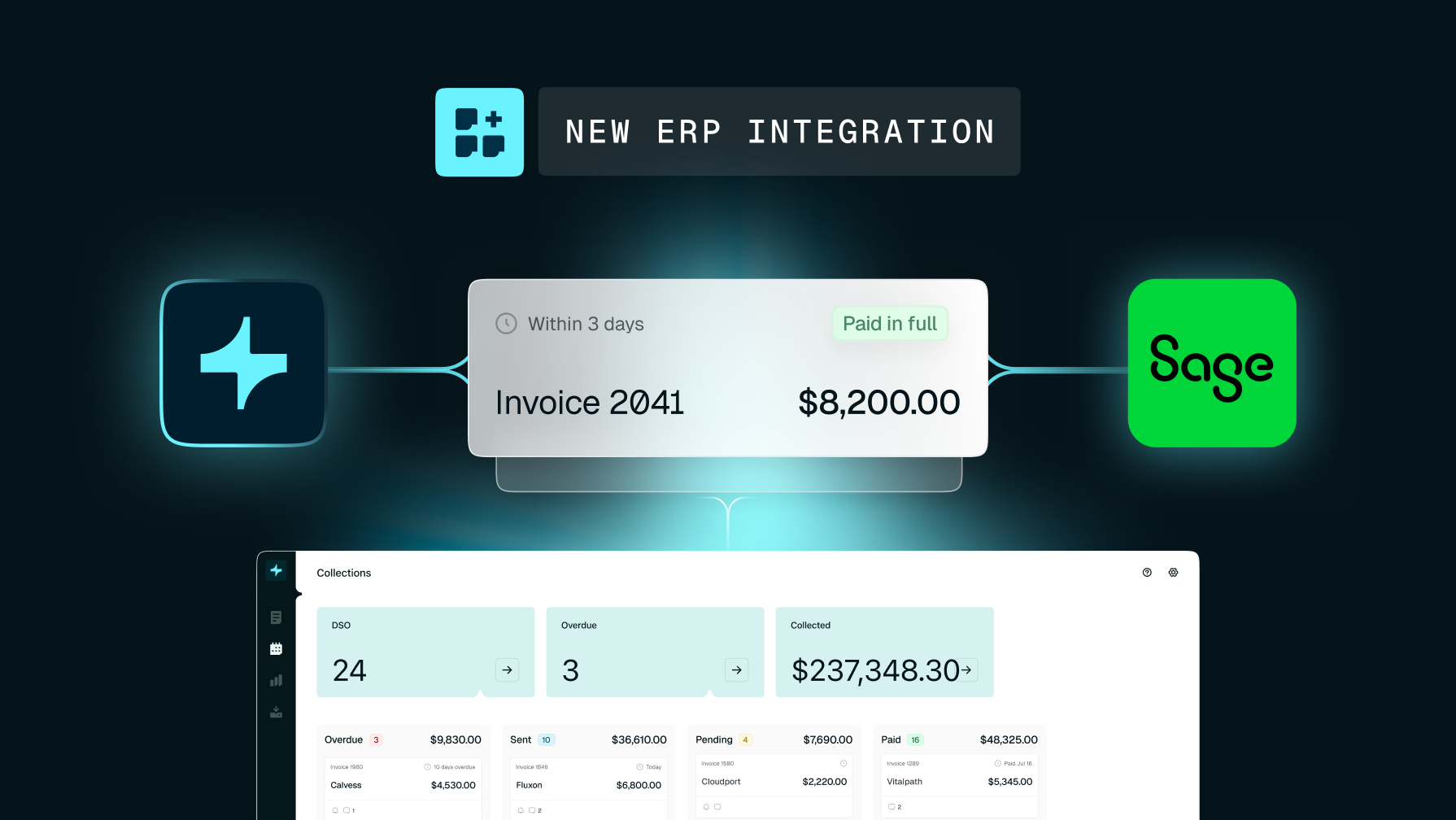
By integrating seamlessly with existing ERP systems, Revenue Automation eliminates manual processes across the revenue cycle — replacing disconnected handoffs between billing, recognition, and reporting with a single automated workflow.
Why revenue automation matters now
Three structural shifts have made Revenue Automation essential for modern finance leaders — not optional.
Pricing models are getting more complex. 61% of SaaS companies now use usage-based pricing, and 80% of customers feel it better reflects value received (Bain & Company). But usage-based, hybrid, and tiered models generate billing complexity that manual processes simply cannot handle at scale. Every pricing permutation multiplies the opportunities for errors, delays, and revenue leakage.
Compliance requirements demand automated audit trails. Standards like ASC 606 require precise, consistent revenue recognition across every contract. At scale, manual calculations in spreadsheets introduce compliance risk — where volume and complexity can outpace what spreadsheet-based processes reliably handle. Revenue automation ensures adherence to recognition rules automatically, with full traceability.
Data-driven decision-making requires real-time visibility. Modern CFOs need to forecast revenue, manage cash flow, and plan capacity based on current data — not month-end spreadsheet reconciliation. Revenue automation provides that visibility by centralizing and continuously updating financial data across the entire revenue cycle.
What are the business benefits of revenue automation?
Revenue Automation delivers measurable outcomes across five core areas. Each addresses a specific bottleneck that manual processes create as companies scale.
Faster financial close
Manual month-end closes often stretch into weeks of reconciliation, data gathering, and error correction. Revenue Automation centralizes financial data and automates journal entries, compressing the close cycle and freeing finance teams to focus on analysis rather than data wrangling.
Fewer errors, stronger compliance
Every manual touchpoint in billing and revenue recognition is an opportunity for error. A single miskeyed contract term can cascade through revenue schedules, trigger restatement risk, and consume weeks of reconciliation effort. Revenue automation eliminates manual entry across invoicing, payments, and ASC 606 calculations — reducing mistakes and ensuring consistent, auditable compliance.
Improved cash flow and collections
Faster invoicing and automated payment tracking accelerate collections and reduce revenue leakage. When follow-ups and reconciliation happen automatically, overdue balances shrink and cash arrives faster — without adding operational overhead. Cortex reduced overdue invoices by 50% after automating their collections workflow, turning accounts receivable automation from a bottleneck into a predictable process.
Real-time visibility into revenue data
Real-time dashboards give finance leaders direct visibility into annual recurring revenue (ARR), cash flow, and revenue trends. Instead of waiting for month-end reconciliation to reveal variances, teams catch issues as they emerge and forecast with current data. Informed forecasting replaces backward-looking guesswork — so finance leaders can answer board-level revenue questions in minutes, not weeks.
Scale without adding headcount
Automation absorbs the operational burden of growth. As transaction volume increases, a Revenue Automation platform handles the additional complexity without requiring proportional headcount increases — letting finance teams stay lean while the business scales. Statsig achieved a 100% reduction in aged receivables while scaling invoice volume 3x, demonstrating that growth and operational efficiency don't have to be trade-offs.
What kinds of companies benefit from revenue automation?
Revenue automation is invaluable for rapidly growing software companies facing increasingly complex revenue processes. These companies experience surges in customer volume, each with unique billing requirements. Revenue automation simplifies this complexity by automating invoicing, revenue recognition, and reporting — allowing software businesses to focus on growth rather than manual revenue management tasks. For teams evaluating their options, comparing Revenue Automation platforms side by side can accelerate the decision.
Companies pioneering new business models — usage-based pricing, subscription services, or hybrid arrangements — find significant advantages in Revenue Automation. These models involve dynamic billing requirements that need frequent adjustments. Revenue automation offers the flexibility to manage evolving revenue streams, ensuring robust support for innovative offerings. 30%+ of Tabs customers adopted usage-based models in under 30 days, compared to 9–12 months with traditional solutions.
Service-oriented businesses — consulting firms, professional services companies, and creative agencies — also benefit significantly. These businesses manage diverse billing scenarios: bespoke contracts, variable billing cycles, and project-based client work. Revenue automation integrates billing, accounts receivable (AR), and revenue recognition into a unified platform, keeping financial records accurate and improving cash flow.
How does revenue automation work?
Revenue Automation software operates through two primary layers that together streamline and automate the contract-to-cash cycle, enhancing overall efficiency and accuracy in revenue management automation.
Data aggregation layer. This foundational layer consolidates all essential data — customer details, financial transactions, invoices, and payments — into a single, unified system. By removing data silos and ensuring a cohesive data environment, every module in the platform accesses the same up-to-date, consistent information. This comprehensive data integration is crucial for maintaining accuracy across all revenue-related activities and serves as the backbone for effective automation.
Application layer. Built on top of the data aggregation layer, the application layer comprises interconnected modules tailored to automate specific aspects of revenue management: contract ingestion, invoicing, payment processing, revenue recognition, and financial reporting. Because these modules draw from a single data source, they function cohesively — every component of the revenue process stays aligned and synchronized. This unified approach minimizes manual input and improves accuracy across billing, recognition, and reporting as the business scales.
Core capabilities of a revenue automation platform
Data capture and aggregation
The foundation of any Revenue Automation platform is its ability to ingest and organize data from contracts, purchase orders, and agreements. AI-powered extraction pulls critical details — pricing, terms, billing schedules — directly into downstream workflows, eliminating manual data entry and ensuring every module operates from consistent, up-to-date information. Unlike standalone document extraction tools, a Revenue Automation platform validates ingested data against existing customer records and contract history — catching inconsistencies before they reach billing or recognition.
Invoicing
The invoicing module automates the creation and distribution of invoices across complex scenarios: recurring subscriptions, milestone-based payments, and Usage-Based Billing. It supports custom formatting to meet specific customer needs, improving cash flow and elevating customer satisfaction through precise, timely billing. Because invoicing draws from the same unified data layer as recognition and reporting, every invoice is automatically consistent with the contract terms that generated it.
Payments
This module integrates with payment gateways to accept diverse methods — credit cards, Automated Clearing House (ACH) transfers, and checks. It automates payment status tracking, manages partial payments, and handles exceptions like chargebacks. Unlike standalone Accounts Receivable software, a Revenue Automation platform connects payment data directly to recognition schedules and reporting — so cash application and revenue impact are visible in real time.
Revenue recognition
The Revenue Recognition software module automates revenue calculations based on contract terms, aligning with standards like ASC 606. It handles complexities such as deferred revenue and performance obligations, ensuring accurate and compliant financial reporting with full auditability. Because recognition rules are derived from the same contract data that drives billing, the platform eliminates the reconciliation gaps that plague disconnected tools.
Reporting
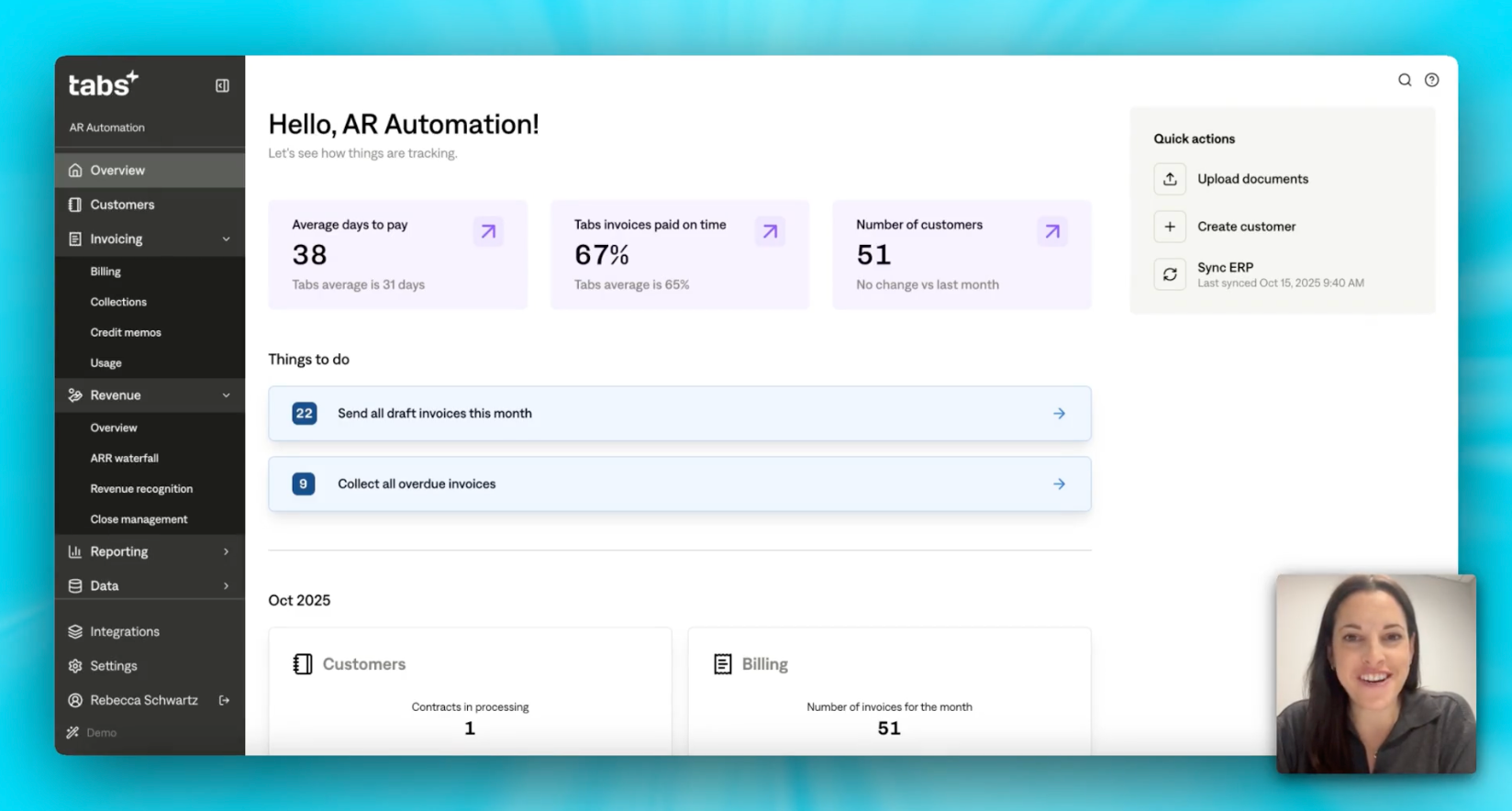
The Reporting module delivers real-time insights on key financial metrics — revenue, ARR, and cash flow. Customizable dashboards allow finance teams to monitor performance, identify trends, and make informed decisions without manual spreadsheet compilation. Every module connects back to the platform's unified data layer, ensuring seamless interoperability with existing ERP systems, CRMs, and business applications.
How Tabs uses AI to automate revenue operations
Most platforms treat AI as a forecasting overlay — impressive demos, limited operational impact. Tabs takes a different approach. AI is embedded in every step of the contract-to-cash cycle, performing specific operational actions that eliminate manual work.
Extract. Tabs uses AI to read contracts and pull out pricing structures, billing schedules, and recognition terms — no manual data entry required.
Normalize. Extracted data is automatically structured and validated against existing records, ensuring consistency across every downstream workflow.
Automate. AI-powered rules translate contract terms into billing workflows, payment schedules, and Revenue Recognition calculations — adapting to usage-based, subscription, or hybrid models without manual configuration.
Track. Every automated action is logged with full traceability, maintaining an audit trail that satisfies ASC 606 compliance requirements without additional effort from finance teams.
With Tabs, AI isn't an overlay. It's operational. It handles the complexity that used to require manual intervention at every step — from contract ingestion through compliance reporting — so finance teams can focus on strategy instead of data entry.
Common objections to revenue automation
"We already have an ERP system."
ERP systems are essential for broad business operations but often lack the specificity needed for complex revenue workflows. Revenue automation enhances your existing ERP by automating invoicing, revenue recognition, and reporting — without requiring a system overhaul.
"Implementing revenue automation sounds complex and time-consuming."
Implementation is a strategic investment, and modern platforms are designed for structured transitions with supported data migration and integration. The long-term benefits — faster closes, fewer billing errors, and audit-ready compliance from day one — far outweigh the initial setup time.
"Our billing and revenue processes are too unique."
Revenue automation platforms are built for flexibility. Whether you're dealing with subscription-based billing, usage-based pricing, or complex contract terms, the platform adapts to your specific needs rather than forcing you into a rigid template.
"We're concerned about the cost."
Revenue Automation replaces labor-intensive manual work with automated workflows — so billing errors drop, cash arrives faster, and your team spends less time on reconciliation and more on strategy. Its scalability means it grows with your business, preventing the need for proportional headcount increases or additional software.
The future of revenue automation
The shift to automated revenue operations is a permanent structural change, not a passing trend. As businesses move deeper into usage-based pricing, hybrid models, and subscription-based services, the complexity of the revenue cycle will only increase. Manual processes that worked at $5M ARR collapse at $50M.
Your finance stack is your company's metabolism. When contract-to-cash automation is clean, when revenue visibility is real-time, when compliance is built into the workflow rather than bolted on after the fact — your entire business moves faster. Sales can experiment with pricing. Product can launch new models. Finance can forecast with confidence instead of caveats.
For finance leaders, the mandate is clear: standardize contract ingestion, automate billing and recognition workflows, connect data across every step of the revenue cycle, and maintain audit-grade accuracy without manual intervention. That's the job now — and it's a structural capability, not a one-time project.
Tabs makes this possible without rebuilding your entire finance stack. AI-powered contract ingestion, automated billing that adapts to any pricing model, and recognition processes that stay compliant from day one — all connected through a single data layer that integrates with your existing ERP and CRM. See Tabs in action.
Revenue automation FAQ
What's the difference between billing software and revenue automation?
Billing software handles one step of the revenue cycle — generating and sending invoices. Revenue Automation covers the full cycle: contract ingestion, billing, payment collection, automated revenue recognition, and financial reporting, all connected through a single data layer.
Is revenue automation only for subscription businesses?
No. Revenue Automation supports SaaS, services, usage-based pricing, hybrid models, and any business with complex or high-volume billing. Any company outgrowing manual revenue processes can benefit.
Does revenue automation ensure compliance with ASC 606?
Yes. Revenue Automation platforms apply recognition rules consistently based on contract terms and maintain full audit trails — so compliance is built into the workflow rather than reconstructed at quarter-end.
How does revenue automation improve the financial close?
Revenue Automation centralizes financial data and automates journal entries, eliminating the manual reconciliation that stretches most close cycles. Finance teams spend less time compiling data and more time analyzing it.
What are the main benefits of revenue automation?
Revenue Automation delivers measurable outcomes across five core areas — from compressing close cycles and strengthening compliance to improving collections and scaling operations without proportional headcount increases. See the full breakdown above.
How does revenue automation support audit readiness?
Revenue automation maintains a complete audit trail for every automated action — from contract ingestion through revenue recognition. Because recognition rules are applied consistently based on contract terms, and every calculation is logged with full traceability, finance teams can demonstrate ASC 606 compliance without reconstructing records from spreadsheets or email threads.