






What AR automation software actually solves for SaaS teams
The average B2B company takes 61 days to collect payment on an outstanding invoice. For SaaS companies juggling usage-based pricing, hybrid contracts, and tiered overages, that number climbs higher — and the manual effort behind it scales even faster.
Accounts receivable automation software eliminates the repetitive, error-prone work between a signed contract and collected cash. It automates invoice generation, payment matching, collections follow-ups, and reconciliation — so finance teams can stop chasing payments and start managing revenue.
But here's the problem most AR automation tools ignore: SaaS billing isn't static. Usage-based pricing means invoices change every cycle. Hybrid contracts blend subscriptions with consumption tiers. And the contract terms that govern all of it are buried in PDFs that no billing system was designed to read.
Generic accounts receivable automation handles the simple cases — fixed invoices, predictable schedules, clean data. It breaks down the moment pricing gets variable, contracts get complex, or volume outpaces headcount.
That's the gap Tabs was built to close. Where traditional AR automation software treats invoices as isolated events, Tabs starts with commercial context — the contract itself. It uses AI to interpret terms, generate billing schedules, and automate collections workflows that actually reflect what was agreed to. Not what was manually re-keyed into a spreadsheet.
Why manual AR is collapsing for SaaS companies
Three market forces are converging to make manual AR processes unsustainable.
Usage-based pricing is now the norm, not the exception. Over 30% of Tabs customers adopted usage-based models in under 30 days — a transition that takes 9–12 months with traditional billing solutions. The shift is accelerating because buyers demand pricing that reflects the value they receive. But every usage-based contract creates a unique invoice every cycle, and manual processes can't keep up.
Hybrid contracts are multiplying complexity. A single customer might have a base subscription, a usage-based overage tier, and milestone-based payments tied to implementation. That's three billing models in one contract. Multiply that across hundreds of customers, and the reconciliation workload becomes untenable.
Invoice volume is scaling faster than headcount. Finance teams aren't growing at the same rate as the businesses they support. When a two-person team is responsible for 500+ invoices per month across multiple pricing models, the math simply doesn't work. The cash flow pressure compounds — late invoices lead to late payments, which lead to inaccurate forecasting, which leads to bad decisions.
The old model — spreadsheets, batch processing, manual reconciliation — was built for a world of annual contracts and predictable billing cycles. That world doesn't exist anymore. Today's AR process automation demands infrastructure that's as dynamic as the pricing models it supports.
This is where contract-native billing changes the equation. When the contract is the single source of truth — not a PDF that someone interpreted and re-entered — every downstream process, from invoice automation to order-to-cash automation, starts from accurate data instead of best guesses.
The real cost of fragmented AR
Name the enemy: fragmented AR stacks.
Most SaaS companies don't have a single AR problem. They have a collection of disconnected systems — one for invoicing, another for collections, a third for revenue recognition — none of which share data cleanly. The result isn't just inefficiency. It's a compounding loss of accuracy, speed, and cash flow visibility that gets worse with every new pricing model.
Consider a scenario that's common in high-growth SaaS: a company running three pricing models (subscription, usage-based, and hybrid), generating 500+ invoices per month, with a two-person finance team. What breaks first?
Everything. Simultaneously.
Symptoms of fragmented AR
- Rising DSO that no one can explain because the root causes span multiple systems
- Invoice disputes triggered by billing errors on usage-based contracts
- Revenue leakage from usage data that never reconciles against contract terms
- Collections teams buried in manual follow-ups because dunning sequences have no contract context
- Month-end fire drills where the close process takes weeks instead of days
Where the problem hides
- Between the CRM handoff and the first invoice — contract terms get lost or manually re-entered, and errors propagate downstream
- In usage data that never reconciles — consumption records in one system, billing logic in another, and no automated accounts receivable process to bridge them
- In dunning sequences that ignore contract context — generic payment reminders sent to enterprise customers with net-60 terms create friction, not collections
- In the gap between data extraction and action — teams pull data from five systems to build one report, and by the time they act on it, the numbers have changed
DSO reduction doesn't come from chasing invoices harder. It comes from eliminating the fragmentation that created the delays in the first place.
What modern AR automation looks like
If fragmented AR is the problem, what does the solution actually require? Not another point tool. Not another integration layer. A fundamentally different architecture.
Here are the 5 pillars of AR automation for SaaS:
1. Contract-native invoicing
The billing engine must read the contract directly. Usage-based, hybrid, tiered — all generated from one source of truth. Invoice automation that starts with the actual agreement eliminates the manual re-entry that creates errors downstream. No more translating PDF terms into spreadsheet logic.
2. Intelligent cash application
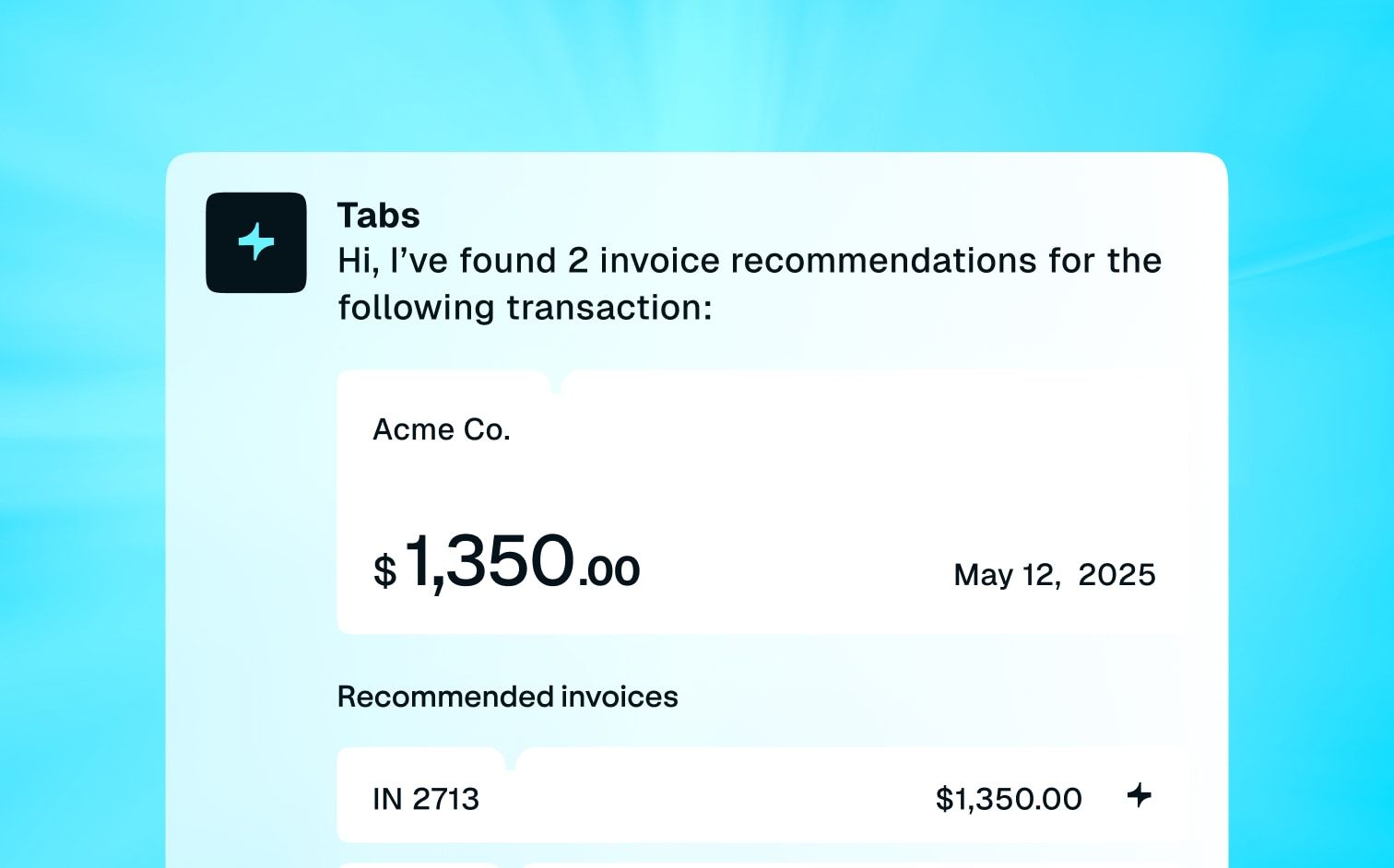
Cash application automation powered by AI handles what manual processes can't: partial payments, multi-currency remittances, and discrepancies between what was invoiced and what was paid. The system matches payments to invoices automatically — and flags exceptions for human review only when necessary.
3. Contextual collections
Collections automation that understands contract terms, payment history, and customer value — not just aging buckets. A net-60 enterprise customer on day 45 shouldn't receive the same dunning email as a self-serve account that's 15 days past due. Context changes everything.
4. Real-time reporting and forecasting
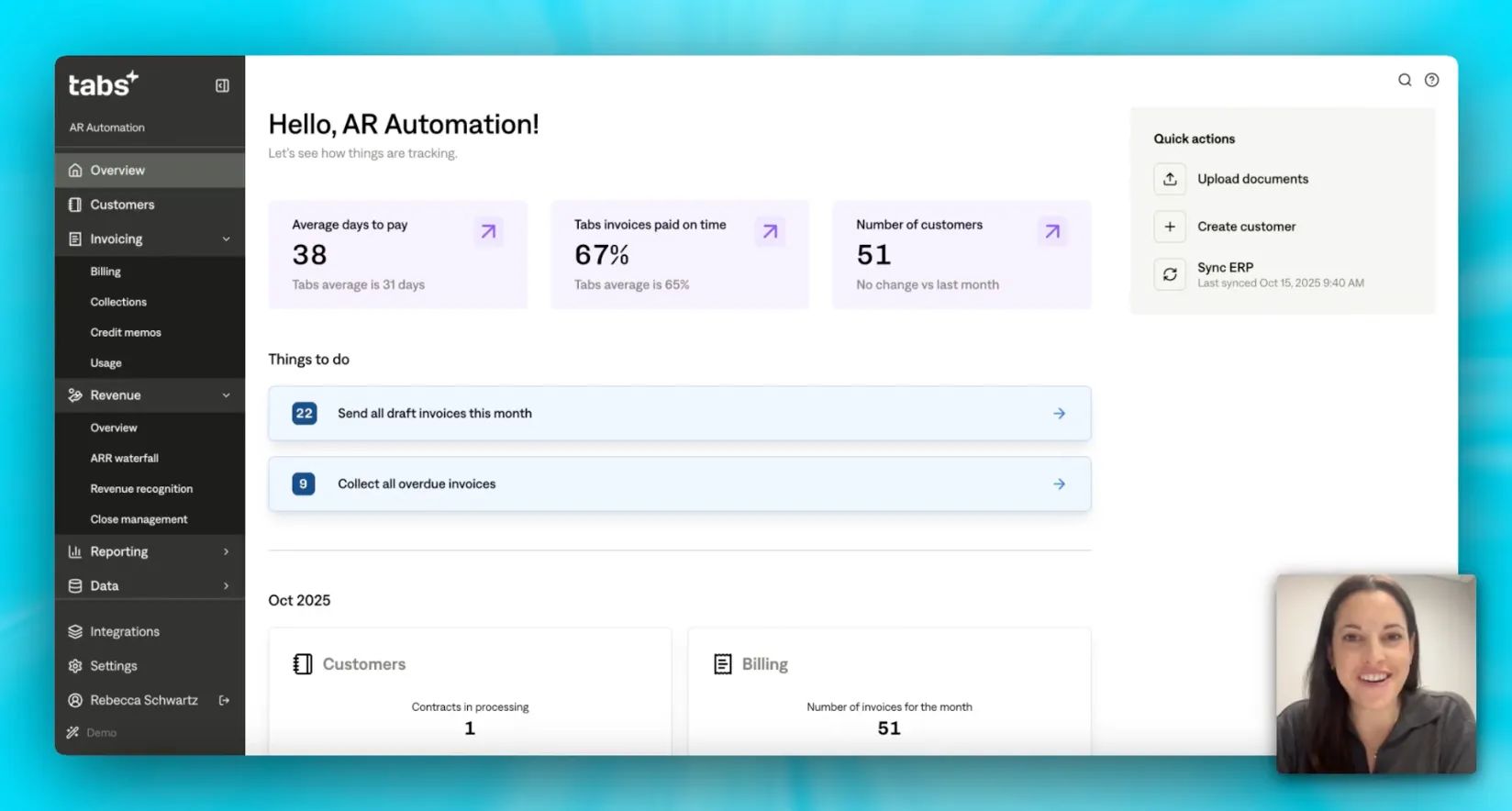
DSO dashboards, cash flow projections, renewal risk signals — all updated continuously, not rebuilt at month-end. DSO reduction starts with visibility. Finance leaders need to see what's happening now, not what happened 30 days ago.
5. Bidirectional ERP integration
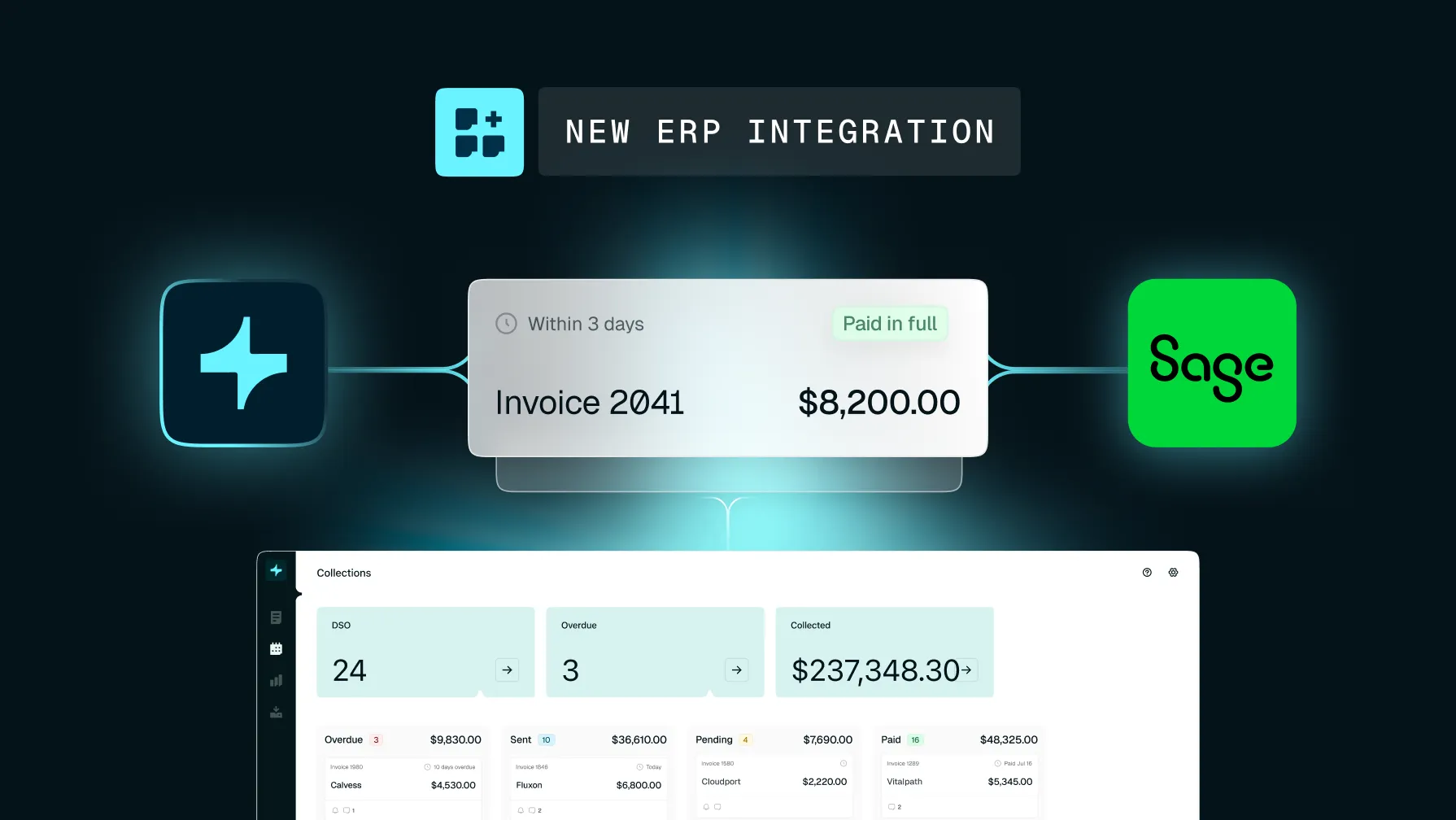
Sync that flows both ways, in real time. Journal entries post automatically to NetSuite, QuickBooks, or Sage Intacct. No CSV exports. No reconciliation drift. No manual uploads that introduce errors on a Tuesday afternoon.
The foundation underneath all five: a system that treats the contract as the single source of truth — not a PDF to be manually interpreted, not a row in a spreadsheet, not a set of assumptions someone made six months ago.
How Tabs automates AR for SaaS teams
Those five pillars describe what modern AR automation requires. Here's how it works in practice.
AI-powered contract interpretation. Tabs reads signed contracts and translates terms into billing schedules, revenue recognition rules, and collection workflows automatically. No manual data entry. No re-keying. The contract goes in, and accurate operational workflows come out.
Real-time usage ingestion. Usage data flows in continuously — not in batches, not at month-end. Invoices reflect actual consumption as it happens, so customers see accurate bills and finance teams avoid the reconciliation scramble.
Smart dunning and payment matching. Collections sequences are driven by contract terms and payment history, not generic aging rules. AI-powered cash application matches payments to invoices automatically — even when remittance data is incomplete, amounts are partial, or currencies don't match.
Unified revenue intelligence. DSO tracking, cash flow forecasting, and renewal risk — one dashboard, not five spreadsheets. Finance leaders get the visibility they need to make decisions without waiting for someone to pull a report.
Bidirectional ERP sync. Journal entries post to NetSuite, QuickBooks, or Sage Intacct automatically. Changes flow both ways. No manual reconciliation, no export files, no drift between what your billing system says and what your ERP reflects.
The results speak for themselves. Statsig achieved a 100% reduction in aged receivables and now handles 3x their previous invoice volume without adding headcount. Cortex reduced overdue invoices by 50%. These aren't projections — they're operational outcomes from AR automation software built for the complexity of modern SaaS.
AR automation is a strategic decision — treat it like one
AR automation isn't a finance project. It's infrastructure for how a SaaS business gets paid.
The companies that scale revenue cleanly — without surprise write-offs, month-end fire drills, or collections teams drowning in manual work — have something in common. They built their accounts receivable automation on a single source of truth from contract to cash. They invested in real-time visibility, not retroactive reporting. And they chose automation that understands commercial context, not just invoice aging.
Before your next board meeting, ask your team three questions:
- Can your current AR stack handle usage-based pricing without manual workarounds?
- How many hours per month does your team spend on payment reconciliation?
- Do your dunning sequences reflect contract terms — or just aging buckets?
If the answers aren't reassuring, the gap isn't going to close on its own. Every new pricing model, every new customer, every new contract adds complexity that manual processes can't absorb.
The shift to modern AR automation isn't about replacing your team. It's about giving them the infrastructure to do what they were hired for — managing revenue strategically, not chasing invoices manually.
Frequently asked questions
What is AR automation software?
AR automation software automates the accounts receivable process — from invoice generation and delivery to payment collection, cash application, and reconciliation. For SaaS companies, the distinction that matters is whether the software can handle usage-based and hybrid pricing models natively, or whether it was designed for static invoicing and retrofitted with workarounds.
How does AR automation reduce DSO?
AR automation reduces days sales outstanding (DSO) by accelerating every step between invoice creation and cash collection. Invoices go out faster because they're generated automatically from contract terms. Collections improve because dunning sequences are contextual, not generic. And cash application speeds up because AI matches payments to invoices without manual intervention. Cortex, for example, reduced overdue invoices by 50% after implementing Tabs.
What AR automation features matter most for SaaS companies?
Four capabilities separate AR automation built for SaaS from generic solutions: contract-native billing that handles usage-based and hybrid pricing without manual configuration, real-time usage ingestion so invoices reflect actual consumption, contextual dunning that accounts for contract terms and payment history, and bidirectional ERP sync that keeps your financial systems aligned without CSV exports.
Can AR automation integrate with my ERP?
Yes — but the quality of integration matters more than whether it exists. One-way CSV exports aren't integration. Look for bidirectional, real-time sync where journal entries post automatically and changes flow in both directions. Tabs integrates with NetSuite, QuickBooks, and Sage Intacct with real-time bidirectional sync.
How long does it take to implement AR automation?
Implementation timelines vary by vendor, pricing complexity, and existing infrastructure. Some legacy platforms take 9–12 months to deploy. With Tabs, over 30% of customers adopted usage-based billing models in under 30 days — including full contract ingestion, billing automation, and ERP integration.