





For finance teams at B2B companies managing complex billing models, the monthly close often becomes a scramble to reconcile fragmented data, chase contract discrepancies, and manually reconstruct revenue. This guide breaks down the financial close process step by step and shows how automation transforms it from a reactive sprint into a streamlined, strategic operation.
What is the financial close process?
The financial close process is the recurring cycle your finance team uses to finalize, reconcile, and report financial data for a specific period. It transforms raw transactional data—sales, expenses, payments—into accurate financial statements that stakeholders rely on for decision-making.
This process spans recording revenue, reconciling accounts, adjusting entries, and producing reports. While often called the "month-end close process," this cycle also occurs quarterly and annually. The goal is to verify that your general ledger (GL) accurately reflects the business's financial position before you close the books for the period.
For B2B companies with complex billing models—subscription-based, seat-based, usage-based, or hybrid—the close becomes significantly more challenging. Contract terms, usage data, and payment timing all need to reconcile perfectly. This is where Revenue Automation platforms like Tabs provide commercial context that generic tools miss. Tabs uses AI models to interpret signed contract terms and translate them into billing workflows and Revenue Recognition schedules.
Why financial close process improvement matters
Improving the close process is a strategic priority, not just an operational checkbox. A slow or error-prone close creates a lag between business reality and financial visibility. When you accelerate the close, you shift finance from backward-looking reconciliation to forward-looking strategy.
Speed advantage
Reducing days to close gives leadership earlier access to financial data. In a fast-moving market, waiting weeks after month-end to understand your cash position is a competitive disadvantage.
Speed enables faster board reporting and allows the business to respond quickly to market changes. And when your upstream revenue data is clean—because your billing and Revenue Recognition are automated—the close itself becomes a review rather than a reconstruction.
Accuracy and trust
Fewer manual touchpoints reduce error rates and post-close adjustments. When the close process is messy, finance teams often force balances to match, leading to restatements later.
Accurate, consistent closes build credibility with auditors, investors, and the board. They prove your company has strong internal controls—and that your numbers can be trusted.
Strategic insight
The financial close should be a source of business intelligence, not just compliance. When finance teams spend less time on manual data entry and reconciliation, they can focus on variance analysis and forecasting.
This shift allows finance to act as a growth partner. Instead of explaining what happened, you're helping leadership understand what to do next.
Steps in the month-end close process
To achieve financial close process improvement, you must first understand the steps involved. While every company has unique nuances, the core workflow remains consistent.
Why it matters: The close only gets faster when you standardize the inputs—revenue, expenses, and reconciliations—before you try to automate tasks.
Record all revenue and cash
Capture all revenue transactions and cash receipts for the period before anything else. Incomplete revenue data is a leading cause of restatements.
Verify that all invoices have been sent and that recognized revenue aligns with the service period. For subscription or usage-based models, this means ensuring your billing system has captured all billable events.
Update accounts payable
Ensure all vendor invoices and financial obligations are recorded before the cutoff date. This involves processing received invoices and estimating accruals for services received but not yet billed.
Accurate AP recording ensures your expense reporting reflects the true cost of operations for the period.
Review prior period balances
Before diving into current period activity, verify that prior period adjustments have been properly reflected. Opening balances must tie out to the previous month's closing balances.
If these numbers don't match, every subsequent calculation in your close reporting will be incorrect.
Reconcile all accounts
This is often the most time-consuming step—matching subledger balances to the general ledger. You must substantiate every balance sheet account to ensure the numbers are real and supported.
- Bank reconciliations: Match cash balances to bank statements
- Prepaid expenses: Amortize prepayments like software subscriptions
- Intercompany accounts: Ensure transactions between subsidiaries net to zero
Manage fixed assets
Record depreciation, disposals, and new asset additions. Fixed asset errors can materially impact the balance sheet, particularly for capital-intensive businesses.
Review the capitalization threshold to ensure small purchases aren't incorrectly categorized as assets.
Assemble financial statements
Once the trial balance is adjusted and reconciled, compile the income statement, balance sheet, and cash flow statement. This step reveals any remaining imbalances missed during reconciliation.
Conduct a pre-close review
Finance leadership validates entries, investigates significant variances, and approves adjustments before finalizing. This review acts as a quality control gate, catching errors before they become audit findings.
Compare actuals against budget, and analyze variances—period-over-period fluctuations—to explain major changes.
Finalize and prepare for next close
Lock the period to prevent further posting, generate the final report package, and distribute to stakeholders. Then immediately document lessons learned and update the close calendar.
The best time to improve the next close is right after finishing the current one.
Common financial close challenges
Despite having a checklist, many teams struggle to close books efficiently. Identifying these obstacles is the first step toward removing them.
Time pressure and outdated data
Tight close windows combined with stale or incomplete data force teams into reactive mode. When information arrives late—usage data for billing, vendor invoices, contract amendments—finance must rush to make last-minute adjustments.
This time pressure increases manual errors, which then require time-consuming corrections.
Disparate systems and data quality
Disconnected systems create reconciliation nightmares. When your CRM, ERP, billing platform, and spreadsheets don't communicate, data quality suffers at every handoff.
- Billing to GL: Invoices generated outside the ERP may not sync correctly
- CRM to Revenue: Contract terms often don't match revenue recognition schedules
- Bank to ERP: Manual uploads of bank feeds lead to version-control issues
This fragmentation forces finance teams to act as "human middleware," manually moving data between systems. Tabs helps eliminate this problem by creating a unified Commercial Graph—a system of intelligence for contracts, usage, and payments that provides commercial context across your finance stack.
Best practices for financial close process improvement
To move from a chaotic close to a streamlined operation, you need structural changes. These best practices reduce variability and create repeatability.
Standardize procedures
You cannot automate a process you haven't defined. Standardizing means creating documented Standard Operating Procedures (SOPs), defining clear ownership, and maintaining a detailed close calendar.
- Document procedures: Write step-by-step instructions for every task
- Assign owners: Every account and task needs a primary owner and backup
- Define timelines: Set strict deadlines for cut-offs and approvals
Standardization reduces reliance on tribal knowledge. The close can proceed even if a key team member is out.
Adopt continuous closing
The most effective teams shift from period-end sprints to ongoing close activities throughout the month. Continuous closing means performing reconciliations daily or weekly rather than waiting until the first day of close-week.
This approach spreads workload evenly and surfaces issues earlier—organizations adopting continuous close methodologies reduce close time by an average of 50%—preventing the crunch time panic that leads to burnout and errors.
Financial close automation and AI
Automation accelerates the close by eliminating manual tasks and reducing errors. But automation is an enabler of process discipline, not a replacement for it.
Generic automation tools can match numbers. Modern Revenue Automation platforms provide commercial context. Tabs AI doesn't merely capture contract terms. It uses AI models trained on your specific contract language and historical billing outcomes to interpret implications and generate accurate billing workflows and Revenue Recognition entries.
Automate reconciliations and journal entries
Automation handles high-volume, repetitive tasks that consume valuable time. AI can flag anomalies and suggest corrections based on historical patterns, freeing your team to focus on exceptions rather than routine matching. McKinsey's 2025 survey of 102 CFOs found 44% now use generative AI for over five use cases, up from just 7% the prior year.
Tasks suited for automation include bank reconciliations, intercompany eliminations, accrual entries, and revenue deferrals.
Deploy close management dashboards
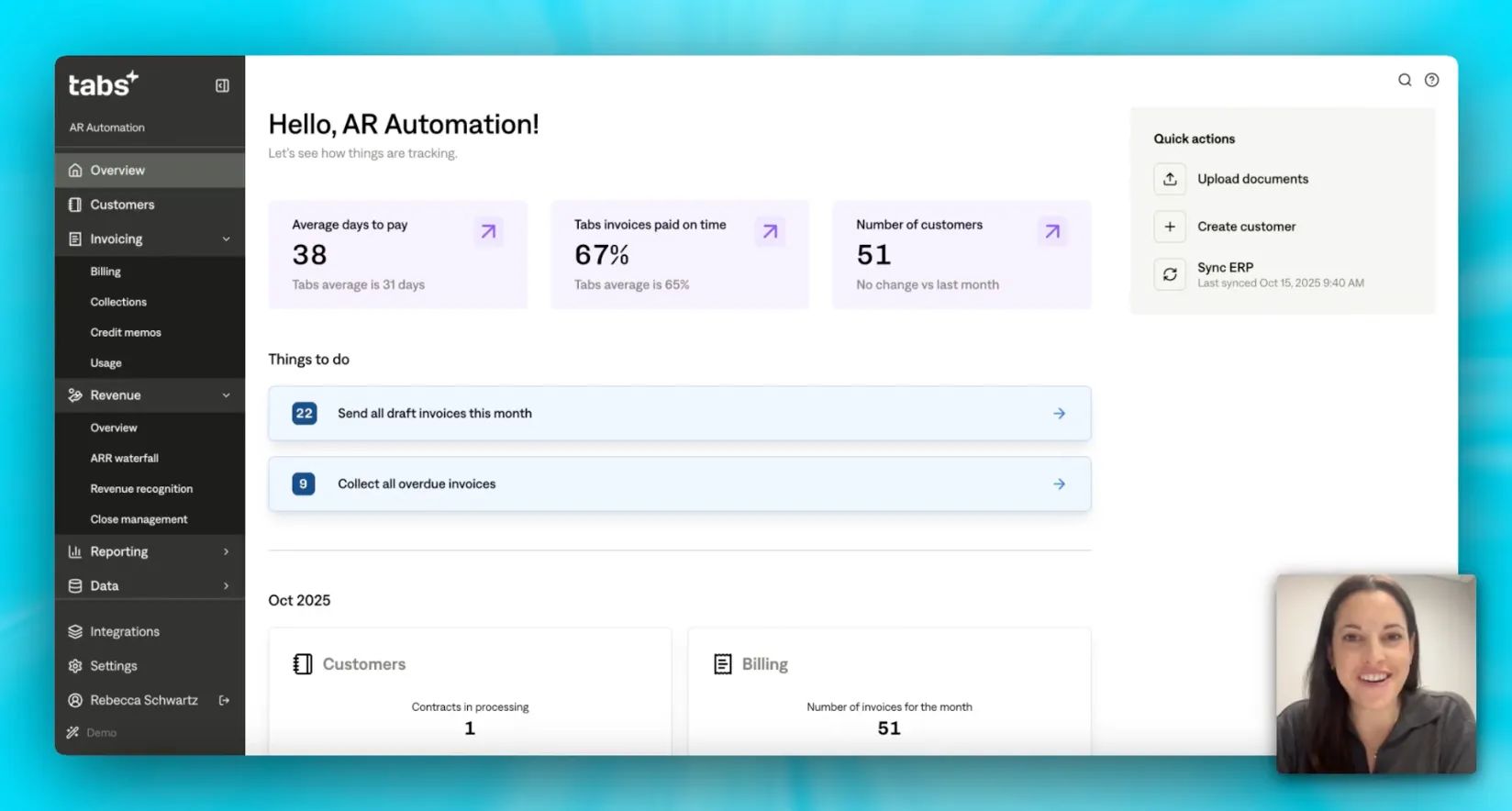
Real-time visibility into close progress replaces status update meetings and email chains. Dashboards let you see exactly which tasks are complete, which are at risk, and where bottlenecks are forming.
A single source of truth for close status eliminates the "where are we?" conversations that slow everything down.
Contract-to-cash improvements that accelerate the close
The efficiency of your financial close is directly tied to the accuracy of your upstream revenue operations. If billing is incorrect or revenue recognition data is messy, your close will inevitably be slow.
Tabs eliminates these upstream problems so finance teams aren't chasing contract discrepancies during close-week. Tabs vautomatically translates complex contract terms into accurate invoices and Accounting Standards Codification (ASC) 606-compliant revenue schedules, with configurable review steps for exceptions.
| Workflow Area | Traditional Approach | Automated with Tabs |
|---|---|---|
| Invoice generation | Manual PDF review and data entry | Auto-generated from signed contracts synced downstream from CRM/CPQ |
| Revenue recognition | Spreadsheet-based Accounting Standards Codification (ASC) 606 schedules | Automated, audit-ready entries |
| AR visibility | Fragmented reports across systems | Real-time aging and collection status |
| Cash application | Manual matching of payments | Automated reconciliation with context |
When your billing and Revenue Recognition are accurate from the start, the close becomes a verification exercise rather than a detective mission.
Metrics and roadmap to reduce days to close
You cannot improve what you do not measure. To reduce your days to close, you need a framework for tracking performance and a phased roadmap.
Key metrics to track:
- Days to close (DTC): The primary measure of close efficiency
- Post-close adjustments: Indicates accuracy of the initial close
- Reconciliation aging: Tracks how long items remain unreconciled
- Task completion rate: Measures adherence to the close calendar
Roadmap phases:
- Document current state and identify bottlenecks
- Standardize procedures and assign clear ownership
- Automate high-volume, repetitive tasks
- Implement continuous closing practices
- Deploy dashboards for real-time visibility
Improving the financial close is a journey. But by automating the complex contract-to-cash workflows that feed into the close, you eliminate the root causes of delay—not just the symptoms.
FAQ
How long should the month-end close process take?
Best-in-class finance teams close within five business days, though many B2B companies with complex billing models take 10–15 days. The goal is continuous improvement—reducing your current timeline while maintaining accuracy.
Can you automate revenue recognition for usage-based billing?
Yes. Modern Revenue Automation platforms like Tabs handle usage-based, subscription, and hybrid models by applying Accounting Standards Codification (ASC) 606 rules automatically based on contract terms and actual consumption data.
What is the difference between a soft close and a hard close?
A soft close is a preliminary review of financials before the official cut-off, allowing teams to identify issues early. A hard close is the final, locked version of the books for the period that cannot be modified without formal adjustments.