





This guide breaks down how to evaluate B2B accounts receivable automation software. The right solution handles the full contract-to-cash workflow—from AI-powered contract ingestion and invoicing to collections, cash application, and ASC 606-compliant revenue recognition.
What is accounts receivable automation software?
Accounts receivable automation software replaces manual invoicing, collections, and payment tracking with automated workflows. According to PwC, applying standard automation can deliver 30% to 40% efficiency improvements. It connects your CRM and ERP so data flows from signed contract to collected cash without spreadsheets or manual data entry.
For B2B finance teams, this software handles the entire contract-to-cash process, which is especially critical for usage-based pricing. Modern platforms go beyond basic automation and provide commercial context. That means the platform captures and structures your contract terms, then applies them to generate accurate billing schedules and Revenue Recognition journal entries—with clear rules, approvals, and an audit trail.
Tabs uses AI to capture terms directly from signed contracts, eliminating the manual review that typically delays invoicing. This Commercial Graph is what separates Tabs from generic tools that only digitize steps. Tabs carries contract terms forward into billing schedules, collections logic, cash application, and Revenue Recognition, without relying on manual interpretation.
Common accounts receivable challenges automation solves
Finance leaders typically seek automation when manual work starts threatening accuracy or cash flow. As transaction volumes grow, managing receivables via email and spreadsheets becomes a bottleneck.
- Late invoicing: Delays between contract signature and invoice generation create immediate revenue gaps.
- Rising days sales outstanding (DSO): Manual follow-ups are inconsistent, extending payment cycles unnecessarily.
- Slow reconciliation: Matching payments to invoices consumes hours that could go toward strategic work.
- Compliance risk: Spreadsheet-based revenue recognition creates audit exposure as deal complexity increases.
Late invoicing and revenue leakage
When finance teams wait on sales or legal to extract terms from a PDF, invoices go out late. This manual review process introduces errors—under-billing, missed milestones, or incorrect pricing.
Tabs addresses this with AI-powered contract ingestion that extracts billing terms from executed agreements and maps them to your billing workflow. Tabs captures billing terms directly from executed contracts, so invoices can be generated automatically as soon as the agreement is signed. No waiting. No re-keying.
Slow collections and rising DSO
Without automation, collections efforts are reactive. Teams only follow up after invoices are significantly past due, and they lack visibility into which accounts need attention first.
The result is unpredictable cash flow and strained customer relationships from inconsistent outreach.
Manual cash application and reconciliation
Matching incoming payments to open invoices is tedious, especially when remittance data arrives separately or is incomplete. This delays month-end close and obscures your true cash position.
When payments aren't applied quickly, customers may receive collection notices for bills they've already paid.
Spreadsheet-driven revenue recognition
Tracking deferred revenue and Accounting Standards Codification 606 (ASC 606) requirements manually works for early-stage companies. But as deal complexity increases—usage-based pricing, milestone billing, hybrid contracts—spreadsheets become a liability.
Disconnected rev rec processes increase the likelihood of restatements and complicate every audit.
Core features to expect in accounts receivable automation software
Why this matters: Feature checklists vary widely across vendors. Knowing which capabilities are table stakes versus differentiators helps you avoid overpaying—or underbuying and hitting walls later.
Invoicing and statements automation
The platform should generate invoices directly from contract data, handling recurring schedules and one-off fees. You shouldn't need to manipulate PDFs or manually create documents.
Payments acceptance and processing
Look for embedded payment links that let customers pay immediately via credit card or ACH, and the ability to include wire instructions when needed. Real-time payment status updates keep both parties informed.
Collections workflows and dunning
Effective automation includes customizable reminder sequences and escalation rules based on invoice balance or aging. KPMG helped one client achieve $30 million in savings by segmenting customers based on payment history and risk. Tabs enhances this with actionable insights—context on why payments are delayed, not just generic reminders.
Deductions and dispute management
The platform should track short payments and customer disputes, routing them to the right person for resolution. Efficient dispute management prevents small issues from stalling large payments.
Customer analytics and dashboards
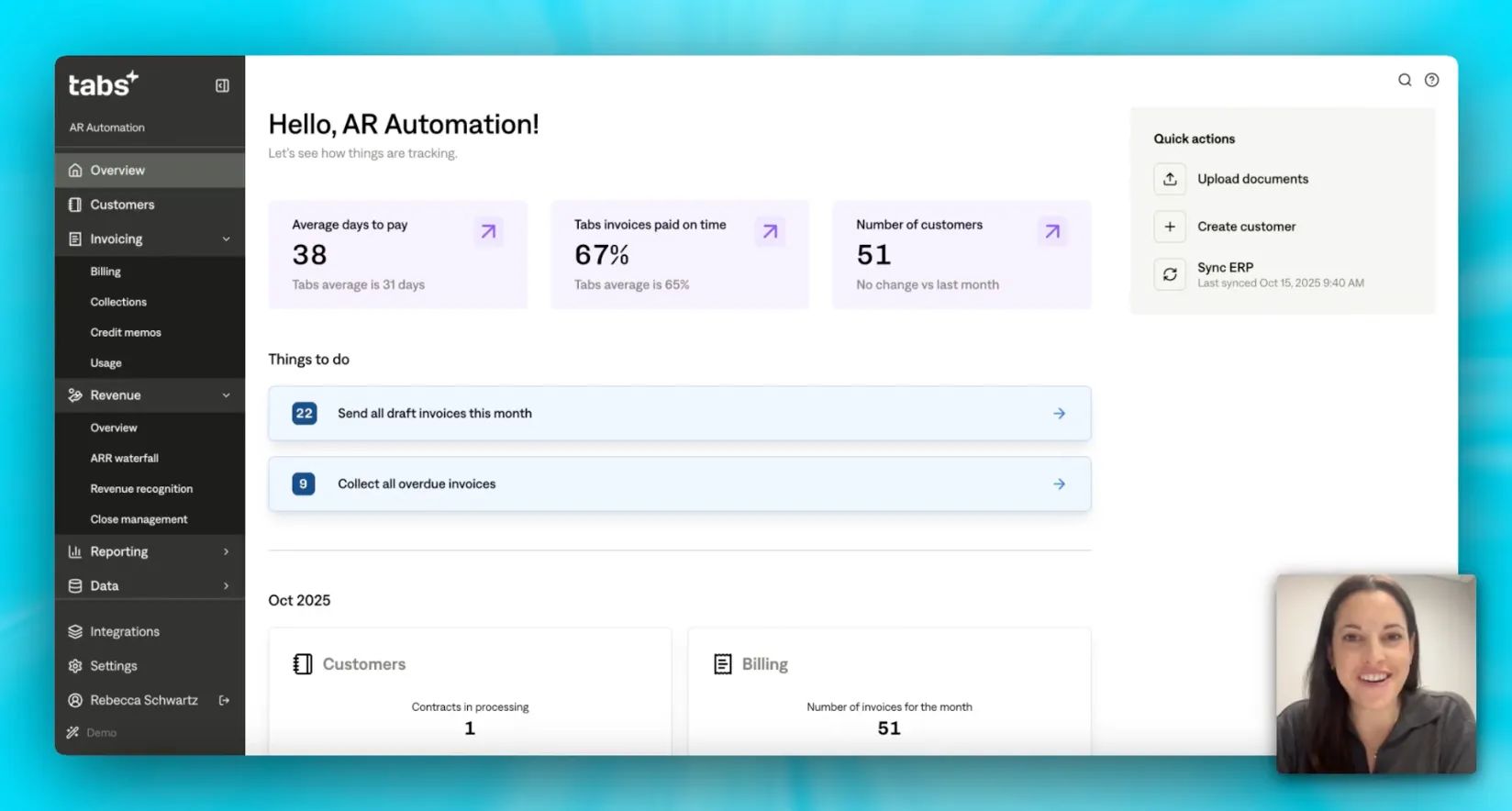
You need real-time visibility into AR aging, Days Sales Outstanding (DSO), and cash forecasting. Modern platforms surface insights through interactive dashboards rather than static reports.
Cash application and reconciliation
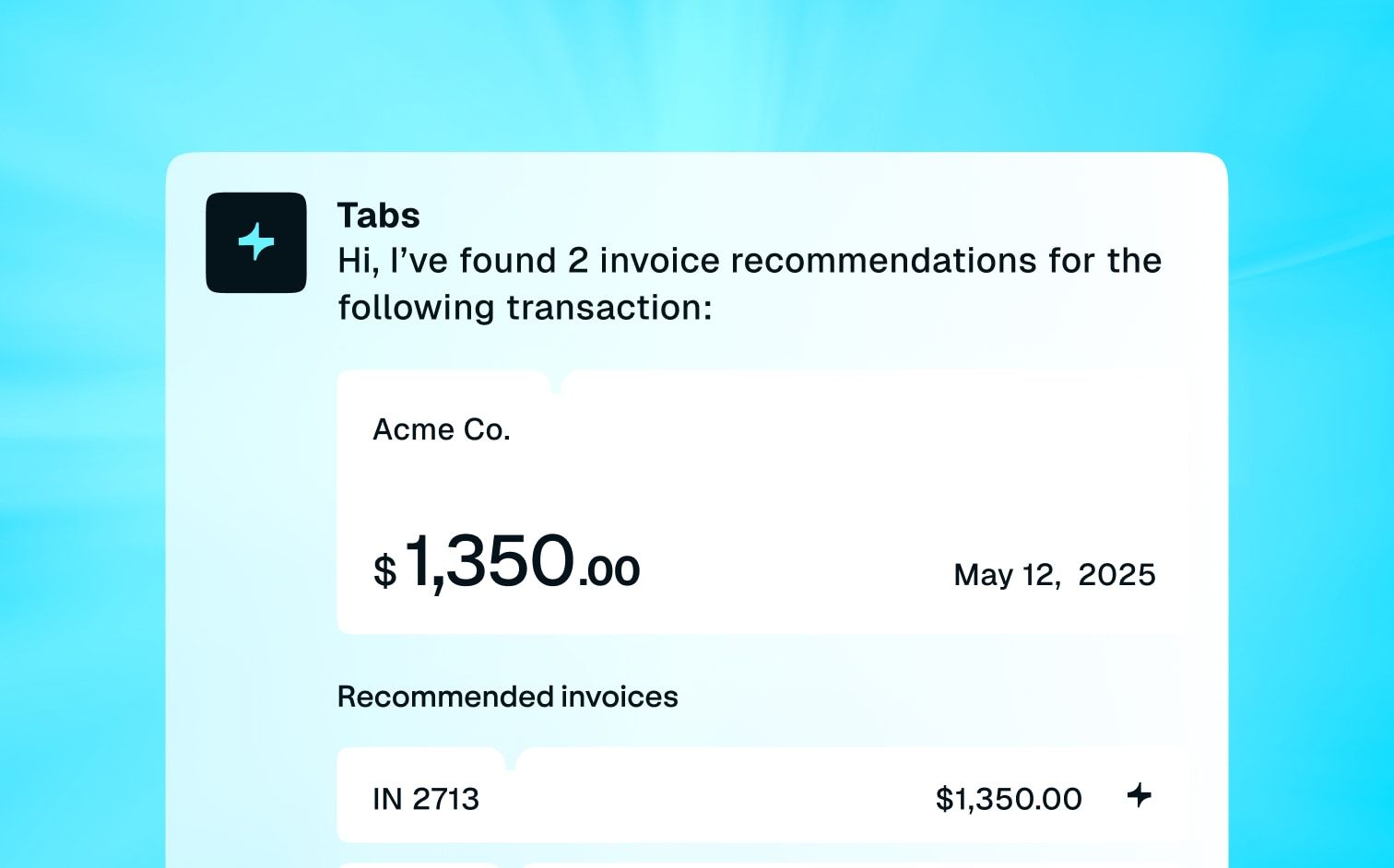
Automated cash application matches payments to invoices using remittance data and payment amounts. Advanced systems suggest matches for unapplied cash and route exceptions for review.
Security certifications and controls
Enterprise-grade security is non-negotiable. Expect SOC 2 Type II compliance, Payment Card Industry Data Security Standard (PCI DSS) compliance for payments, and access controls like single sign-on (SSO) and role-based access control (RBAC).
Tabs maintains SOC 2 compliance and implements enterprise-grade security with audit-ready controls.
| Feature Category | Key Capabilities | Questions to Ask |
|---|---|---|
| Invoicing | Auto-generation, recurring schedules | Does invoicing pull directly from contract terms? |
| Collections | Dunning sequences, escalation rules | Can workflows adapt based on payment history? |
| Cash Application | AI-based matching, exception handling | What's the auto-match rate? |
| Analytics | AR aging, DSO tracking, forecasting | Is reporting real-time or batch-updated? |
| Security | SOC 2, PCI DSS, SSO | What certifications are current? |
Steps to evaluate accounts receivable automation software
TL;DR: Evaluation isn't just about features—it's about fit. These steps help you pressure-test vendors against your actual workflows and growth plans.
Step 1—Align stakeholders and goals
Identify who owns the decision—typically the CFO, Controller, and RevOps leaders. Define what success looks like: DSO reduction, faster close, or headcount efficiency.
Step 2—Map contract-to-cash workflows
Document your current process from contract signature through cash collection. Identify where manual handoffs and data entry occur. This becomes your baseline for evaluating automation coverage.
Step 3—Score features against use cases
Weight capabilities based on your business model. A company with usage-based pricing has different priorities than a professional services firm with milestone billing.
Step 4—Validate integrations and data model
Confirm native integrations with your ERP—QuickBooks, NetSuite, or Sage Intacct—and your CRM. Ask about API flexibility for custom workflows.
Tabs offers native ERP integrations and developer-friendly APIs that let you extend functionality without replatforming.
Pressure-test Tabs with your data—book a demo
Step 5—Run a controlled pilot with real data
Request a sandbox using actual contracts and invoices. Evaluate accuracy of invoice generation and collections workflow behavior. Avoid demos with synthetic data that don't reflect your billing complexity.
Step 6—Confirm security, pricing, and ROI
Verify certifications and data residency requirements. Model total cost of ownership including implementation and training. Build an ROI case based on DSO improvement and error reduction.
Best accounts receivable automation software by company size
Different stages of growth dictate different requirements. A solution that works for a small business often breaks under enterprise complexity.
SMB priorities
Small businesses prioritize ease of setup and affordability. They need fast time-to-value without heavy implementation.
- Quick onboarding in days, not months
- Integrated payments to reduce friction
- Basic dunning to save time
Mid-market priorities
Mid-market companies focus on scalability and ERP integration. They're outgrowing basic tools and need systems that handle increased volume.
- Native ERP connectors for NetSuite or Sage Intacct
- Configurable collections workflows
- Role-based access as the team grows
Enterprise priorities
Enterprise buyers require multi-entity support, global compliance, and advanced analytics. They need platforms that handle complexity without custom development.
- Multi-currency and multi-entity consolidation
- Advanced AI-based cash application
- SOC 2, PCI DSS, and regional compliance
SaaS and usage-based priorities
Companies with subscription, usage-based, or hybrid billing have unique needs. Tabs natively supports all three models, allowing you to evolve pricing without rebuilding infrastructure.
- Metered billing based on consumption data
- Real-time usage integration from your product
- Revenue recognition that handles hybrid contracts
AI in accounts receivable automation software
Why this matters: AI in AR isn't just about speed—it's about context. The difference between generic automation and purpose-built AI is whether the platform can connect contract terms, customer payment behavior, and your revenue model to drive the right billing and collections actions.
The most useful AI in AR doesn't just score risk—it automates specific steps (like generating invoices from executed terms, recommending next-best collection actions, and proposing cash-application matches) based on contract and payment context. Tabs uses AI models trained on the Commercial Graph—a unified customer record that links executed contracts, usage data, invoices, payments, and key terms—so automation reflects what was actually agreed to.
AI for contract ingestion
AI parses contract PDFs, Word documents, and emails to extract billing terms—pricing, payment schedules, and renewal clauses. Tabs captures terms directly from signed contracts to generate invoices without manual intervention.
AI for invoice generation
Once terms are extracted, AI applies them to generate accurate invoices for complex models. This includes subscription tiers, usage-based calculations, and hybrid structures.
AI for collections outreach
AI prioritizes outreach based on payment history, balance size, and dispute status, then recommends or triggers the next reminder in your configured sequence—so timing and messaging reflect real account context, not a one-size-fits-all cadence.
AI for cash application
Machine learning matches payments to invoices by analyzing remittance data and historical patterns. AI surfaces unapplied cash for review rather than requiring manual investigation.
Commercial Graph context
The Commercial Graph connects contracts, usage, payments, and terms into a unified record. This context enables better automation—like suppressing dunning emails when an invoice is in dispute and routing the issue to the right owner before follow-ups resume. Generic automation tools lack this commercial context.
Implementation, integration, and security requirements
Successful implementation depends on technical readiness and clear requirements.
ERP integration requirements
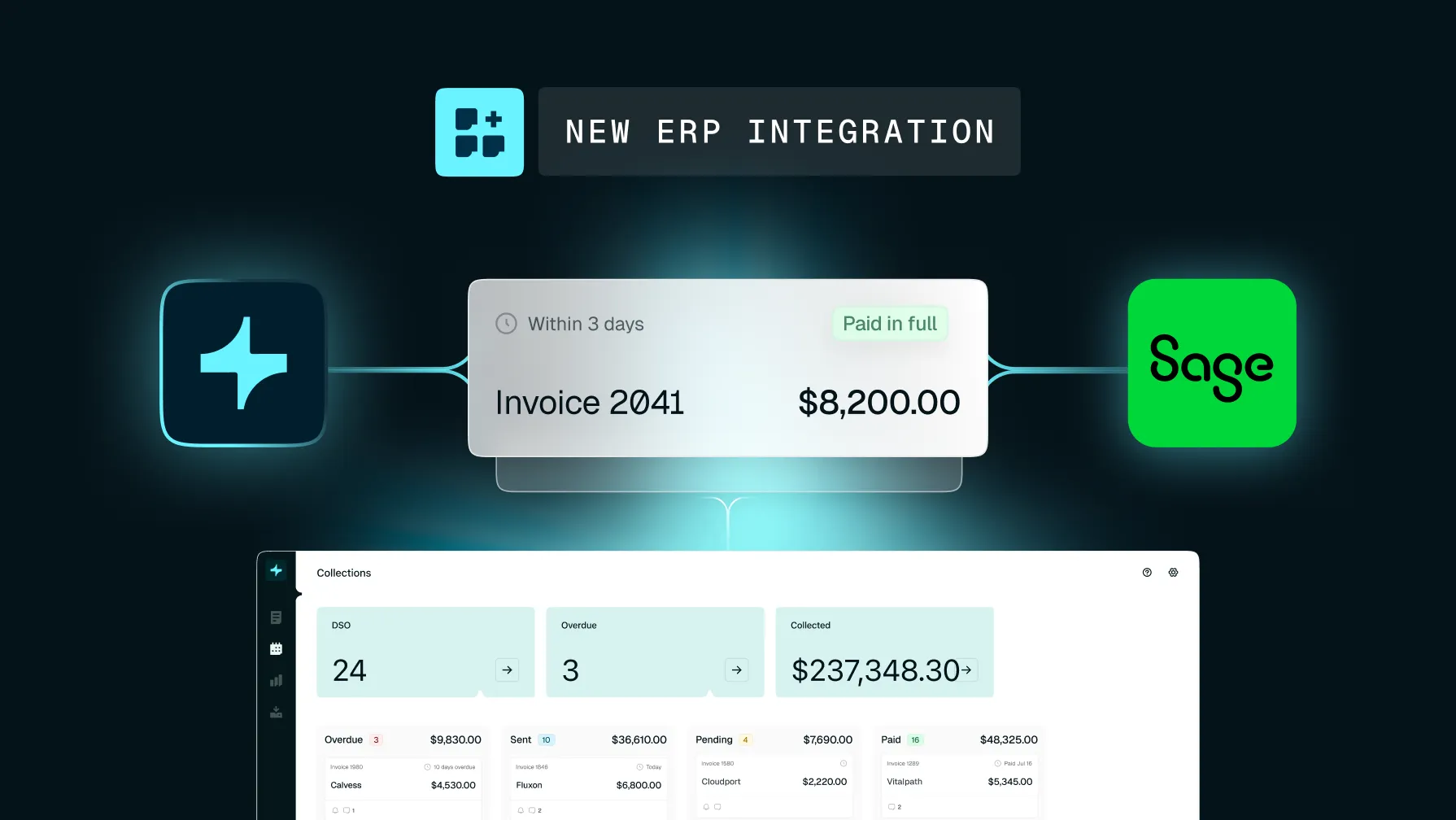
Look for native integrations with QuickBooks, NetSuite, and Sage Intacct. The integration must support bidirectional data flow so payments recorded in AR are instantly reflected in your ERP.
If you have edge cases, Tabs can extend native connectors with APIs—without forcing a replatform.
Security and compliance requirements
- SOC 2 Type II: Confirms operational security controls
- PCI DSS: Required for payment handling
- SSO/SAML: Enables centralized access management
- RBAC: Ensures appropriate data access by role
Pricing and timeline expectations
Clarify what's included in base pricing versus add-ons. While some implementations take months, many Tabs customers go live in <30 days. Explore how Tabs can help you go live in <30 days.
Frequently asked questions
Does AR automation integrate with QuickBooks, NetSuite, and Salesforce without replacing them?
Yes. Modern platforms offer native integrations and APIs that connect to your existing systems. Tabs integrates with QuickBooks, NetSuite, Sage Intacct, and major CRMs out of the box.
How does AR automation handle subscription, usage-based, and hybrid billing models?
Purpose-built platforms support all three models natively by ingesting usage data and applying contract logic. Tabs handles metered billing, overage calculations, and complex structures without custom development.
What controls ensure ASC 606-compliant revenue recognition in AR automation?
Platforms automate revenue recognition by linking billing data to contract terms. Tabs supports ASC 606-aligned Revenue Recognition by tying billing events to executed contract terms, generating schedules and journal entries, and maintaining audit-ready change logs and approvals.
Which security certifications should we require from AR automation vendors?
Require SOC 2 Type II for operational security and PCI DSS for payment handling. Look for SSO for access management and encryption for data at rest and in transit. Tabs maintains SOC 2 compliance with audit-ready controls.