




How real-time revenue reporting transforms finance operations
Finance teams at B2B companies deserve to see their revenue data as it happens—not days later after manual reconciliation. This guide covers how real-time revenue reporting works, the key features your platform needs, and how Tabs delivers continuous visibility across billing, AR, and revenue recognition.
Benefits of real-time revenue reporting
Real-time revenue reporting is the ability to see your invoiced, collected, and recognized revenue as transactions happen—not days or weeks later after manual reconciliation. This means you can answer questions about your financial position right now, without waiting for month-end close or chasing down data across multiple systems.
The difference between real-time visibility and traditional reporting is the difference between driving with a clear windshield and driving while looking in the rearview mirror. When your revenue data updates continuously, you catch problems before they compound. When you're working from last week's numbers, you're always reacting.
Tabs doesn't just show when invoices are due—it forecasts when cash will actually land, based on historical payment behavior and the commercial terms in your signed contracts. This commercial context transforms raw data into actionable intelligence. You're not just seeing numbers; you're understanding what those numbers mean for your business.
- Faster decision-making: You act on current data rather than waiting for reconciled reports that are already stale by the time they reach your desk.
- Improved forecast accuracy: Your revenue projections reflect actual billing and collection patterns instead of estimates and assumptions.
- Reduced time-to-close: Automated data flows eliminate the manual reconciliation work that drags out every month-end—reducing close cycles by 30-40% according to research.
- Cash flow visibility: AR balances and collection status update continuously, so you can intervene on overdue accounts before they become write-offs.
- Risk mitigation: Discrepancies surface immediately rather than during audit prep when they're expensive to fix.
How real-time revenue reporting works
Building continuous financial visibility requires connecting your data sources into a unified workflow. The goal is transforming static financial records into a dynamic system of intelligence that updates as your business operates.
Integrate source systems
Real-time reporting starts with connecting the systems where your revenue data originates. This typically includes your CRM for customer and deal information, your billing platform for invoices, your payment processor for collection status, and your ERP for general ledger reconciliation.
When these systems don't talk to each other, your finance team becomes the integration layer—manually pulling data, matching records, and reconciling discrepancies. That manual work introduces delays and errors that make real-time visibility impossible.
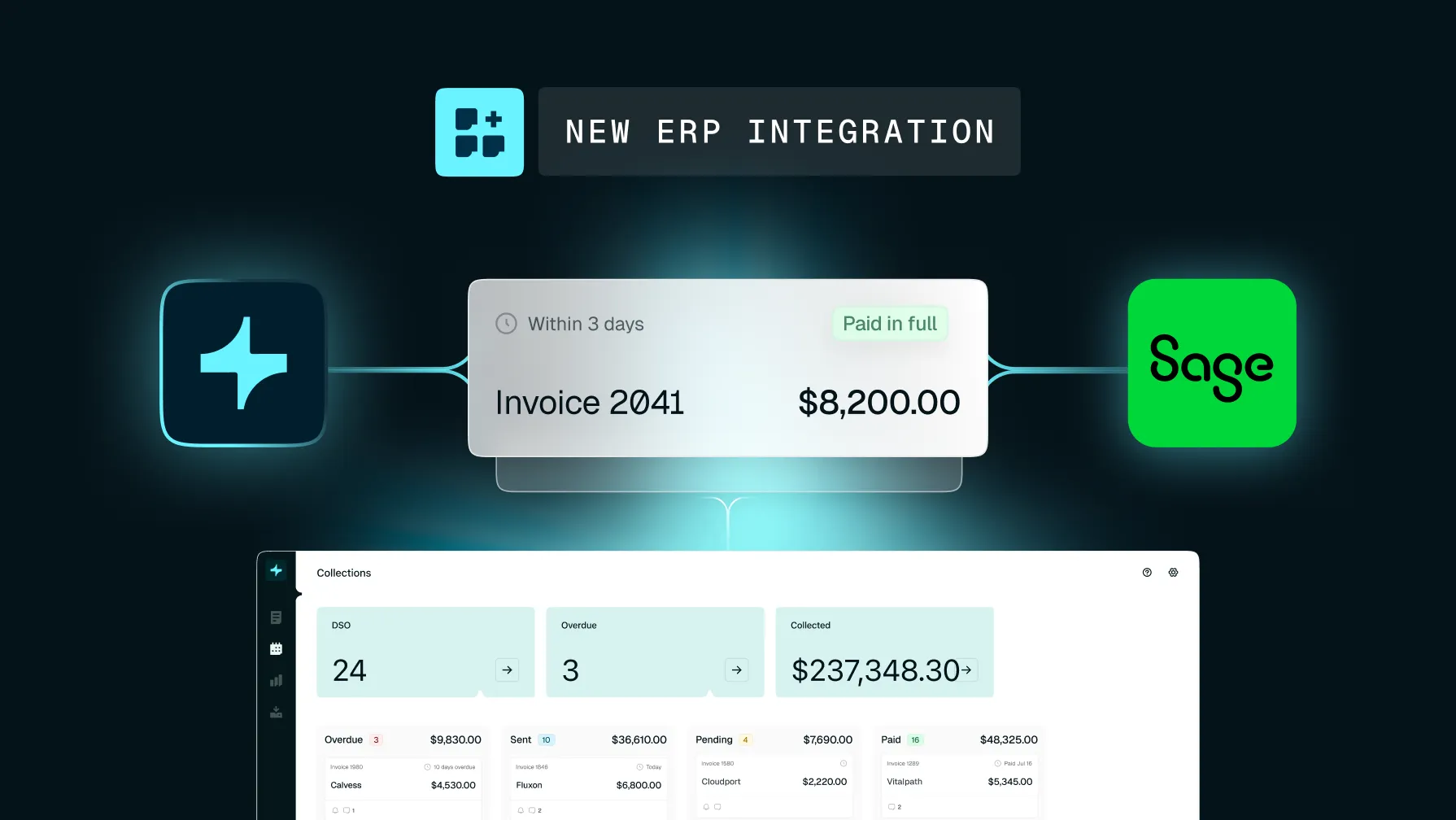
Tabs connects directly to major ERPs like QuickBooks, Oracle NetSuite, and Sage Intacct, plus CRM systems, to unify data at the source. This keeps Tabs downstream of your CRM and CPQ—so finance can operationalize signed contracts without replacing the tools your sales team already uses.
Why it matters: Native integrations eliminate the manual data transfers that create latency and errors in your financial reporting.
Automate data capture
Manual data entry is the enemy of real-time visibility. Every time someone re-keys contract terms into a billing system or copies invoice details into a spreadsheet, you introduce delays and potential errors.
Modern revenue automation extracts contract terms, billing schedules, and payment data automatically. But extraction alone isn't enough. Your system must map those terms to billing rules and Revenue Recognition logic—so invoices and schedules reflect what was actually contracted.
Tabs uses AI to parse contract language from PDFs and emails—capturing clauses, escalators, and billing terms without manual review. Tabs doesn't just extract text—it uses trained models to classify clauses (like escalators, proration, and invoicing triggers) and convert them into structured billing rules that match the signed contract terms.
Why it matters: Automated capture eliminates re-keying errors and ensures your billing reflects what was actually contracted.
Configure real-time dashboards
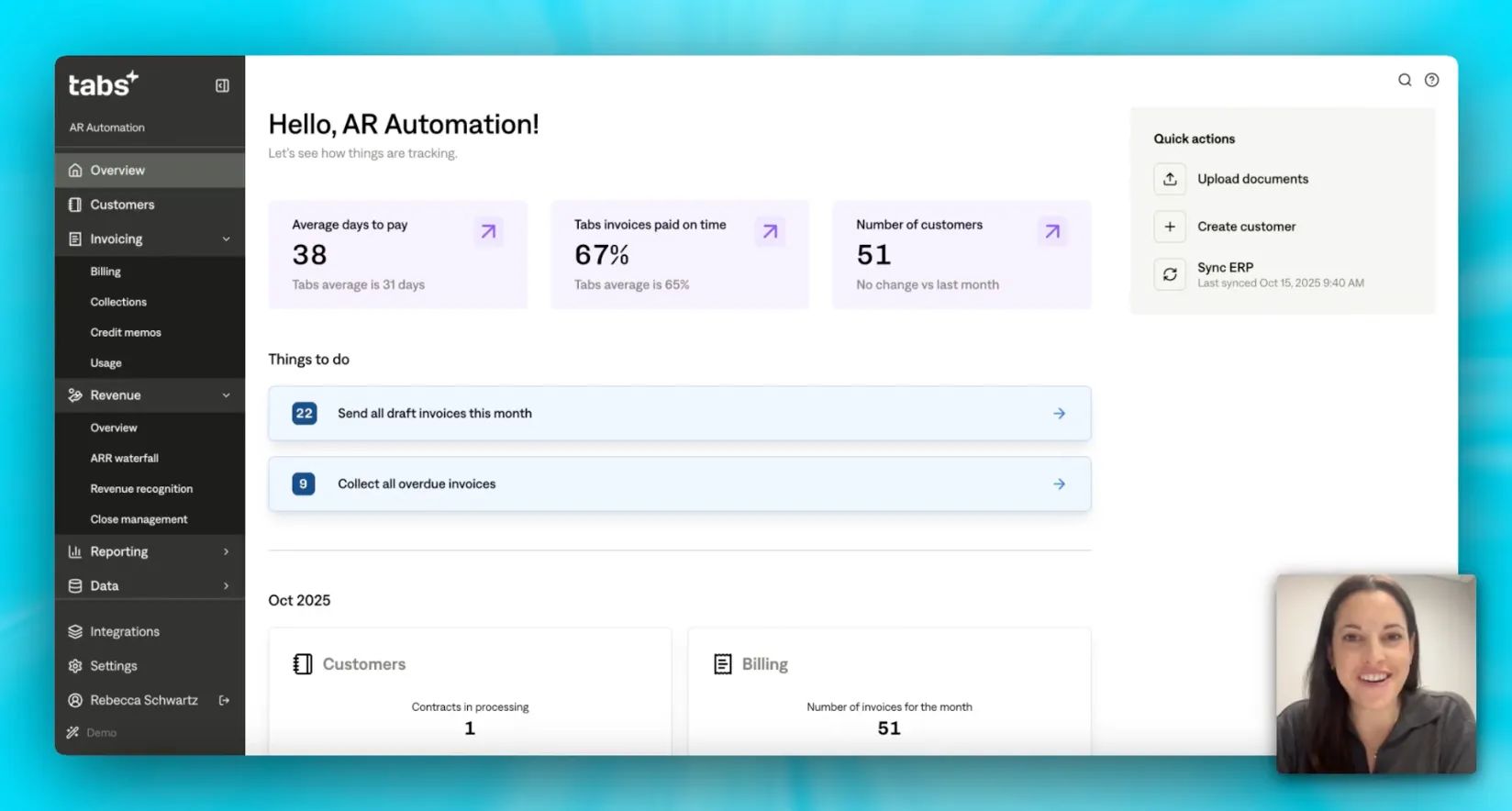
Dashboards must reflect real-time data, not batch-processed snapshots from yesterday or last week. The difference matters when you're trying to answer questions from your board, your investors, or your own leadership team.
Effective dashboards surface ARR, cash, AR balance, and renewal metrics with complete transparency into what has been invoiced, collected, and recognized. You should be able to drill down from a top-level number to the underlying transactions without switching tools or waiting for someone to pull a report.
Why it matters: Live dashboards let you trust your numbers without second-guessing whether the data is current.
Monitor revenue KPIs
Once your data flows continuously, you need to track the metrics that indicate financial health. The right KPIs depend on your business model, but most B2B companies monitor a core set:
- Annual recurring revenue (ARR) and monthly recurring revenue (MRR): Track recurring revenue as contracts activate and renew.
- Accounts receivable (AR) aging: Identify overdue balances before they become collection problems.
- Days sales outstanding (DSO): Measure collection efficiency in real time rather than at month-end.
- Deferred revenue: Monitor recognition schedules against billing events.
- Revenue by segment: Break down performance by customer, product, or contract type.
Why it matters: Continuous KPI monitoring lets you spot trends before they become problems.
See your revenue in real time—book a demo
Key features for real-time revenue reporting
Not all financial software can handle the demands of continuous data processing. A true real-time revenue reporting solution needs specific capabilities to manage modern B2B complexity.
Connect ERPs and CRMs
Native integrations eliminate manual data transfers and ensure consistency across your entire finance stack. Bidirectional sync keeps finance and sales teams aligned, preventing the discrepancies that arise when what was sold doesn't match what was billed.
Tabs offers native connectors plus developer-friendly APIs for custom integrations. This extensibility means you can connect additional systems or embed billing capabilities directly into your own products without starting from scratch.
Why it matters: Seamless integration ensures your revenue data stays consistent across every system that touches it.
Support usage and hybrid billing
Modern B2B pricing includes subscription-based billing, usage-based, and hybrid models.
Usage-based billing adds complexity because revenue isn't known until consumption occurs. Your system needs to ingest usage data continuously, calculate billing amounts based on contract terms, and update revenue metrics as consumption happens.
Tabs natively supports metered billing, seat-based pricing, overage tiers, and milestone payments—calculating revenue in real time as consumption occurs. This flexibility allows product teams to launch new pricing models without breaking your finance operations.
Why it matters: Flexible billing support lets you evolve your pricing strategy without rebuilding your finance infrastructure.
Automate revenue recognition
ASC 606 compliance requires accurate allocation of revenue across distinct performance obligations. This means you can't just recognize revenue when you invoice—you must recognize it as you satisfy each obligation in the contract.
Manual spreadsheets introduce errors and audit risk when tracking these complex schedules. And the more complex your contracts, the more likely those spreadsheets contain mistakes.
Tabs automates revenue schedules based on contract terms and billing data, maintaining audit-grade transparency throughout the entire lifecycle. Performance obligations are identified and allocated automatically, and revenue is recognized as obligations are satisfied.
Why it matters: Automated revenue recognition eliminates the month-end scramble to reconcile complex revenue streams.
Enforce access controls and audit trail
Real-time data access requires role-based permissions to protect sensitive financial information. Not everyone needs to see every number, and your system should enforce appropriate boundaries.
Every transaction, adjustment, and override must be logged for audit readiness. When auditors ask why a number changed, you need to show them exactly who changed it, when, and why.
Tabs maintains SOC 2 compliance with enterprise-grade security and a complete audit trail from contract signature to cash collection.
Why it matters: Comprehensive access controls and audit trails protect your data and simplify compliance.
Challenges with real-time revenue reporting and how to mitigate risk
Implementing continuous financial visibility isn't without obstacles. Understanding these challenges helps you deploy mitigation strategies that protect data integrity.
Integrate legacy systems
Older ERPs and billing systems often lack modern APIs required for continuous data synchronization. They were built for batch processing, not real-time data flows.
The mitigation is choosing a platform with flexible integration options—including file-based imports, webhooks, and custom connectors. You shouldn't have to replace your entire ERP just to get real-time visibility.
Tabs provides robust APIs that connect legacy tools without requiring full system replacement. This approach modernizes your finance stack without the massive disruption of an ERP migration.
Validate data accuracy
Real-time data is only valuable if it's accurate. Bad data flowing faster is still bad data—it just creates problems more quickly.
The mitigation is implementing validation rules at the point of ingestion and running continuous reconciliation checks against source systems. Errors should be caught before they pollute downstream reporting.
Tabs uses AI to normalize and validate data against pricing logic and compliance rules in real time. Custom terms aren't treated as exceptions; they're reconciled against your pricing structure automatically.
Manage change adoption
Finance teams accustomed to manual processes may resist new workflows. The spreadsheet they've used for years feels safe, even if it's slow and error-prone.
The mitigation is starting with high-impact use cases, demonstrating quick wins, and providing training that shows the value of the new approach. Deloitte's Q4 2025 CFO Signals survey found that 50% of CFOs prioritize finance automation, suggesting leadership alignment may already exist. Tabs is designed for rapid deployment—many teams can go live in <30 days, depending on data readiness and integration scope.
Protect sensitive data
Revenue data includes customer contracts, payment information, and financial records. Security isn't optional.
The mitigation is enforcing encryption, access controls, and maintaining recognized compliance certifications. Tabs maintains SOC 2 compliance with audit-ready controls to ensure your most sensitive data remains secure.
Why Tabs is built for real-time revenue reporting
Generic automation tools fail because they weren't designed for the nuances of B2B revenue models. Tabs is purpose-built for finance teams who need clarity across their entire contract-to-cash process.
Extract contract terms with AI
Tabs uses AI-powered contract parsing to convert signed terms into structured billing rules and Revenue Recognition schedules—with an approval workflow for exceptions.
This isn't generic document extraction. Tabs uses trained models to identify revenue-relevant terms and map them into billing logic and Revenue Recognition schedules. It captures the commercial context behind every agreement, not just the text.
Generate invoices from contracts
Tabs automatically generates invoices based on extracted contract terms. No manual data entry. No PDF manipulation. No re-keying information that already exists in your signed agreements.
Invoices reflect the actual agreement—including usage-based components, milestone payments, and hybrid structures. What you bill matches exactly what was sold.
Recognize revenue under ASC 606
Tabs automates revenue recognition schedules based on contract and billing data. Performance obligations are identified and allocated automatically without spreadsheet intervention.
Revenue is recognized as obligations are satisfied, with a complete audit trail. Your books are always ready for review.
Unify contracts, usage, and payments
Tabs creates a unified customer record—called the Commercial Graph—that connects contracts, usage data, payments, and terms. This unified view enables accurate, contextual decision-making across your entire revenue operation.
When your data is unified, your finance team transforms from a reactive administrative function into a strategic business partner—a shift that matters given EY's finding that 47% of CFOs say their finance function lacks the right capabilities for future strategic priorities.
Frequently asked questions
What is real-time reporting in a finance context?
Real-time reporting is the ability to access current, continuously updated financial data without waiting for batch processing or manual reconciliation. In revenue contexts, this means seeing invoiced, collected, and recognized revenue as transactions occur rather than after month-end close.
How does real-time revenue reporting differ from standard ERP dashboards?
ERP dashboards typically display data after batch processing and often lack context about contract terms or billing logic. Real-time revenue reporting platforms like Tabs provide continuous updates with commercial context—connecting what was contracted to what was billed to what was collected.
What data sources need to connect for real-time revenue visibility?
The core data sources include your CRM for customer and contract data, billing platform for invoices and usage, payment processor for collection status, and ERP for general ledger reconciliation. Tabs integrates with all of these to create a unified view.
Can real-time reporting support ASC 606 compliance requirements?
Real-time reporting and ASC 606 compliance are complementary. Real-time visibility into billing and collection events supports accurate revenue recognition by ensuring performance obligations are tracked as they're satisfied.
How does Tabs calculate usage-based revenue in real time?
Tabs ingests usage data continuously, calculates billing amounts based on contract terms, and updates revenue metrics as consumption occurs. This enables finance teams to see usage-based revenue in real time rather than waiting for end-of-period calculations.