





Metered billing software: A finance leader's guide to scaling B2B revenue
For finance leaders at B2B companies navigating usage-based and hybrid pricing models, this guide breaks down how metered billing software works, what to look for when evaluating platforms, and how to implement a system that turns raw consumption data into accurate invoices and compliant revenue recognition.
What is metered billing software?
Metered billing software tracks what your customers actually use and bills them accordingly. It sits between your product's usage data and your invoicing system, turning raw consumption events into accurate invoices without manual calculation.
Think of it as the system that captures every API call, compute hour, and transaction—and translates that activity into billable line items and revenue. Without it, your finance team is stuck downloading usage logs, wrestling with spreadsheets, and hand-keying invoices at month-end.
But counting usage events is just the beginning. Modern usage-based billing software applies complex pricing logic, handles late-arriving data, and ensures every invoice reflects the exact terms in your contract. This is where most legacy systems fall apart—and where Tabs differentiates. Tabs uses AI models to extract and classify commercial terms (pricing, credits, minimums, ramps, and amendment effective dates), then translates those terms into billing workflows that match what was signed—reducing the gap between sales commitments and what finance can invoice.
The core components of a metered service platform:
- Metering engine: Captures raw usage events in real time as customers interact with your product
- Aggregation layer: Groups millions of events into standardized billable units
- Rating engine: Applies your pricing rules, tiers, and discounts based on contract terms
- Invoicing engine: Generates invoices and syncs directly with your ERP
Why metered billing replaces flat-rate pricing
Flat-rate pricing assumes every customer uses your product the same way. That assumption breaks down fast—especially with AI-native products where consumption is elastic and unpredictable.
When you force variable usage into a flat-rate box, you create forecasting blind spots. You leave money on the table with power users. And you frustrate light users who feel they're overpaying for features they barely touch.
Metered billing fixes this by aligning revenue with value delivered. Customers pay for what they use. Your revenue grows as their adoption grows. And your forecasts actually reflect reality.
Why finance teams are making the switch:
- Value alignment: Customers never feel like they're paying for shelfware
- Expansion revenue: Land-and-expand happens naturally as usage increases—and McKinsey's analysis of 55 B2B SaaS companies shows top-quartile NRR players sustain higher valuations through both bull and bear markets.
- Forecasting accuracy: Revenue correlates with product adoption, not arbitrary contract cycles
- Pricing flexibility: You can launch hybrid models without rebuilding your infrastructure
Pricing models for metered and hybrid billing
Pure pay-as-you-go is rare in B2B. A PwC/m3ter survey found 52% of B2B software companies operate usage or hybrid models, blending subscriptions, usage commitments, and overages to balance predictable cash flow with upside potential. Your billing infrastructure needs to handle hybrid billing natively.
Subscriptions with overages
Customers pay a base fee that includes a usage allowance. When they exceed that threshold, overage charges kick in automatically. This model works well for API products where baseline usage is predictable but spikes happen.
Why it matters: Gives customers cost predictability while protecting your margins from heavy users.
Outcome-based pricing
You bill for business outcomes—successful transactions, resolved tickets, closed cases—rather than raw consumption. This requires sophisticated tracking to ensure you only charge for successful events.
Why it matters: Customers like it because ROI is easier to quantify, and pricing aligns tightly to measurable outcomes.
Multi-dimensional usage pricing
Some products bill across multiple vectors simultaneously: API calls plus storage plus compute time. Your system must aggregate across all dimensions and present a unified invoice.
Why it matters: Manual calculation across dimensions leads to delayed billing and confused customers.
Credit burndown with prepaid balances
Customers buy credits upfront and draw down based on usage. You need real-time balance tracking and automated alerts before credits run out.
Why it matters: Excellent upfront cash flow for you, flexibility for the buyer.
Negotiated enterprise contracts
Enterprise deals rarely fit standard tiers. They include volume discounts, minimum commits, ramp schedules, and custom pricing. Your billing system must operationalize these terms without spreadsheet workarounds.
Tabs excels here. Tabs uses AI models to extract terms from signed contract language and translate them into billing logic automatically—reducing the gap between what sales negotiates and what finance can bill.
Why it matters: Closes the dangerous disconnect between signed contracts and actual invoices.
How metered billing software works
Turning a raw product event into a paid invoice requires a precise data pipeline. Each stage introduces potential failure points. Modern platforms must handle edge cases—late-arriving events, duplicate submissions, retroactive amendments—without breaking.
Metering engine and event capture
Usage events flow in from product telemetry, APIs, or third-party sources. The system enforces idempotency—a safeguard that prevents duplicate billing if the same event submits twice. Schema validation ensures incoming data is formatted correctly before entering the financial pipeline.
Why it matters: Bad data at the source cascades into billing errors downstream.
Aggregation layer and normalization
Raw events get grouped into billable units based on time windows, customer accounts, and usage dimensions. This layer handles late-arriving events from network latency and backfill scenarios when upstream systems dump historical data.
Why it matters: Without proper aggregation, you're either overbilling or leaving revenue uncollected.
Rating engine and pricing rules
Aggregated usage gets priced according to contract terms—applying tiers, volume discounts, minimums, and overages. This is the most complex layer of SaaS metering—and where legacy systems typically break.
Why it matters: Rating errors are the number one cause of billing disputes.
Invoicing engine and ERP sync
The system generates invoices, delivers them, and syncs with your accounting systems. A strict audit trail lets you trace any line item back to its source events.
Why it matters: Auditors and customers both demand traceability.
Automate usage-to-cash with Tabs
Features to evaluate in metered billing software
Skip the generic feature checklists. Focus on capabilities that solve real operational problems.
Real-time metering accuracy
Near-real-time visibility matters for customer trust, internal forecasting, and preventing bill shock. Evaluate latency tolerances and data freshness guarantees carefully.
Why it matters: Stale data leads directly to billing disputes and delayed cash collection.
Aggregation and rating flexibility
You need configurable aggregation windows and support for complex pricing logic. The system must handle mid-cycle changes—upgrades, downgrades, amendments—without manual fixes.
Why it matters: If your software can't prorate automatically, your team spends days fixing invoices.
Usage transparency for customers
Customer-facing portals, alerts, and reporting help buyers understand consumption before invoices arrive. Transparency reduces disputes and builds trust.
Why it matters: When customers can monitor their own spend, they're far more likely to renew.
Integrations with CRM and ERP
Your billing software must fit existing workflows—not require a full stack rebuild. Tabs connects natively to Salesforce, HubSpot, NetSuite, and QuickBooks, ensuring contract data flows into billing without manual re-entry.
Why it matters: Disconnected systems create the data chaos that kills revenue accuracy—a PwC/m3ter survey found 87% of billing systems are not integrated with ERP or general ledger systems.
Implementation steps for finance and RevOps
Rolling out metered billing requires tight coordination between finance, product, and RevOps. Follow a structured approach to avoid costly billing errors.
Step 1: Define billable metrics
Start with the fundamental question: what are you charging for? Define the unit of measure, granularity, and attribution rules. Involve product, finance, and sales early to ensure alignment.
Why it matters: Misaligned metrics create downstream chaos in billing and forecasting.
Step 2: Instrument event capture
Work with engineering to instrument usage tracking at the source. Define event schemas, establish data governance, and test thoroughly for completeness and accuracy.
Why it matters: You can't bill what you can't measure.
Step 3: Configure pricing and rating
Map contract terms to pricing rules in your billing system. Account for edge cases like volume discounts, minimums, and custom tiers. Tabs uses AI models to ingest signed contract language and translate terms into pricing logic automatically—reducing setup time and minimizing translation errors (for example, minimum commits, tiered rates, ramp schedules, and amendments).
Why it matters: Manual configuration is slow and error-prone.
Step 4: Automate invoicing and collections
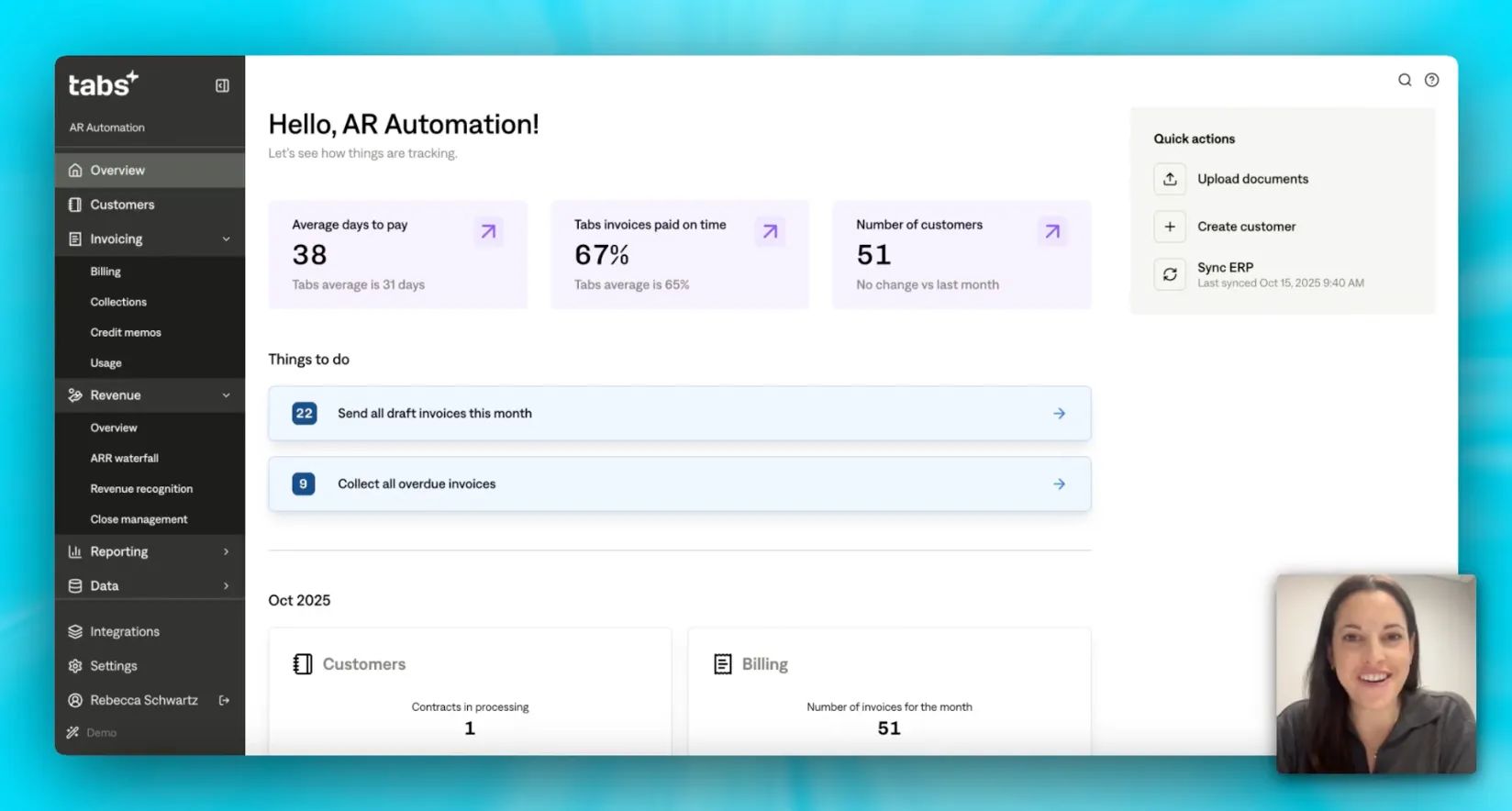
Connect billing to invoicing workflows and collections processes. Set up dunning sequences, payment reminders, and cash application rules. Tabs automates the full cycle from invoice generation through payment reconciliation.
Why it matters: Manual collections drain time and delay cash.
Key metrics to track in metered billing
Running a usage-based business requires tracking different metrics than traditional subscription models.
- Metered utilization rate: Percentage of committed usage actually consumed
- Overage rate: Frequency and magnitude of usage exceeding thresholds
- Commit coverage: How much of minimum commitments are fulfilled
- Effective price per unit: Actual revenue per unit after discounts and tiers
- Days Sales Outstanding (DSO): Time from invoice to payment—critical for cash flow
How Tabs supports metered billing end to end
Tabs is the Revenue Automation platform built for modern B2B billing complexity, sitting downstream of your CRM and configure, price, quote (CPQ) system to operationalize signed contracts.
Tabs's AI doesn't just extract fields—it classifies obligations, timing, and pricing terms, then translates them into accurate billing workflows and ASC 606-compliant Revenue Recognition. Modern revenue automation platforms don't just show when invoices are due—they forecast when cash will actually land, based on historical payment behavior and contract terms.
- AI contract ingestion: Reads signed contracts and extracts billing terms automatically
- Flexible pricing models: Supports subscriptions, Usage-Based Billing, hybrid, and enterprise contracts natively
- Real-time metering: Tracks usage events and applies rating logic as consumption happens
- Automated invoicing and collections: Generates invoices, sends reminders, and reconciles payments
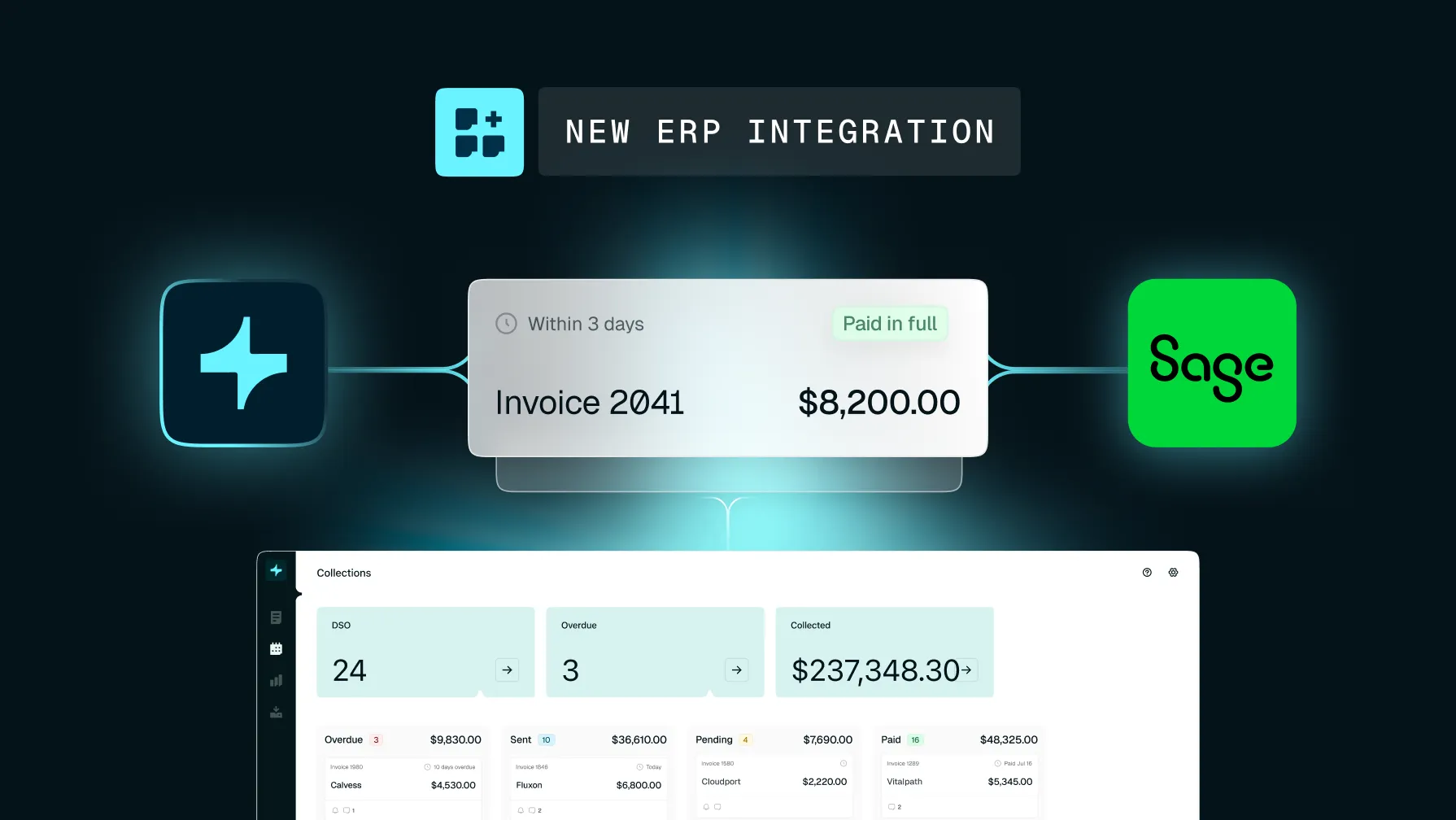
- ERP and CRM integrations: Connects natively to NetSuite, QuickBooks, and Salesforce
- Revenue recognition: Automates ASC 606 compliance based on contract and billing data
Frequently asked questions
How does metered billing software connect to existing ERP and CRM systems?
Modern platforms offer native connectors and APIs that sync data both ways—no rip-and-replace required. Tabs integrates with NetSuite, QuickBooks, and Salesforce out of the box.
How does usage-based revenue get recognized under ASC 606?
You must track performance obligations and allocate revenue as usage occurs. Tabs automates this based on your contract terms and real-time billing data.
What prevents customers from experiencing bill shock with metered pricing?
Real-time usage dashboards, threshold alerts, and customer-facing portals give buyers visibility before invoices arrive. Transparency reduces disputes and strengthens relationships.