





How to choose invoicing automation software for B2B finance
Key takeaways
- Invoicing automation splits into two distinct problems: AP automation handles vendor bills coming in (OCR, PO matching, payment scheduling), while AR automation handles customer invoices going out (contract extraction, dunning, cash application, revenue recognition). Most generic tools only solve the AP side.
- AI-powered AR platforms like Tabs start from the signed contract rather than a blank invoice template, extracting billing terms automatically instead of requiring someone to manually interpret a PDF and enter the logic by hand.
- Generic AI billing tools can pull a date or dollar amount from a document, but struggle with B2B-specific complexity — like how a mid-contract upgrade should flow through a usage-based pricing tier — which is where purpose-built models add real value.
- Feature priorities differ sharply by category: AP platforms are judged on PO matching and payment scheduling, while AR platforms are judged on contract-to-invoice automation, dunning sequences, and ASC 606-compliant revenue recognition.
- Teams with high automation adoption saw a 41% average reduction in DSO, driven mainly by faster collections through automated reminders and embedded payment links, alongside gains in touchless processing rate and audit traceability.
Finance teams at B2B companies need invoicing automation that matches their billing complexity, whether that means processing vendor bills at scale or generating customer invoices from contracts with subscription, usage-based, or hybrid terms.
This guide breaks down the eight best tools across AP and AR automation, explains how to evaluate them based on your specific workflows, and shows where AI-powered platforms like Tabs fit for teams managing the full contract-to-cash cycle.
What is invoicing automation software?
Invoicing automation software is technology that captures, validates, and processes invoices without manual data entry. This means you stop copying numbers from PDFs into spreadsheets and start letting software handle the repetitive work.
Most tools in this category focus on accounts payable (AP), processing the vendor bills coming into your business. They use optical character recognition (OCR) to read documents, match invoices to purchase orders, and route exceptions for approval before syncing to your ERP.
But for B2B companies, there's another side to the equation. You also need to automate the invoices going out to your customers. This is where accounts receivable (AR) automation comes in and where most generic tools fall short.
Invoicing automation software like Tabs' takes a different approach by focusing on the AR side. Instead of processing incoming bills, Tabs uses AI to automate core contract-to-cash workflows—invoice generation, collections workflows, cash application support, and ASC 606-compliant Revenue Recognition—based on signed contracts downstream of your CRM and CPQ.
AP vs AR invoicing automation for B2B finance
Understanding this distinction matters when you're evaluating your finance stack. AP automation handles the money leaving your business. AR automation handles the money coming in. They solve fundamentally different problems.
AP automation captures vendor bills, matches them to purchase orders, and schedules payment runs—with Deloitte research showing savings ranging from 25 to 40%. The goal is optimizing when you pay suppliers and maintaining visibility over outgoing cash.
AR automation generates invoices from customer contracts, manages collections, applies cash to open balances, and supports ASC 606-compliant Revenue Recognition.
Tabs sits firmly on the AR side as a system of intelligence downstream of your CRM. Tabs automates outgoing invoices for B2B companies with complex billing models—subscription, usage-based pricing, or hybrid structures that generic AP tools weren't built to handle.
How invoicing automation software works
The workflow depends entirely on whether you're processing payables or receivables.
For AP, the process follows a predictable path: capture the document, extract the data, validate against purchase orders, route for approval, post to the ERP, and execute payment.
For AR, the workflow starts differently. It begins with the signed contract, extracts the billing terms, generates the invoice, delivers it to the customer, tracks payment, applies cash, and triggers revenue recognition.
Traditional systems require humans to bridge the gap between a signed contract and a generated invoice. Someone reads the PDF, interprets the terms, and manually enters the billing logic. This is where errors creep in and delays compound.
Benefits of invoicing automation software
The benefits extend far beyond saving time on data entry. When you remove manual touchpoints, you eliminate the primary source of billing errors and reconciliation delays.
- Faster cycle times: Invoices go out in hours, not days. No more waiting for someone to manually process the contract.
- Lower error rates: Automated validation catches mismatches before invoices reach customers.
- Improved cash flow: Embedded payment links and automated reminders accelerate collections.
- Audit readiness: Every invoice ties back to its source contract with a complete trail.
For B2B companies, the most significant advantage is creating a unified contract-to-cash workflow. Tabs extends automation past invoice generation, connecting billing to collections and ASC 606-compliant Revenue Recognition in a single system.
Automate AR from contract to cash. Get a demo.
How AI powers invoicing automation software for B2B revenue operations
According to Deloitte's Q4 2025 CFO Signals survey, 87% of CFOs believe AI will play a major role in finance operations. Modern platforms use machine learning to process unstructured documents and natural language processing (NLP) to identify clauses and billing terms.
But generic AI billing software often struggles with B2B complexity. Extracting a date and dollar amount is straightforward. Understanding how a mid-contract upgrade impacts a usage-based pricing tier is not.
Teams need a tool that differentiates with trained models purpose-built for B2B revenue models. It should classify clauses like escalators, milestones, and usage thresholds and maps them into billing logic and ASC 606-compliant Revenue Recognition entries—so you get commercial context, not just extracted fields.
- Contract ingestion: AI parses PDFs, Word documents, and emails to extract billing terms automatically.
- Validation: Custom terms reconcile against your pricing logic in real time.
- Billing logic: The system handles subscription, usage-based, and hybrid models without manual configuration.
- Revenue recognition: Generates ASC 606-compliant journal entries based on actual contract terms.
Invoicing automation software features to prioritize
Your feature priorities shift dramatically depending on whether you need AP or AR automation. AP platforms prioritize purchase order (PO) matching and payment scheduling. AR platforms prioritize contract-to-invoice automation, dunning (collections reminder) sequences, and Revenue Recognition.
| Category | AP-focused features | AR-focused features |
|---|---|---|
| Data capture | Vendor bill OCR, email ingestion | Contract term extraction, usage data ingestion |
| Validation | PO matching, duplicate detection | Billing logic validation, pricing enforcement |
| Workflow | Approval routing, payment scheduling | Invoice delivery, dunning sequences |
| Integration | ERP sync, payment rails | CRM sync, ERP sync, payment gateways |
| Reporting | Spend analytics, cash forecasting | AR aging, DSO tracking, revenue waterfall |
Look for platforms that handle data capture without rigid templates and enforce validation rules automatically. Your finance team should be able to adjust billing rules without submitting tickets to engineering.
The different invoicing automation software use cases
The market is fragmented, with tools built for vastly different users. Understanding these categories helps clarify which solution fits your operational bottlenecks.
All-in-one spend and AP platforms
These combine corporate cards, expense management, and AP automation in a single interface. Best for mid-market companies wanting unified visibility over outgoing cash.
AP automation and payments platforms
Dedicated AP platforms focus on high-volume invoice processing and cross-border payments. Built for enterprise teams managing thousands of vendor bills monthly.
Accounting suites with AP modules
Major ERP and accounting platforms include built-in AP functionality. Ideal for companies wanting native integration without additional tools, though automation depth is typically limited.
SMB accounting with bill pay
Lightweight accounting tools provide basic bill pay for early-stage companies. They work for simple, low-volume needs but lack the automation depth to scale.
Document AI and OCR engines
Specialized data extraction tools that feed into other systems. Best for digitizing high volumes of unstructured documents, but require integration with billing or ERP systems to complete workflows.
AI revenue platforms for AR and billing
These platforms focus on AR—automating invoice generation from contracts, managing collections, and handling revenue recognition. Built for B2B companies with complex billing models including seat-based pricing, subscription, usage-based, and hybrid structures.
Six steps for implement invoicing automation
Software alone won't fix a broken process. Automation amplifies your current operations, so if your data is messy, automation scales the mess faster.
Step 1: Map current invoicing and data flows
Document your existing invoice creation, approval, delivery, and collection processes. Identify every manual touchpoint and note where errors typically occur.
Step 2: Standardize contract and product data
Clean up contract repositories, pricing tables, and customer master data. Inconsistent formats create exceptions that force manual intervention.
Step 3: Select and scope your invoicing platform
Choose based on AP versus AR needs, billing model complexity, and integration requirements. Define whether you're doing full replacement or augmenting existing systems.
Step 4: Configure schedules, rules, and templates
Set up billing schedules, validation rules, and invoice templates. For AR platforms like Tabs, configure how contract terms translate into automated billing logic.
Step 5: Run parallel tests and reconcile outputs
Run the new system alongside existing processes for a defined period. Compare outputs and resolve discrepancies before cutover.
Step 6: Monitor KPIs and optimize workflows
Track touchless rate, exception rate, and cycle time post-launch. Use data to refine rules and expand automation scope.
How to choose the right invoicing automation software for your team
A platform that works for high-volume e-commerce will likely fail a B2B SaaS company with custom enterprise contracts. Evaluate tools against your specific complexities.
Cost and total cost of ownership
Look beyond subscription fees. Factor in implementation costs, integration development, and ongoing maintenance. Balance against projected ROI from time savings and accelerated cash collection.
Integrations with ERP and CRM
Evaluate native connectors versus API-based integrations. For AR automation, CRM integration is critical for pulling contract data. For both AP and AR, ERP sync ensures accurate reporting.
Scalability for multi-entity and global operations
Assess whether the platform handles multiple legal entities, currencies, and tax jurisdictions. Critical for growing B2B companies planning international expansion.
Ease of use for finance teams
Evaluate the learning curve for actual users. Look for intuitive interfaces, clear audit trails, and self-service configuration without engineering support.
Analytics and audit reporting
Assess reporting depth—AR aging, days sales outstanding (DSO) tracking, and revenue waterfalls. For companies with ASC 606 requirements, evaluate revenue recognition reporting carefully.
What results to expect from invoicing automation software
When implemented correctly, you should see immediate reduction in time-to-invoice and higher touchless processing rates. As manual touchpoints disappear, exception rates and cost per invoice drop.
Customers use Tabs to reduce aged receivables and scale invoice volume without adding finance headcount. In published case studies, teams report faster time-to-invoice and fewer overdue invoices after implementing Tabs.
- Time-to-invoice: Invoices can generate within hours of contract signature when billing terms are clear and required integrations are in place.
- Touchless rate: High percentage of invoices process without manual intervention.
- DSO improvement: Organizations with high automation saw an average 41% reduction in DSO through faster collections via automated reminders and embedded payment links.
- Audit readiness: Complete traceability from contract to cash application.
Ready to automate your AR from contract to cash?
Generic automation tools can speed up parts of your invoicing process, but for B2B finance teams managing complex contracts, that's rarely enough. You need a system that understands your actual billing terms, not just one that extracts data faster.
Tabs connects the full contract-to-cash cycle in one platform: AI-powered contract ingestion, accurate invoice generation, automated collections, and ASC 606-compliant revenue recognition, all built for subscription, usage-based, and hybrid billing models.
Teams using Tabs cut DSO, reduce manual reconciliation, and scale invoice volume without adding headcount — and most go live in under 30 days.
Frequently asked questions
Can invoicing automation handle hybrid subscription and usage-based billing models?
Yes. Modern AR automation platforms like Tabs natively support subscription billing, usage-based billing, and hybrid models without custom development or manual workarounds.
How does AI extract billing terms from signed contracts with fewer errors?
AI uses natural language processing trained on contract language to identify billing clauses, payment terms, and milestones. Tabs applies commercial context to translate terms into billing logic, with validation and exception handling—rather than just extracting raw data.
How quickly can Tabs connect to NetSuite, QuickBooks, or Sage Intacct?
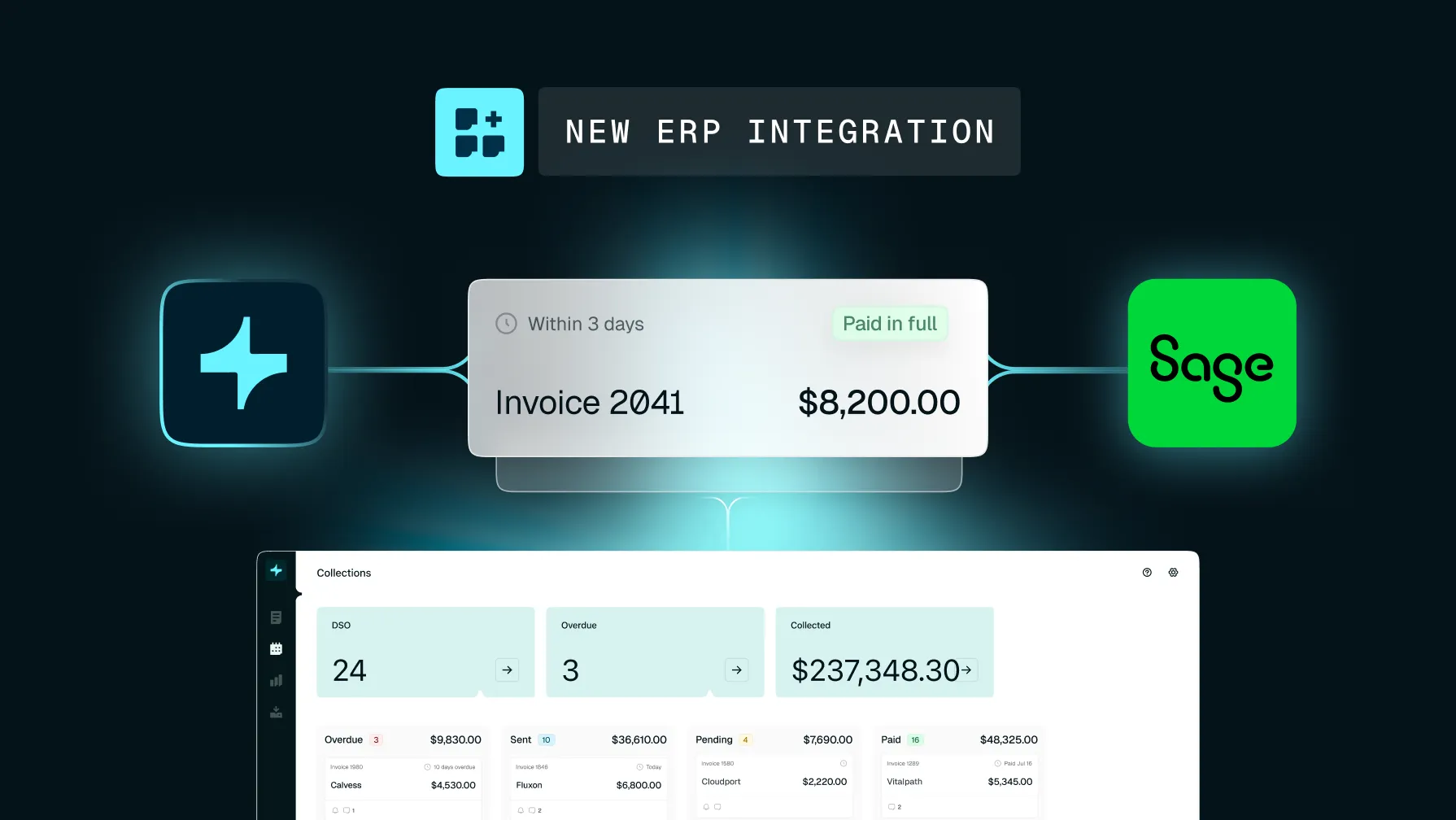
Tabs offers native integrations with major ERPs including NetSuite, QuickBooks, and Sage Intacct. Many teams complete an initial sync in <30 days, depending on entity structure, historical data, and approval workflows.
Which finance KPIs improve first after deploying invoicing automation?
Most teams see immediate improvements in time-to-invoice and error rates, followed by DSO reduction and higher touchless processing rates as collections automation takes effect.