






What customer attrition really costs your business
Acquiring a new customer costs 5–7x more than retaining an existing one. For B2B SaaS companies running on recurring revenue, that math turns customer attrition from a growth metric into a financial emergency. Every lost account compounds — eroding monthly recurring revenue (MRR), inflating customer acquisition costs (CAC), and compressing the lifetime value of your entire book of business.
Customer attrition is the rate at which customers stop doing business with you over a given period. And while most teams treat it as a customer success problem, the root causes often live deeper — in billing errors, payment failures, contract rigidity, and fragmented revenue operations. Attrition isn't just about dissatisfaction. It's about operational friction that erodes trust before anyone on your team sees it coming.
That's why forward-thinking finance leaders are rethinking attrition as a revenue operations problem — one that demands automation, commercial context, and end-to-end visibility across the contract-to-cash lifecycle. Tabs, the AI Revenue Platform, addresses attrition at the commercial layer by translating contract terms into accurate billing, collections, and Revenue Recognition workflows — not just surfacing data, but understanding its business implications.
This article breaks down the types, causes, and measurement of customer attrition — then gives you actionable strategies to reduce it, predict it, and prevent it from quietly draining your revenue.
Customer attrition vs. churn — and why the difference matters
The terms "customer attrition" and "churn" get used interchangeably. But for finance teams tracking revenue with precision, the distinction matters.
Attrition is the broader metric. It captures all customers lost over a period — including natural contract expirations, downgrades, and accounts that simply don't renew. Churn typically refers to active cancellations — customers who deliberately end their relationship with your product. Attrition encompasses churn, but churn doesn't capture the full picture of customer loss.
Why does this matter? Because the strategies for addressing each are fundamentally different. And within attrition itself, the split between voluntary and involuntary loss changes everything about where you invest your retention efforts.
Voluntary attrition
Voluntary attrition happens when a customer actively decides to leave. In B2B SaaS, the triggers are familiar: a CFO consolidating vendors to cut costs, a controller frustrated by persistent billing errors, a VP of Finance switching to a competitor with better pricing alignment. The customer evaluates the relationship and decides it's no longer worth it.
Voluntary attrition demands product improvement, value communication, and pricing flexibility. It's the type most teams focus on — and rightfully so. But it's not the only type draining your revenue.
Involuntary attrition
Involuntary attrition is the silent killer. Customers don't choose to leave — they're lost to operational failures. Failed credit card charges. Expired payment methods. ACH (Automated Clearing House) transfers that bounce without follow-up. Dunning sequences that fire generic emails into the void instead of adapting to customer behavior.
Involuntary attrition is often the most preventable and the most overlooked. It doesn't show up in exit interviews because the customer never made a conscious decision to cancel. They simply fell through the cracks of a payment and collections process that wasn't designed for complexity.
For finance teams, involuntary attrition is a revenue operations failure — not a customer success failure. And the fix lives in your billing and payments infrastructure, not in your CS playbook.
Root causes of customer attrition in B2B SaaS
Generic explanations for attrition — "poor customer service," "lack of engagement" — miss the mark for B2B SaaS. The real causes are structural, operational, and often invisible until a customer is already gone. Here are the five root causes finance professionals should diagnose first.
Billing friction and invoice errors
Manual billing processes breed disputes. When a customer receives an incorrect invoice — wrong amount, wrong terms, wrong line items — the damage extends far beyond the dollar amount. It signals carelessness. It triggers internal escalation on the customer's side. And it creates a trust deficit that compounds with every subsequent billing cycle. Automated invoicing that pulls terms directly from contracts eliminates the manual re-keying that causes these errors in the first place.
Payment failure and weak dunning
Expired cards, failed ACH transfers, and inadequate retry logic cause involuntary attrition that never needed to happen. Basic dunning — sending the same email three times on a fixed schedule — doesn't cut it. Customers ignore it. Finance teams can't track it. And the revenue silently walks out the door.
Pricing misalignment and contract rigidity
Customers outgrow their contracts — or underuse them. Without flexible billing models (usage-based, hybrid, milestone-based), the value exchange becomes lopsided. A customer paying a flat annual fee while their actual usage drops 40% is a churn risk, regardless of how good your product is. Rigid pricing drives voluntary attrition because it forces customers to seek vendors that price to value.
Poor visibility into customer health
Finance teams can't flag at-risk accounts if revenue reporting is siloed or lagging by weeks. When billing data, payment history, and contract terms live in disconnected systems, the signals that predict attrition — late payments, declining usage, and dispute frequency — stay buried until it's too late.
Slow or inconsistent collections
Aggressive collections damage relationships. Passive collections lose money. The right approach sits between the two — personalized, multi-channel, and informed by data. When your collections process doesn't adapt to customer context, you're either alienating good customers or letting revenue age past the point of recovery. And both paths lead to attrition. Connecting collections to Revenue Recognition ensures that the financial impact of slow collections is visible in real time — not discovered during close.
How to measure customer attrition
You can't reduce what you don't measure. These four metrics give finance teams the quantitative foundation to track attrition, benchmark performance, and connect customer loss to revenue impact.
Customer attrition rate (the core formula)
Customer attrition rate measures the percentage of customers lost over a specific period. The standard formula:
(Customers lost during the period / Customers at the start of the period) x 100
For example, if you started Q2 with 500 customers and lost 30, your quarterly attrition rate is (30 / 500) x 100 = 6%. Track this monthly, quarterly, and annually to spot trends early. A spike in monthly attrition often signals a billing or collections issue — not a product problem — especially if voluntary cancellations remain flat.
What is a good attrition rate?
Benchmarks vary by segment. Enterprise B2B SaaS companies with long contract cycles and high switching costs typically see annual attrition rates in the 5–7% range. SMB-focused SaaS products, where contracts are shorter and competition is fiercer, often run between 10–15% annually. Companies with significant usage-based pricing components may see different patterns, as customers can reduce spend without fully churning.
The more important benchmark is your own trajectory. Even a 2% quarterly improvement in attrition rate compounds meaningfully over four quarters — the retention economics accelerate in the same direction as churn does. Track the trend, not just the number.
MRR churn rate
MRR churn rate tells you how much recurring revenue you've lost — which matters more to your P&L than headcount alone. The formula:
(MRR lost to churn during the period / MRR at the start of the period) x 100
If your MRR at the start of the month was $200,000 and you lost $8,000 to churn, your MRR churn rate is 4%. This metric is especially critical for companies with wide ACV variance — losing two enterprise accounts hits differently than losing 20 SMB accounts, even if the customer count is lower. Pairing MRR churn with Revenue Recognition data ensures you're capturing the full financial picture, not just the billing side.
Customer lifetime value
Customer lifetime value (CLV) connects attrition to acquisition economics. Higher attrition compresses CLV, which changes the math on how much you can afford to spend acquiring each new customer. A simplified calculation:
Average revenue per account (ARPA) x Gross margin % x (1 / Annual attrition rate)
For example, if your ARPA is $50,000, gross margin is 80%, and annual attrition is 10%, your CLV is $50,000 x 0.80 x 10 = $400,000. Reduce attrition to 5%, and CLV doubles to $800,000. That's the strategic case for investing in retention infrastructure — better invoicing, smarter payment processing, and tighter reporting on churn by cohort, contract type, and billing model.
How to reduce customer attrition
Diagnosing attrition is step one. Reducing it requires systematic changes to your billing, collections, pricing, and data infrastructure. These five strategies target the root causes that drive both voluntary and involuntary attrition in B2B SaaS.
Fix your billing and payment infrastructure
Involuntary attrition is the lowest-hanging fruit — and the most embarrassing to explain to your board. Automate invoice generation directly from contract terms. Support multiple payment rails — ACH, wire, and credit card — so customers can pay the way they prefer. Implement smart dunning sequences that retry at optimal intervals based on payment history, not arbitrary schedules. Tabs automates this end-to-end, translating contract terms into accurate invoices and routing failed payments through intelligent recovery workflows — without manual intervention.
Implement proactive dunning and collections
Basic retry logic is table stakes. Proactive dunning adapts to customer behavior — adjusting escalation timing, channel preferences, and messaging based on the account's payment history and contract value. A collections insights dashboard turns accounts receivable from a reactive firefight into a predictive function, surfacing aging trends and next-best-actions before accounts become write-offs — helping you reduce DSO (Days Sales Outstanding) systematically. The difference between good and great dunning is commercial context: understanding not just that a payment failed, but why it likely failed and what recovery path has the highest probability of success.
Align pricing to value delivery
When your pricing model doesn't reflect how customers consume your product, attrition follows. Offer usage-based or hybrid billing models that flex with actual consumption. Rigid annual contracts with no usage correlation create a value gap that competitors exploit. This doesn't mean abandoning subscription pricing — it means layering in flexibility. Automated invoicing that handles usage-based, milestone-based, and hybrid models removes the operational barrier that keeps most companies locked into flat-rate billing long past its expiration date.
Build feedback loops into your revenue operations
Exit interviews, NPS (Net Promoter Score) surveys at renewal, and billing dispute tracking all feed a closed-loop system — but only if the data reaches finance and RevOps, not just customer success. Track the type of disputes (pricing confusion, incorrect charges, late invoices) alongside the volume. Route escalation data to the teams that control the infrastructure. The pattern in your billing disputes is often the leading indicator of your next quarter's attrition rate.
Empower your team with real-time revenue data
When finance teams have dashboards showing at-risk accounts, collection aging, and churn by cohort, they act earlier. Pair Revenue Recognition data with billing and payment signals to build a composite view of customer health. Align customer success and finance around shared retention KPIs — not just renewal rates, but payment timeliness, dispute resolution speed, and expansion revenue trends. The teams that reduce attrition fastest are the ones that see the signals first.
Early warning signs and how to predict attrition
The best retention strategy is catching attrition before it happens. The signals are almost always there — hiding in your billing data, payment patterns, and customer behavior. The challenge isn't data availability. It's surfacing the right signals in time to act.
Warning signs of customer attrition
These seven signals should trigger immediate review from your finance and revenue operations teams:
- Repeated payment failures or late payments — a customer who was previously on-time shifting to consistently late is a behavioral change, not a billing glitch
- Increase in billing disputes or invoice queries — one dispute is a data issue; three disputes in a quarter is a relationship issue
- Decline in product usage or login frequency — usage drops often precede cancellation by 60–90 days in B2B SaaS
- Delayed contract renewals or extended negotiation cycles — when a straightforward renewal becomes a prolonged negotiation, the customer is evaluating alternatives
- Decrease in expansion revenue — no upsells, no add-ons, no seat increases signals a customer that has mentally capped their investment
- Support ticket volume spike followed by silence — the most dangerous pattern; the customer stopped complaining because they stopped caring
- Customer contact champion leaves the organization — executive turnover at the buyer is one of the strongest attrition predictors in enterprise SaaS
Using data to predict attrition before it happens
The data you need to predict attrition already lives in your billing and payment systems. Cohort analysis reveals which customer segments attrit fastest. Payment behavior modeling flags accounts whose payment patterns are deteriorating. Revenue trend monitoring surfaces accounts where MRR is declining through downgrades before a full cancellation occurs.
The challenge is aggregating these signals into a unified view. When contract data lives in PDFs, billing logic lives in spreadsheets, and payment data lives in a separate system, no single team has the full picture. Revenue reporting that connects billing, payments, and contract terms in one view makes these patterns visible. And AI contract extraction ensures the terms buried in your agreements — renewal clauses, escalator provisions, and termination windows — are structured data your team can act on, not unreadable PDFs in someone's inbox.
How Tabs helps reduce attrition across the revenue cycle
Customer attrition in B2B SaaS is rarely a single point of failure. It's a chain reaction — a billing error creates a dispute, a dispute erodes trust, eroded trust delays renewal, and a delayed renewal becomes a lost account. Breaking that chain requires automation and visibility at every stage of the revenue cycle.
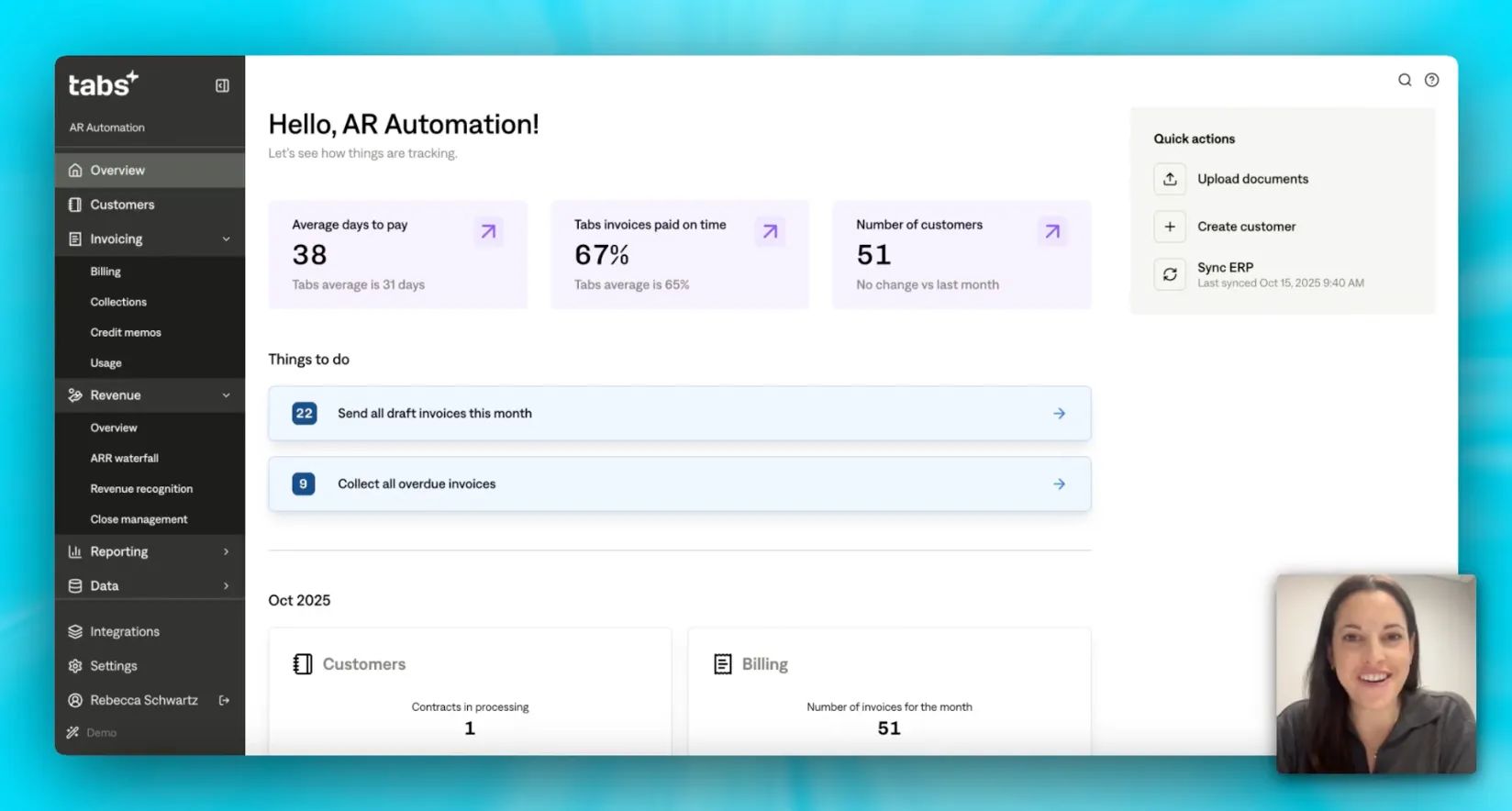
Tabs uses AI to automate the contract-to-cash workflow — not as a bolt-on analytics layer, but as the operational backbone that translates contract terms into accurate billing, intelligent collections, and real-time revenue visibility.
Billing: Tabs automates invoicing directly from contract terms — including usage-based, milestone-based, and hybrid models. AI contract extraction parses billing clauses, payment schedules, and pricing logic from PDFs and documents, eliminating the manual re-keying that causes the invoice errors driving voluntary attrition.
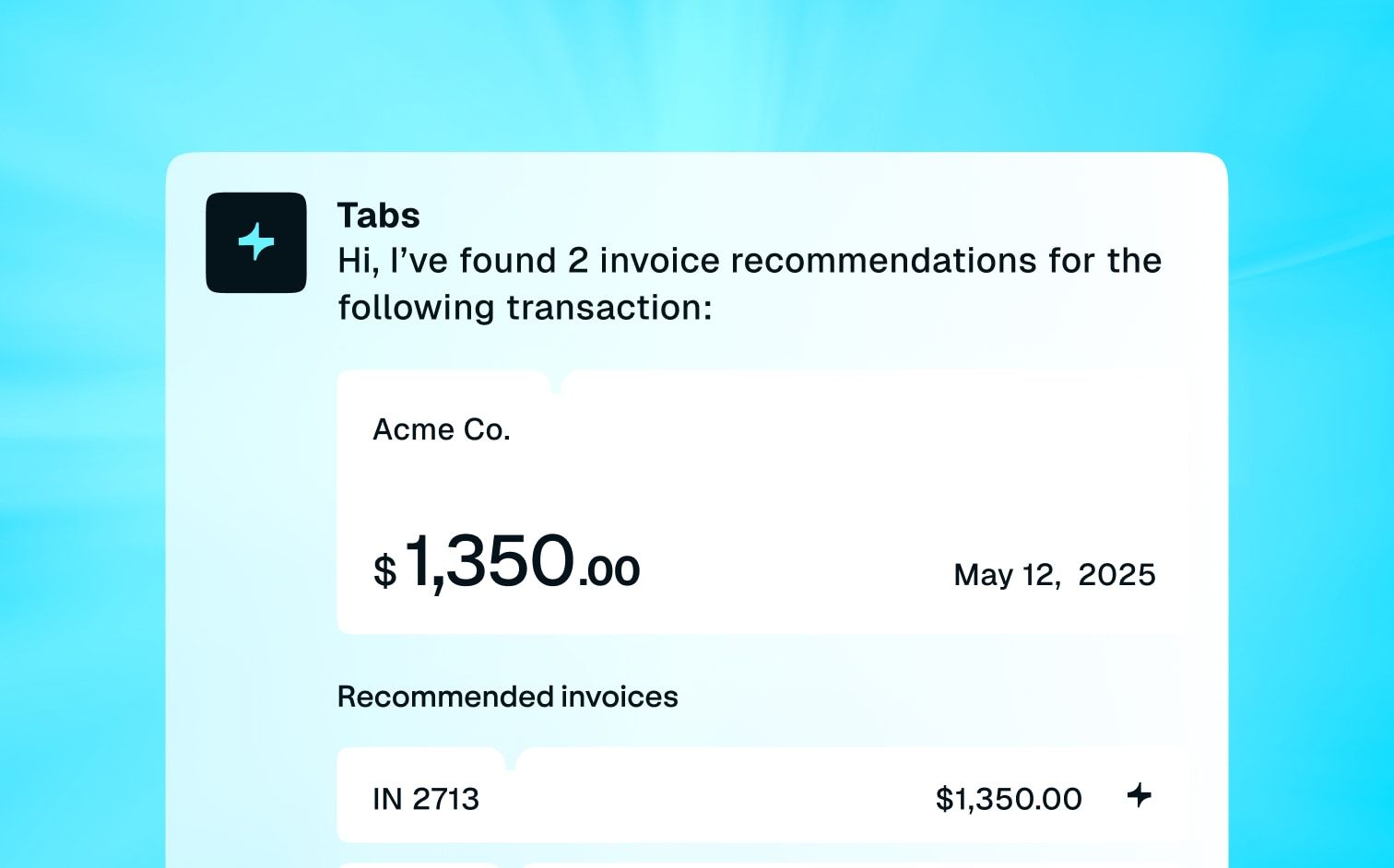
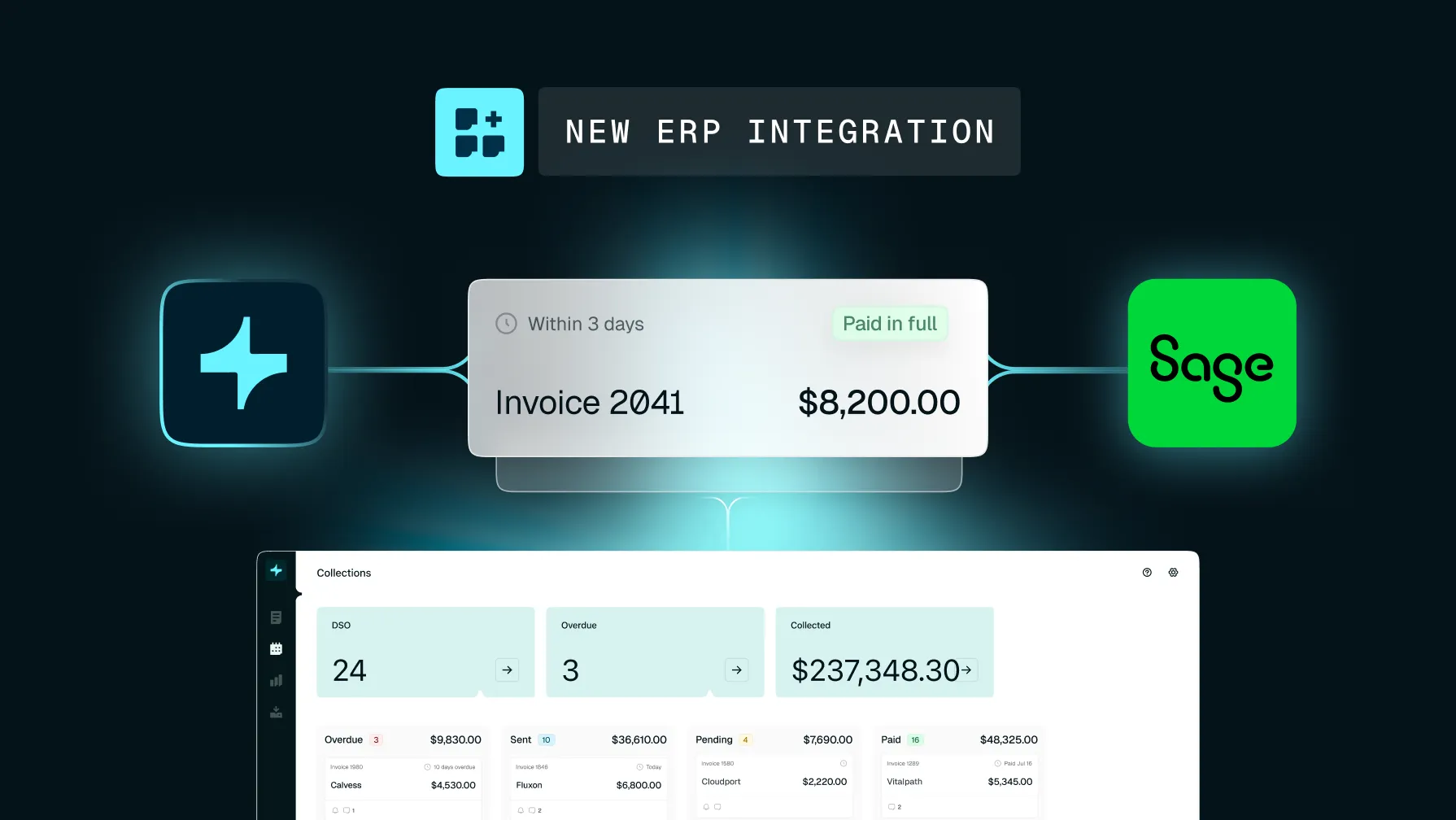
Payments and collections: Smart dunning adapts to each customer's payment behavior — adjusting timing, channel, and escalation based on history, not static rules. A multi-rail payment portal supports ACH, wire, and card payments. AI cash application matches incoming payments to open invoices automatically. And a collections insights dashboard shows aging, risk, and next-best-action in real time.
The results speak for themselves:
- Statsig achieved a 100% reduction in aged receivables and handled 3x their previous invoice volume — without adding headcount
- Cortex reduced overdue invoices by 50%
When billing is accurate, collections are intelligent, and your team has real-time visibility into every account's health — attrition stops being an inevitability and starts becoming a solvable problem.
Frequently asked questions about customer attrition
What is customer attrition?
Customer attrition is the rate at which customers stop doing business with you over a given period. For B2B SaaS companies, it directly impacts MRR, CLV, and the long-term economics of your customer base.
What is the difference between customer attrition and churn?
Attrition is the broader metric — it includes all customer losses over time, including natural contract expirations and non-renewals. Churn typically refers to active cancellations. Finance teams should track both, because the strategies for reducing each are different. Involuntary attrition from payment failures requires infrastructure fixes; voluntary churn from dissatisfaction requires product and relationship investment.
How do you calculate customer attrition rate?
Divide the number of customers lost during a period by the number of customers at the start of that period, then multiply by 100. For example: if you start Q1 with 400 customers and lose 20, your quarterly attrition rate is (20 / 400) x 100 = 5%.
What is a good customer attrition rate for B2B SaaS?
Enterprise B2B SaaS companies typically see annual attrition rates of 5–7%, while SMB-focused products often run higher at 10–15%. But benchmarks vary by pricing model, contract length, and market segment. The most meaningful benchmark is your own quarter-over-quarter trend.
What causes customer attrition?
In B2B SaaS, the most common causes are billing friction and invoice errors, payment failures with inadequate dunning, pricing that doesn't align with value delivery, poor visibility into customer health, and inconsistent collections processes. Many of these are revenue operations problems, not customer success problems.
How can you reduce customer attrition?
Start with your billing and payment infrastructure — automate invoicing, implement smart dunning, and support multiple payment rails to eliminate involuntary attrition. Then align pricing to value delivery, build feedback loops between finance and customer success, and equip your team with real-time revenue data to spot at-risk accounts early.
What are the early warning signs of customer attrition?
Key signals include repeated payment failures, increasing billing disputes, declining product usage, delayed contract renewals, stalled expansion revenue, support ticket spikes followed by silence, and loss of the customer's internal champion. The most reliable indicators combine payment behavior data with usage and engagement signals.