





For finance teams at B2B companies managing complex billing, payments, AR, and revenue recognition workflows, this guide explains how AI reconciliation works, why traditional matching methods fall short, and how contract-aware automation transforms month-end close from a bottleneck into a continuous, confident operation.
What is AI reconciliation?
AI reconciliation is the process of matching bank transactions, invoices, and payments to your general ledger using machine learning instead of rigid, rule-based systems. This means your finance team stops manually hunting for mismatches and starts relying on intelligent automation that adapts to messy, real-world data—an approach 71% of organizations now use in finance operations according to KPMG.
Traditional reconciliation breaks as soon as something unexpected happens. A missing transaction ID. A vendor name that doesn't match exactly. A partial payment against multiple invoices. Rule-based systems flag these as exceptions and route them to your team for manual review.
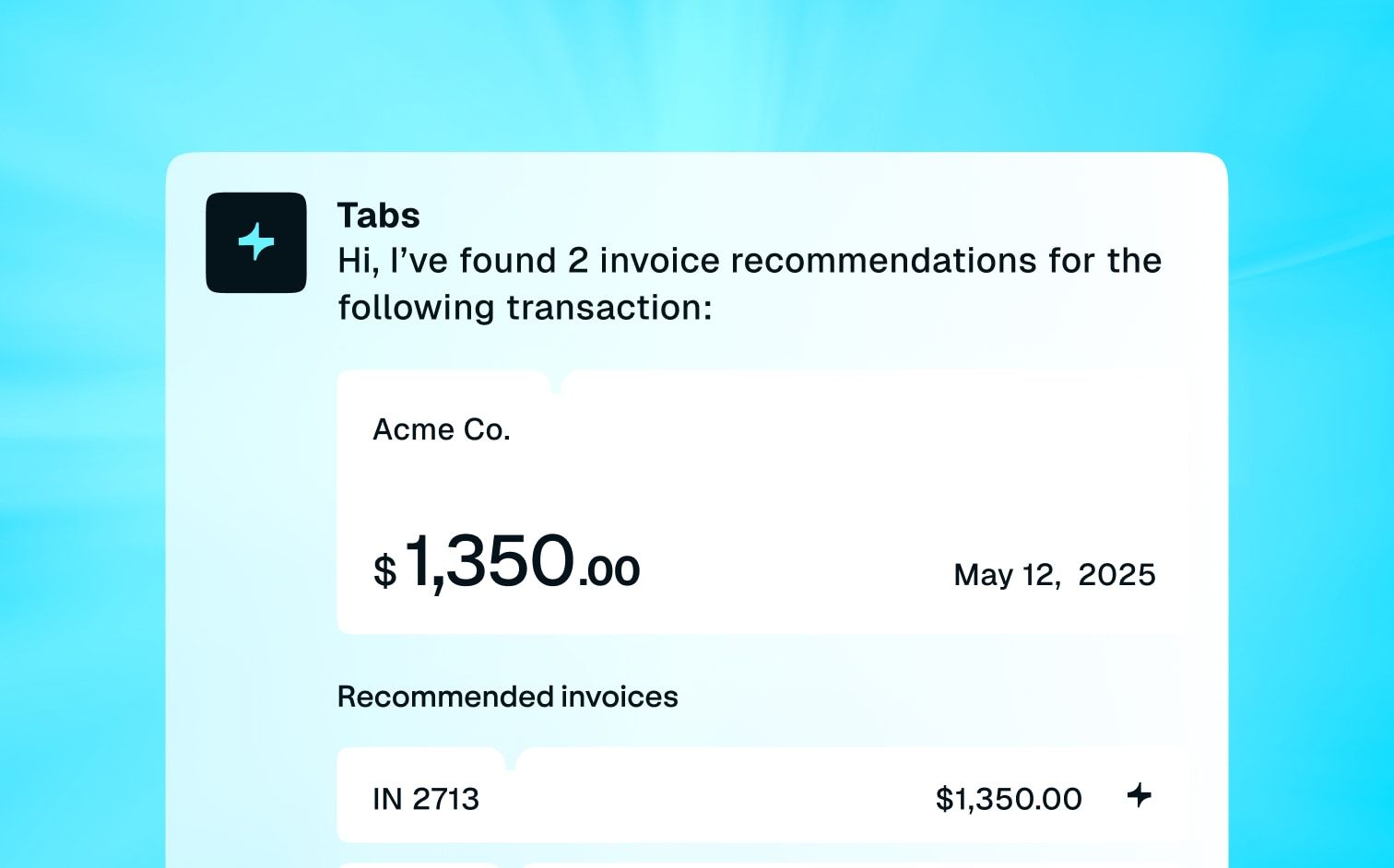
AI bank reconciliation can match many of these edge cases automatically, using trained models to infer likely matches from patterns in payer names, references, amounts, and payment history. For example, it can associate a payment from "ACME GROUP TREASURY" with reference "PAYMENTS MARCH" to three open invoices for "Acme Corp"—even when amounts vary due to early payment discounts or bank fees—then route low-confidence matches for review.
| Traditional reconciliation | AI reconciliation |
|---|---|
| Exact-match rules only | Fuzzy matching with contextual understanding |
| Batch processing at month-end | Continuous, real-time matching |
| Manual exception handling | Automated anomaly detection |
| Breaks on data inconsistencies | Adapts to naming variations and partial payments |
But here's what most AI reconciliation tools miss: they focus on matching transactions without understanding why those transactions exist in the first place. Tabs approaches this differently by starting with the signed contract—, sitting downstream of your CRM and CPQ so reconciliation is grounded in the commercial terms you've already agreed to. When you know the original billing terms, payment schedules, and discount structures, reconciliation becomes dramatically simpler— because you're not guessing at intent.
Why manual and ERP-based matching fail for B2B finance
B2B payments are messy—. 44% of B2B invoices in the United States are now overdue. Your customers don't pay clean, predictable amounts on predictable dates. They pay three invoices with one wire transfer. They take early payment discounts you forgot you offered. They send payments from treasury accounts with names that look nothing like their company name. They pay based on usage, which varies month to month.
Your enterprise resource planning (ERP) system wasn't built for this. Enterprise resource planning systems demand perfect data alignment—exact transaction IDs, precise amounts, matching dates. One missing character breaks the entire match.
And spreadsheets can work—until they don't. Until transaction volume doubles. Until you're reconciling across multiple entities and currencies. Until the person who built the spreadsheet leaves and nobody understands the formulas.
The core problem is that these tools treat reconciliation as a matching exercise divorced from commercial context. They don't know that Invoice #4521 includes a 2% early payment discount if paid within 10 days. They don't know that Customer ABC always pays from a different legal entity than the one on the contract. They just see numbers that don't match and flag exceptions.
Modern revenue automation platforms approach this differently. They don't just match transactions—they apply contract terms, billing logic across models like subscription billing, and historical payment behavior to determine the most likely allocation.
AI reconciliation use cases across contract to cash
AI reconciliation isn't a single feature. It's a set of capabilities that transform how finance teams handle the entire contract-to-cash process.
Automate transaction matching
The most immediate application is intelligent payment matching. AI matches incoming payments to open invoices even when remittance data is incomplete or inconsistent. Using trained models and feedback from your team's corrections, it adapts to customer payment patterns over time—f. For example, associating Customer XYZ with a consistent originating bank account and reference format.
Why it matters: Your team stops spending hours on line-by-line payment matching and starts focusing on actual exceptions that require human judgment.
Streamline data ingestion and normalization
Finance teams receive data from everywhere: bank feeds, payment processors, lockbox files, ACH reports. Each source uses different formats, naming conventions, and reference structures.
AI parses and structures unstructured payment data by extracting key fields (payer, reference, amount, date, invoice hints) without requiring consistent formatting from the sender. It normalizes vendor names, transaction descriptions, and reference codes automatically—building a clean reconciliation database from messy inputs.
Why it matters: You stop manually reformatting data before you can even begin reconciliation.
Unlock intelligent rule suggestions
Static rule engines require you to anticipate every possible scenario upfront. AI analyzes how your team resolves exceptions and recommends new matching rules or model adjustments—subject to review—so similar matches can be automated in the future.
These suggestions improve over time. As transaction volume increases, the system typically increases first-pass match rates and reduces repeat exceptions for your specific edge cases.
Why it matters: Your reconciliation process gets faster over time without requiring constant manual rule configuration.
Scale multi-entity reconciliation
Reconciling across subsidiaries, currencies, and intercompany transactions creates exponential complexity. AI handles the mapping between entities without requiring separate rule sets for each combination.
Why it matters: You can scale operations across new entities without proportionally scaling your finance team.
Detect anomalies and compliance risks
AI flags unusual patterns before they hit your books: duplicate payments, unexpected amounts, timing anomalies that might indicate errors or fraud. This shifts your team from reactive investigation to proactive monitoring.
Why it matters: You catch problems early instead of discovering them during audit prep.
Continuous accounting replaces month-end reconciliation
The traditional month-end close is a sprint. Finance teams spend days—sometimes weeks—matching accumulated transactions, chasing down discrepancies, and manually reconciling across systems. It's stressful, error-prone, and fundamentally reactive.
Continuous accounting flips this model. Instead of batch processing at month-end, AI reconciliation happens in real-time as transactions occur. You see discrepancies immediately and resolve them before they compound.
This changes everything about how finance operates:
- Real-time cash visibility: Know your actual cash position at any moment, not just after reconciliation completes
- Proactive exception management: Address mismatches when they occur, not weeks later during close
- Faster close cycles: Month-end becomes a verification step rather than a production effort
- Earlier anomaly detection: Catch potential issues before they become material problems
The shift from batch to continuous isn't just about speed. It's about confidence. When you're reconciling continuously, you're never surprised by what you find at month-end.
Automate reconciliation with contract-aware AI
How AI reconciliation works for payments and AR
AI reconciliation doesn't follow static rules—it uses trained models to make informed decisions based on historical patterns and contextual signals. Understanding the mechanics helps you evaluate whether a tool will actually work for your business.
Fuzzy matching scores the likelihood that "ACME GROUP TREASURY" and "Acme Corp" refer to the same entity by analyzing naming patterns, payment history, bank account metadata, and other contextual signals. It doesn't require exact matches to make confident connections.
Confidence scoring assigns match confidence levels to each transaction. You set thresholds for auto-posting versus manual review. High-confidence matches post automatically; lower-confidence matches route to your team for verification.
Learning from corrections means the system improves over time. When someone on your team corrects a match, that feedback gets incorporated into future matching logic. The system learns your specific business patterns.
Exception summarization groups related exceptions and provides context on why matches failed. Instead of investigating each exception individually, your team sees patterns and can resolve issues in batches.
The key difference between generic AI tools and purpose-built finance automation is commercial context. A tool that incorporates contract terms, billing schedules, and historical payment behavior typically outperforms one that evaluates transaction data in isolation.
Tabs approach to AI reconciliation
Tabs approaches reconciliation by starting upstream—at the contract. Most reconciliation tools try to match payments to invoices without understanding why those invoices exist. Tabs uses AI to automate key steps across contract-to-cash by powering workflows with the Commercial Graph—an intelligent customer record that unifies signed contracts, usage data, invoices, payments, and terms so those terms translate into accurate billing and Revenue Recognition workflows.
Because Tabs sits downstream of your CRM and CPQ, it captures terms from signed contracts and operationalizes them into invoicing workflows—with validation and approvals where you need them. This means reconciliation starts with clean billing data rather than trying to fix mismatches after the fact.
Here's what commercial context actually means in practice:
- Contract-aware matching: Tabs applies contract terms—including discounts, milestone schedules, usage-based pricing thresholds, and hybrid billing arrangements—when matching and allocating payments, not just invoice totals
- End-to-end visibility: Because Tabs supports billing, collections workflows, and Revenue Recognition, reconciliation benefits from complete transaction context rather than siloed data
- Automatic exception resolution: When Tabs detects common reasons a payment differs from an invoice (early payment discounts, bank fees, or partial payments), it proposes the appropriate accounting treatment and can auto-post within your approval thresholds
This is the difference between a system of record and a system of intelligence. Tabs doesn't just store your data—it encodes the commercial logic behind it and uses that context to automate billing, cash application, and Revenue Recognition workflows.
Integration with ERP and CRM for end-to-end control
Adopting AI reconciliation doesn't mean abandoning your existing finance stack. The best tools connect seamlessly to your current systems, acting as an intelligent layer that orchestrates data flow.
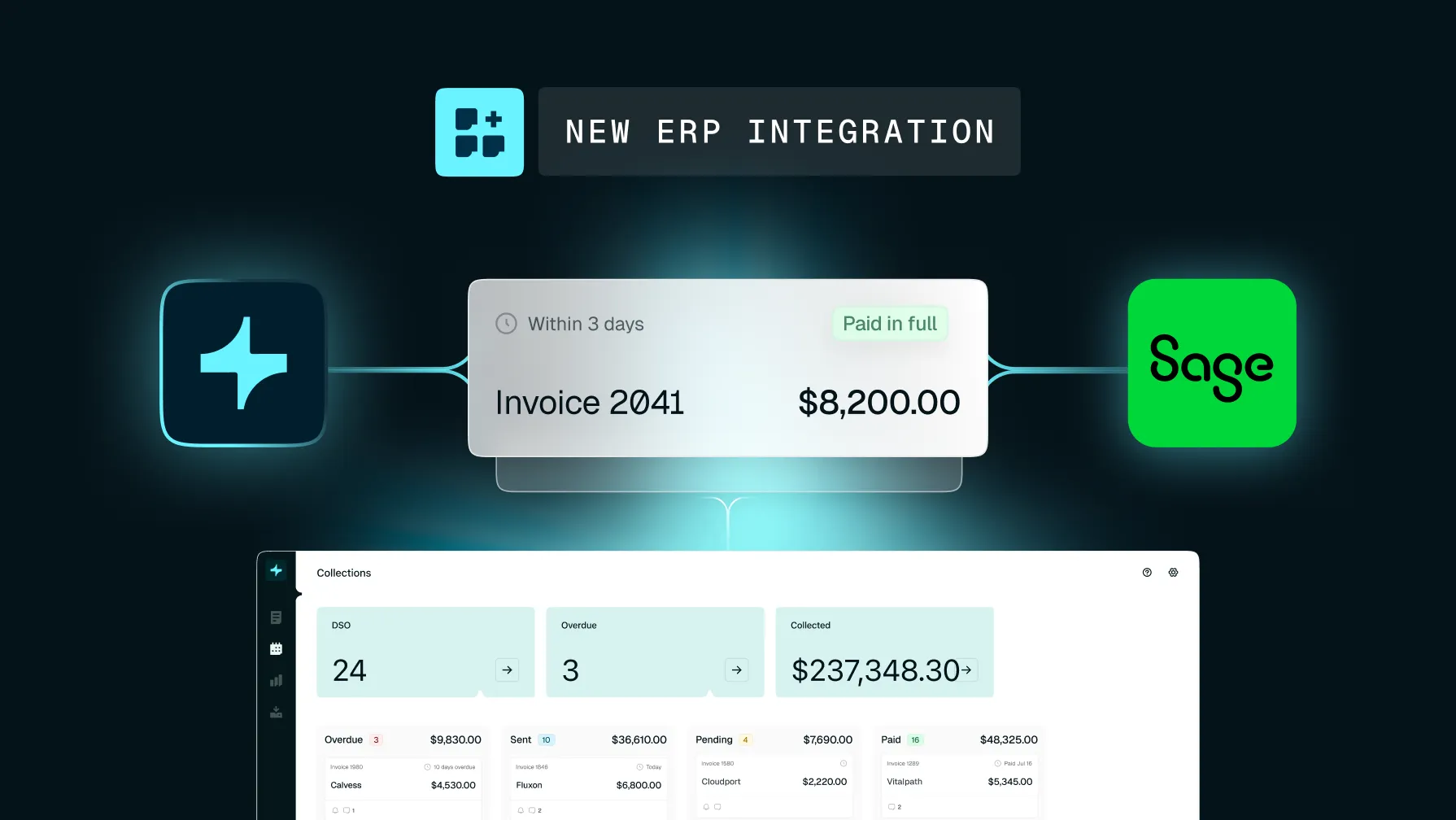
Tabs offers native integrations with major ERPs including QuickBooks, Oracle NetSuite, and Sage Intacct. It also connects to leading CRM systems and provides developer-friendly APIs for custom connections.
What this means practically:
- Native ERP sync: Reconciled transactions post directly to your general ledger with proper coding and documentation
- CRM contract data: Customer and contract information flows from your CRM to inform matching logic
- Bi-directional data flow: Updates in either system reflect across your stack without manual re-entry
- Developer-friendly APIs: Extend reconciliation capabilities or embed them into custom workflows
The goal is making your existing tools more powerful while eliminating the manual work required to keep them synchronized.
Security, auditability, and compliance for finance teams
Finance leaders can't deploy technology that acts as a black box. AI reconciliation must be fully auditable—every match decision traceable, explainable, and verifiable.
Tabs maintains audit-ready security controls designed for finance teams:
- Complete audit trail: Every match, exception, and correction is logged with timestamps, user attribution, and decision rationale
- Explainability: AI match decisions can be reviewed and understood—never hidden behind opaque algorithms
- Access controls: Role-based permissions ensure appropriate separation of duties
- Data security: Encryption at rest and in transit, aligned with SOC 2 controls
Trust is built through transparency. When auditors ask why a specific payment was matched to a specific invoice, you need a clear answer—not a shrug and a reference to "the algorithm."
What to evaluate in AI reconciliation tools
Not all AI reconciliation tools are created equal. When evaluating options, look past the marketing language and focus on what actually matters for your business.
- Match accuracy and explainability: Can the system explain why it matched a transaction? What's the accuracy rate on first-pass matching?
- Integration coverage: Does it connect to your ERP, bank feeds, and payment processors natively, or require custom development?
- Learning capability: Does the system improve over time based on corrections, or rely entirely on static rules?
- Exception handling workflow: How are exceptions surfaced, prioritized, and resolved? Can you set confidence thresholds?
- Scalability: Can it handle your transaction volume today and as you grow across entities and currencies?
- Time to value: How long does implementation take? What's required from your team during setup?
- Auditability: Is there a complete audit trail? Can you demonstrate compliance to auditors?
Speed is table stakes. Cleanliness is the differentiator. The right AI reconciliation tool doesn't just match faster—it matches accurately, learns continuously, and gives you confidence in every close.
From month-end bottleneck to continuous close
AI reconciliation changes the role of finance teams from manual processors to strategic partners. The goal isn't just faster matching—it's better visibility, fewer errors, and more time for analysis that actually moves the business forward.
When you unify your contract-to-cash process with intelligent automation, month-end transforms from a bottleneck into a seamless, continuous operation. Your team stops chasing exceptions and starts providing the insights leadership actually needs.
Frequently asked questions
Will AI reconciliation replace accountants on my finance team?
AI handles routine matching and flags exceptions, but human judgment remains essential for complex cases, policy decisions, and final approval. The goal is augmentation—freeing your team from manual work so they can focus on higher-value analysis. Deloitte's Q4 2025 CFO Signals survey found that 49% of CFOs cite automating processes for higher-value work as their top finance talent priority.
Which ERP systems does Tabs integrate with for AI reconciliation?
Tabs offers native integrations with QuickBooks, Oracle NetSuite, and Sage Intacct, alongside leading CRM systems. The platform also provides developer-friendly APIs to connect custom tools and extend functionality across your entire finance stack.