





As usage-based pricing becomes the norm, reconciliation remains one of the most time-consuming bottlenecks in the month-end close. This guide explains how AI reconciliation works, where it delivers the greatest impact across billing, payments, AR, and revenue recognition, and how to measure success as you move from manual spreadsheet work to intelligent automation.
What is AI reconciliation?
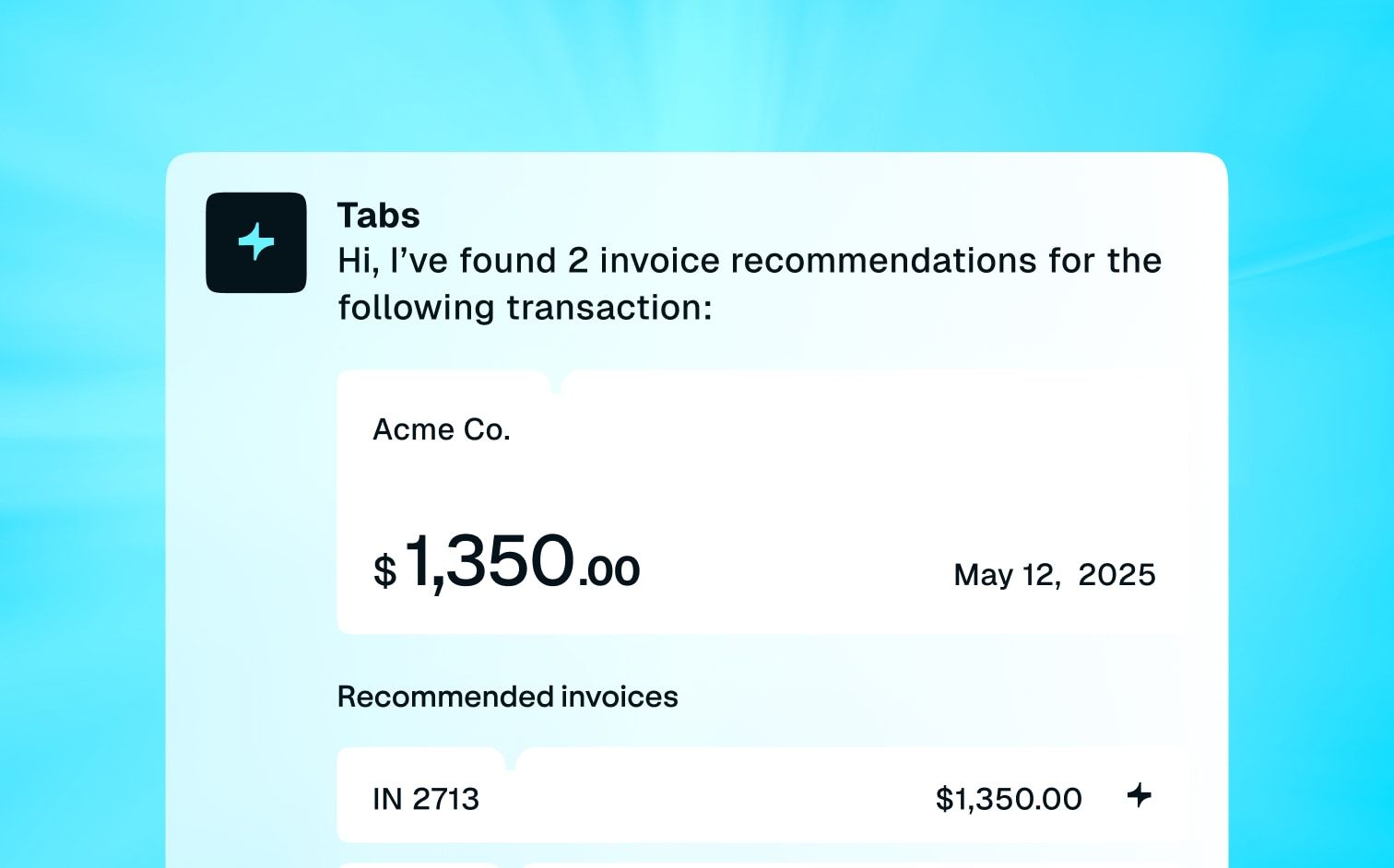
AI reconciliation is the use of artificial intelligence to automatically match, verify, and analyze financial data across multiple systems. This means you can connect your bank statements, invoices, payment processor reports, and general ledger to reconcile them—without manual spreadsheet work.
Traditional reconciliation relies on exact matches. If a reference number is off by one character, the system breaks. AI-powered reconciliation uses trained models and pattern recognition to handle messy, real-world data. As your team resolves exceptions, those resolutions become labeled outcomes the models use to improve future matching and routing.
The difference matters most for B2B companies with complex billing. When you're dealing with usage-based pricing, hybrid contracts, and multi-entity structures, rigid rule-based matching simply can't keep up. But matching numbers is only half the problem.
Tabs provides commercial context—mapping contract terms to billing and revenue workflows so reconciliation reflects the business implications of each agreement, not just isolated figures. Because Tabs sits downstream of CRM and CPQ and operationalizes the signed contract as your system of intelligence, it translates terms into billing workflows and revenue recognition-ready data. Downstream reconciliation starts from the agreement, not a spreadsheet interpretation.
How AI reconciliation works across finance systems
AI reconciliation follows a clear sequence: ingest raw data, normalize it into a standard format, apply trained models to find matches, and flag exceptions for human review. Unlike static if-then rules, these systems improve over time as model training data expands—boosting match confidence, reducing exceptions, and improving routing based on prior resolutions.
The process connects four primary data sources:
- Bank feeds: Direct connections to financial institutions via standard formats like BAI2 or MT940
- Payment processors: Settlement reports from gateways that show gross revenue, fees, and net deposits
- ERPs: Your core accounting system where the final general ledger resides
- Invoices: Billing records generated from customer contracts
Technologies shaping AI reconciliation
Several technologies work together to power modern reconciliation. Machine learning algorithms improve matching accuracy by analyzing historical patterns. Natural language processing (NLP) extracts structured fields from unstructured remittance advice and email threads—like invoice numbers, amounts, and dispute notes. Optical character recognition (OCR) converts scanned documents into searchable data.
The industry is also shifting toward continuous accounting—updating books daily rather than in a month-end batch. This requires real-time data processing and anomaly detection that flags unusual patterns before they compound into larger problems.
Why it matters: These technologies reduce the manual hunting that typically consumes your team's time during close.
Accelerate your close with AI reconciliation
Manual reconciliation vs AI-powered reconciliation
Many finance teams still rely on spreadsheets to tie out accounts at month-end. Spreadsheets offer flexibility, but they introduce compliance risk and manual touchpoints that slow down the entire organization. Maintaining proper segregation of duties gets harder when multiple accountants edit the same workbook—especially when approvals and evidence live in email threads.
Speed is table stakes. Cleanliness is the differentiator.
| Feature | Manual reconciliation | AI-powered reconciliation |
|---|---|---|
| Matching approach | Exact matches via VLOOKUP | Fuzzy matching based on patterns |
| Error rate | High risk of broken formulas | Low error rate with continuous learning |
| Cycle time | Days or weeks at month-end | Real-time or daily processing |
| Scalability | Requires more headcount | Handles volume increases automatically |
| Audit readiness | Fragmented evidence across files | Centralized, immutable audit trails |
| Exception handling | Reactive hunting for data | Proactive routing with context |
Benefits of AI reconciliation for finance teams
B2B revenue complexity creates a massive administrative burden for accounting teams trying to scale. Usage-based pricing, hybrid contracts, and multi-entity structures make cash application and cash visibility hard to scale without intelligent automation.
- Faster month-end close: Automated matching eliminates the backlog of transactions waiting for review, enabling same-day cash posting
- Reduced days sales outstanding (DSO): Matching payments to invoices faster gives you real-time visibility into outstanding balances
- Audit-ready trails: Every automated match and human intervention is logged, creating transparency that satisfies compliance requirements
- Scalable throughput: Your team can process thousands of complex transactions without adding headcount
AI reconciliation use cases in B2B contract-to-cash
Reconciliation friction compounds across the entire contract-to-cash lifecycle. What starts as a minor billing discrepancy quickly snowballs into a headache during revenue recognition. Here's where AI makes the biggest impact.
Payment-to-invoice matching in accounts receivable
Matching incoming cash to open invoices is rarely straightforward in B2B. Customers frequently omit reference numbers, combine multiple invoices into one payment, or short-pay due to disputes. AI parses remittance data and applies fuzzy matching to connect partial payments to the right customer and invoice set—even when the remittance data is incomplete.
Why it matters: Cash gets applied correctly without hours of manual detective work.
Processor payout and fee reconciliation
Payment gateways deposit net amounts while you need to record gross revenue. Reconciling settlement reports requires separating the core payment from interchange fees, chargebacks, and refunds before posting to the ERP. AI automatically parses these complex reports and routes each component to the correct account.
Why it matters: You eliminate manual journal entries for thousands of credit card transactions.
Funds-in-transit tracking and cash clarity
Timing mismatches between when a payment is initiated and when it hits your bank account create blind spots in cash positioning. AI tracks funds-in-transit across multiple systems and payment gateways, eliminating the end-of-month scramble to figure out which deposits belong to which accounting period.
Why it matters: Treasury teams gain accurate, real-time visibility into working capital.
Multi-entity and intercompany reconciliation
Growing B2B companies often operate across multiple subsidiaries, requiring complex intercompany eliminations. AI handles currency conversion and entity resolution automatically, ensuring that a payment collected by a U.S. entity on behalf of a U.K. subsidiary is properly recorded and eliminated during consolidation.
Why it matters: Corporate close no longer gets delayed by manual consolidation work.
Anomaly detection and exception workflows
Not every transaction should be matched automatically. AI protects your control framework by identifying outliers—duplicate payments, unexpected variances, potential fraud—that require human judgment. When an exception occurs, the system routes it to the appropriate reviewer with all necessary context attached.
Why it matters: Your team maintains oversight without getting bogged down in routine matching.
Implementation best practices for AI reconciliation
You cannot plug an AI tool into a broken process and expect perfect results. A successful rollout depends on clean data, clear governance, and a phased approach.
- Start with high-volume reconciliations: Target the specific accounts—like payment gateways—that consume the most manual hours during close
- Establish a single source of truth: Designate one system as the final destination for all reconciled data
- Define exception thresholds early: Set clear materiality thresholds so the system knows when to auto-clear and when to route for review
- Plan for change management: Conduct thorough testing and clearly define roles so your team understands how daily tasks will shift
KPIs for AI reconciliation programs
You cannot improve what you do not measure. Finance leaders must track specific metrics to validate return on investment—KPMG's 2024 AI in Finance report found that 92% of companies report their finance AI initiatives are meeting or exceeding ROI expectations.
Match rate and auto-clear percentage
Match rate measures the percentage of transactions paired without human intervention. A high first-pass match rate—the share of transactions that auto-match on the first attempt—is the primary driver of scalability. Tracking this metric over time shows how well the system adapts to your specific data patterns.
Exception rate and time-to-resolution
Exception rate tracks how often the system flags a transaction for manual review. Monitoring average time-to-resolution identifies bottlenecks in your team's workflow. Lower rates and faster resolution signal a well-tuned system.
Close cycle time and DSO impact
The ultimate test is how reconciliation efficiency impacts broader financial metrics. Faster matching directly reduces days to close, giving leadership quicker access to accurate reporting. It also lowers Days Sales Outstanding (DSO) by enabling faster collections—critical as PwC research indicates DSO has increased globally by 6.6% over the past five years.
How Tabs automates reconciliation across contract-to-cash
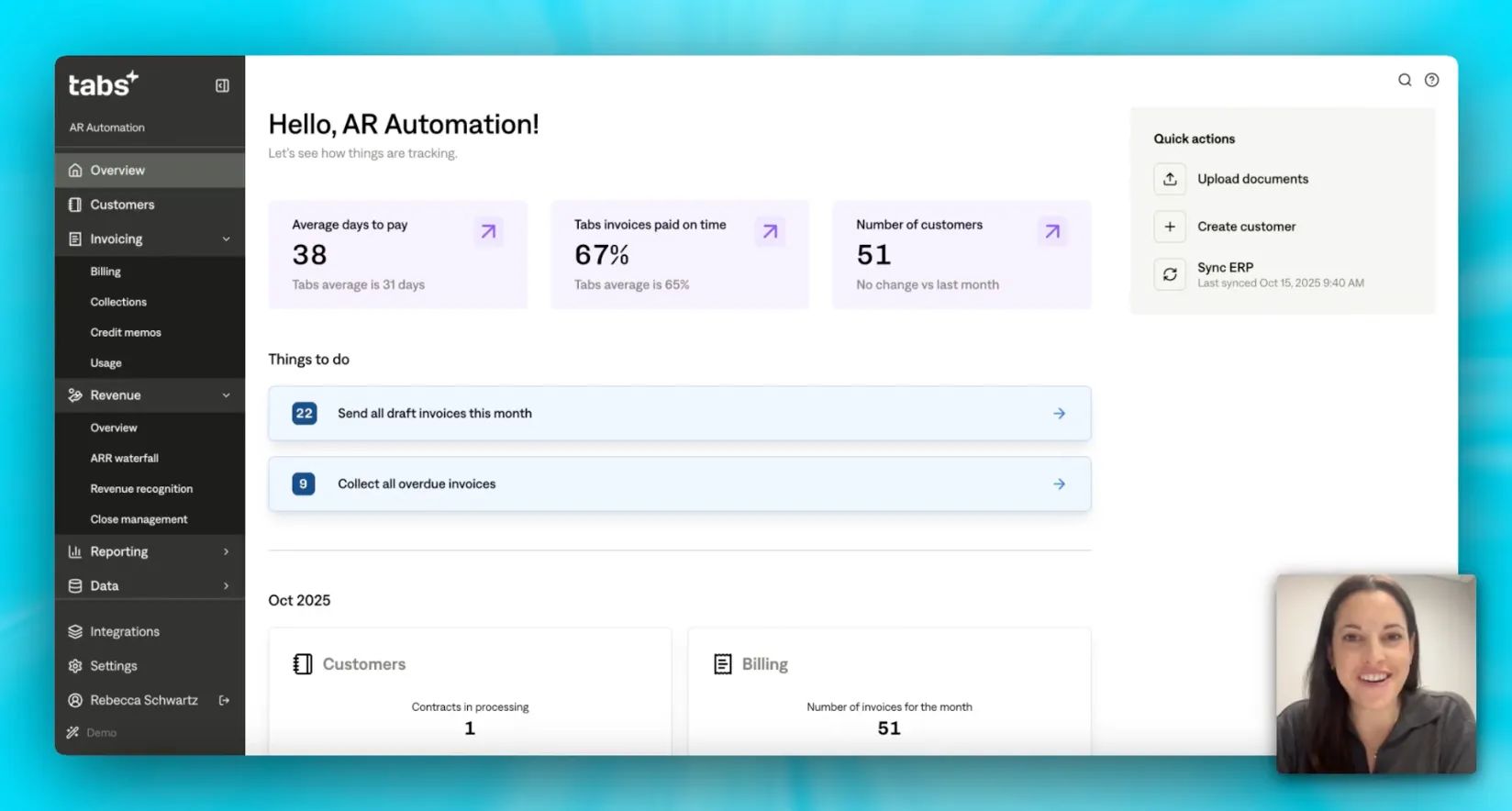
Fragmented tech stacks force finance teams to stitch together data from CRMs, billing tools, and ERPs. Tabs eliminates this friction by sitting downstream of CRM and CPQ and operationalizing the signed contract as the source of truth—so when a payment arrives, Tabs can map it to the right customer, invoices, and contract terms based on structured agreement data and billing logic.
- AI contract ingestion: Automatically captures terms, dates, and pricing structures directly from signed agreements
- Automated invoicing: Generates accurate bills for subscription, usage-based, or hybrid models based on ingested contract data
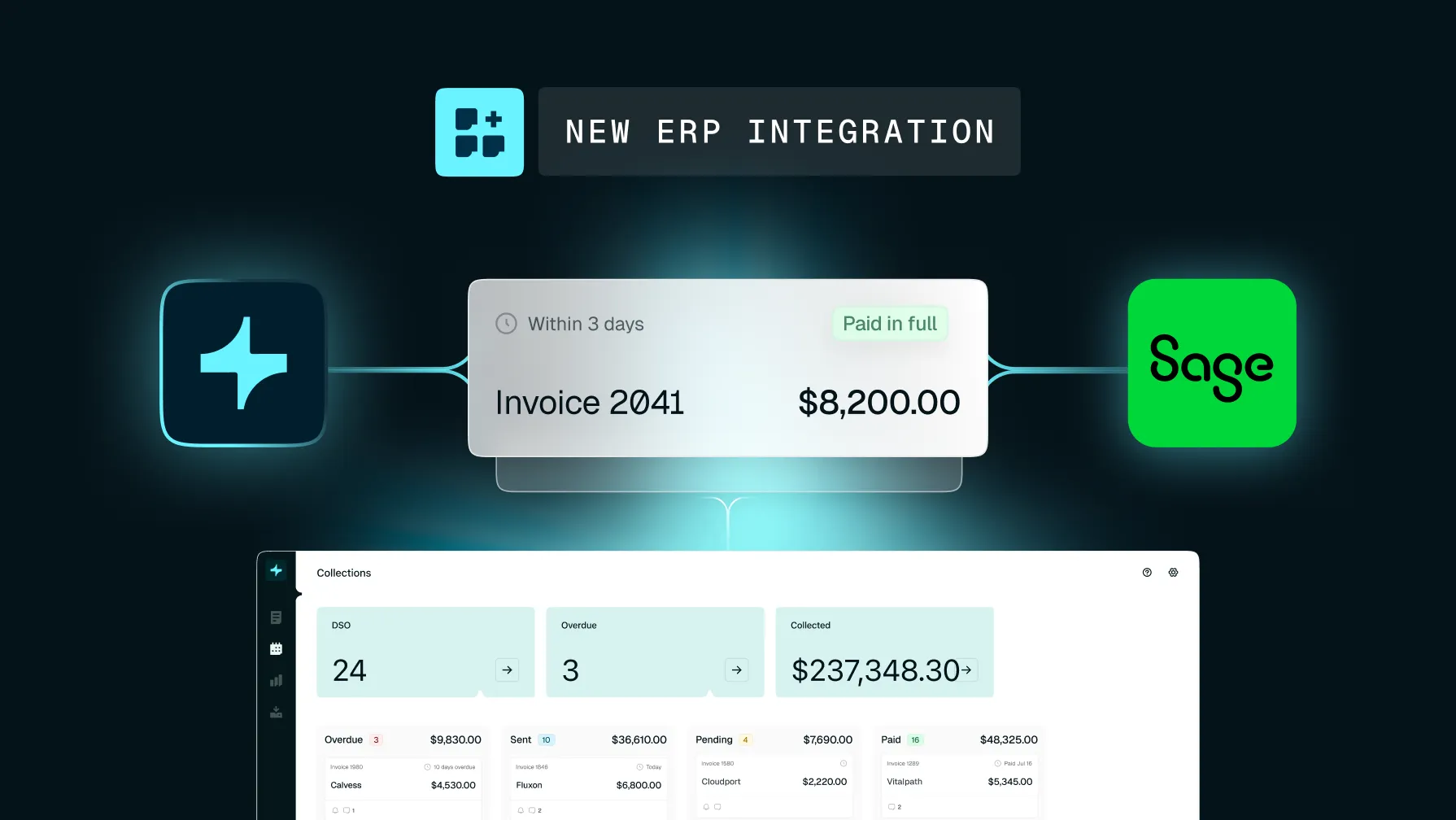
- Collections and payment tracking: Embeds payment links and automatically matches incoming cash to the correct invoice
- Unified audit trail: Maintains SOC 2-compliant, audit-grade transparency from contract signature to final GL posting
Frequently asked questions
Does AI reconciliation work with usage-based and hybrid billing models?
Yes. AI reconciliation can handle variable transaction volumes and complex billing structures—including seat-based, usage-based, subscription, and hybrid models—and typically requires less custom configuration than rule-based matching, because models adapt to your historical exceptions.
How does AI reconciliation handle processor fees, refunds, and chargebacks?
AI parses settlement reports, separates gross from fees and adjustments, and helps you post each component to the right general ledger account. (See "Processor payout and fee reconciliation" above for workflow detail.)
What KPIs should finance teams track to measure AI reconciliation success?
Track match rate, exception rate, time-to-resolution, and close cycle time as the primary indicators that your reconciliation program is driving efficiency.
Why AI reconciliation is becoming the new operating model
Intelligent automation is no longer just a tool for working faster—it's a fundamental shift in how finance operates. The industry is moving away from reactive, batch-processed month-end closes toward continuous accounting and real-time cash visibility.
Modern CFOs recognize that relying on manual processes for mission-critical revenue data limits business growth—Deloitte's Q4 2025 CFO Signals survey found that 87% of CFOs expect AI to be extremely or very important to their finance operations in 2026.
When your finance infrastructure isn't the bottleneck, the entire company moves faster. Pricing teams can iterate. Product can monetize new capabilities immediately. And finance becomes a strategic partner rather than a catch-all for downstream chaos.
Tabs provides the commercial context and Revenue Automation necessary to make this proactive operating model a reality.
Explore how Tabs can help you go live in <30 days.