






For finance and accounting teams at B2B companies managing complex billing, payments, and Revenue Recognition workflows, AI is transforming accounts receivable from a manual, error-prone process into an automated system that accelerates cash collection and delivers clean books. This guide covers how AI-powered AR works, the specific workflows it automates, implementation best practices, and what modern finance leaders need to know to evaluate and adopt these capabilities.
What is AI in accounts receivable
AI in accounts receivable uses machine learning and natural language processing to automate large portions of the invoice-to-cash cycle—while routing true exceptions to your team. This means your finance team stops manually entering data, chasing payments, and reconciling spreadsheets—and starts focusing on work that actually requires human judgment.
Traditional AR automation follows rigid rules. If a payment doesn't match an invoice exactly, the system flags it for manual review. AI works differently. It uses trained models to learn from historical payment patterns, extract data from messy documents like PDFs and emails, and classify and route exceptions based on prior outcomes and available context.
But here's what separates useful AI from generic automation: commercial context. Extracting contract terms is increasingly straightforward. Understanding what those terms mean for your billing logic, Revenue Recognition, and cash collection—that's the hard part.
Tabs uses AI in accounts receivable to translate contract language into accurate billing workflows. When a contract includes usage thresholds, milestone triggers, or escalation clauses, Tabs doesn't just capture that data. It operationalizes it—turning complex terms into invoices that reflect what you actually agreed to with your customer.
The core technologies powering this shift include:
- Machine learning: Identifies payment patterns and predicts when customers will actually pay based on their historical behavior, not just when invoices are due.
- Natural language processing: Reads contracts, emails, and remittance advice to extract terms without requiring manual review or re-keying.
- Predictive analytics: Forecasts cash inflows and flags accounts likely to pay late before they become overdue.
These technologies work together to create what modern finance leaders need: a system of intelligence—not just a system of record.
How AI automates accounts receivable processes
Every AR team knows the pain of manual processes. You're matching payments to invoices line by line. You're copying contract terms into billing systems by hand. You're sending collection emails one at a time, hoping customers respond.
AI changes this by handling repetitive work and routing the exceptions that truly need your attention.
Why this matters: Most AR teams spend hours matching payments to invoices and chasing down discrepancies. AI can increase straight-through processing and shorten time-to-close by pushing only true exceptions to your team.
The contract-to-cash process contains dozens of micro-steps that traditionally require someone to touch them. AI automates these steps with higher accuracy and speed than manual processes allow.
Invoice generation is where many billing errors originate. When someone manually reads a contract PDF and enters terms into a billing system, mistakes happen. AI reads signed contracts and creates invoices that reflect actual terms—including seat-based billing, usage thresholds, milestone triggers, and escalation clauses that are easy to miss.
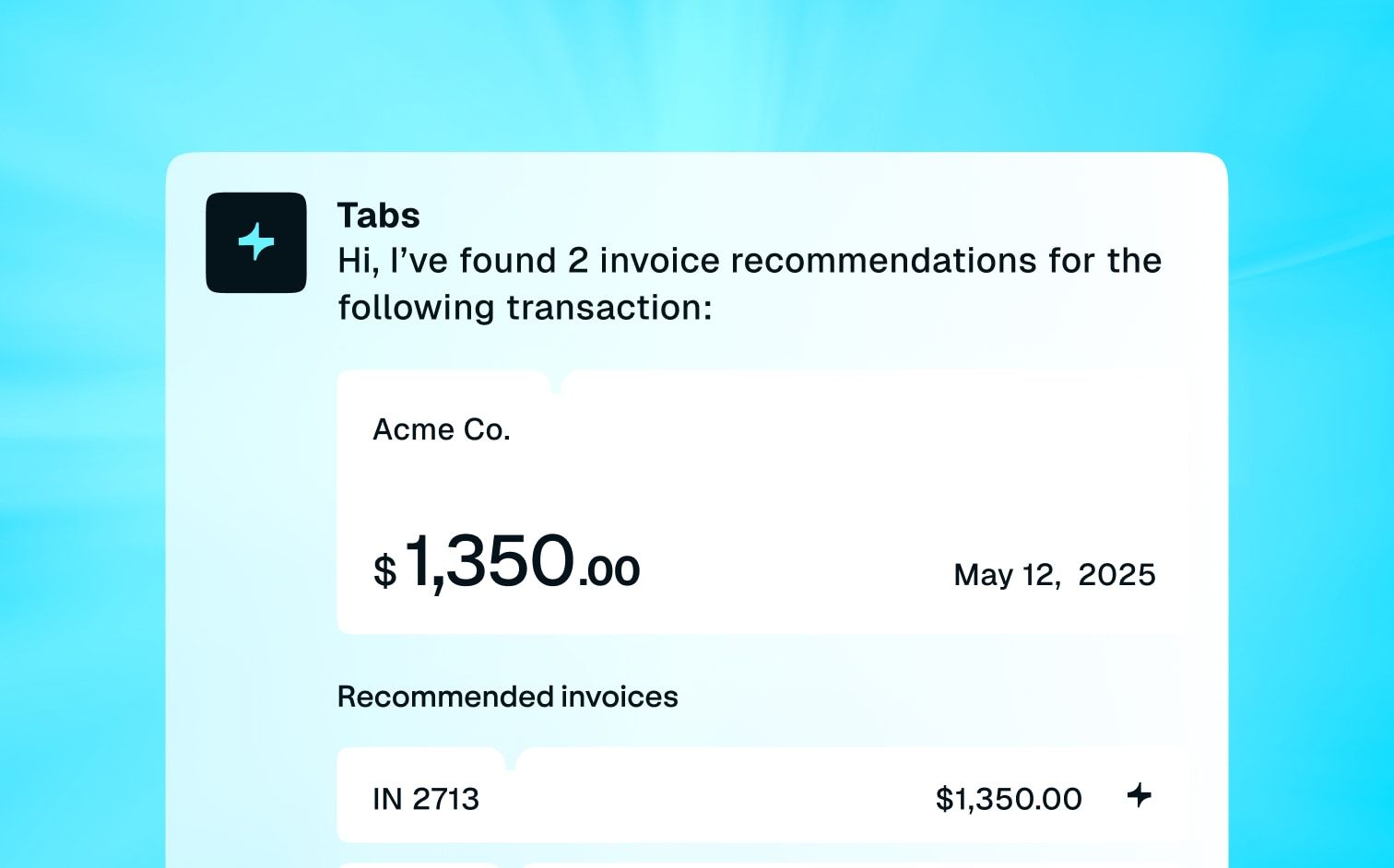
Cash application is the most time-consuming AR task for many teams. When a customer sends a single wire payment covering multiple invoices, someone has to untangle which amounts apply where. AI parses bank files, emails, and PDFs to match payments to open invoices without manual intervention—EY's research on Ford shows AI-powered AR can achieve over 90% auto-cash application rates.
Collections prioritization determines whether your team spends time on accounts that will pay anyway or focuses on the ones that need attention. AI ranks overdue accounts by likelihood to pay, enabling collectors to focus on high-impact outreach rather than working through a list chronologically.
Dispute management catches problems before they escalate. AI flags short payments and deductions, identifies root causes, and routes exceptions to the right team member—instead of letting discrepancies sit unnoticed until month-end close.
Tabs sits downstream of your CRM and configure, price, quote (CPQ) systems to operationalize signed contracts. Your sales team closes deals the same way they always have. Tabs ingests the finalized contract data and translates it into accurate billing logic, ensuring invoices are right the first time.
Automate invoice-to-cash with Tabs
Benefits of AI for accounts receivable
Speed is table stakes. Clean books are the differentiator.
The best finance teams don't just close faster—they close with clarity. No last-minute surprises. No revenue reinstatements. No awkward conversations with auditors about why invoices don't match contract terms.
When you eliminate manual data entry from your AR process, you fundamentally change the economics of your finance department. The benefits extend beyond time savings to impact your cash position, customer relationships, and ability to scale.
Faster cash collection comes from automated dunning and payment reminders. Instead of relying on someone to remember to follow up, the system sends context-aware reminders based on each customer's payment history and communication preferences.
Accurate cash forecasting shows when cash will actually land—critical for subscription-based billing and other recurring revenue models—not just when invoices are due. Modern revenue automation platforms analyze historical payment behavior and contract terms to predict collection timing—giving you the confidence to make capital allocation decisions.
Reduced manual effort frees your team from reconciliation work. Touchless cash application eliminates hours of spreadsheet matching each week, letting your AR team focus on complex disputes and strategic analysis.
Fewer billing disputes result from invoices generated directly from contract terms. When your invoice accurately reflects what you agreed to with your customer, you eliminate the errors that trigger pushback and delayed payments.
| AR function | Manual process | AI-powered automation |
|---|---|---|
| Cash Application | Line-by-line spreadsheet matching | Touchless reconciliation from bank files and remittance data |
| Forecasting | Based on static invoice due dates | Based on historical customer payment behavior |
| Invoicing | Manual data entry from PDF contracts | Automated generation from extracted contract terms |
| Collections | Chronological outreach to all overdue accounts | Risk-scored prioritization for targeted outreach |
These improvements directly impact your Days Sales Outstanding (DSO). EY reports that AI-powered collections can deliver a 30% improvement in DSO. When invoices are accurate and delivered promptly, customers pay faster. When cash application happens instantly, your AR balance reflects reality—giving modern CFOs the confidence to make strategic decisions.
How to implement AI for accounts receivable
You don't need to rip out your existing finance stack to implement AI. The most successful deployments layer intelligence over current systems, driving immediate value without disrupting ongoing operations.
TL;DR: You don't need perfect data to start. Focus on one high-impact workflow, measure results, and expand from there.
Audit your data first. Identify where contract terms, invoices, and payment records live today. Are they in your CRM? Your ERP? Email threads? Understanding your current state helps you prioritize what to automate and where data quality issues might create problems.
Prioritize high-volume workflows. Start with cash application or dunning—areas where automation delivers immediate time savings. These workflows are repetitive, error-prone, and consume significant AR team bandwidth. Quick wins here build momentum for broader adoption.
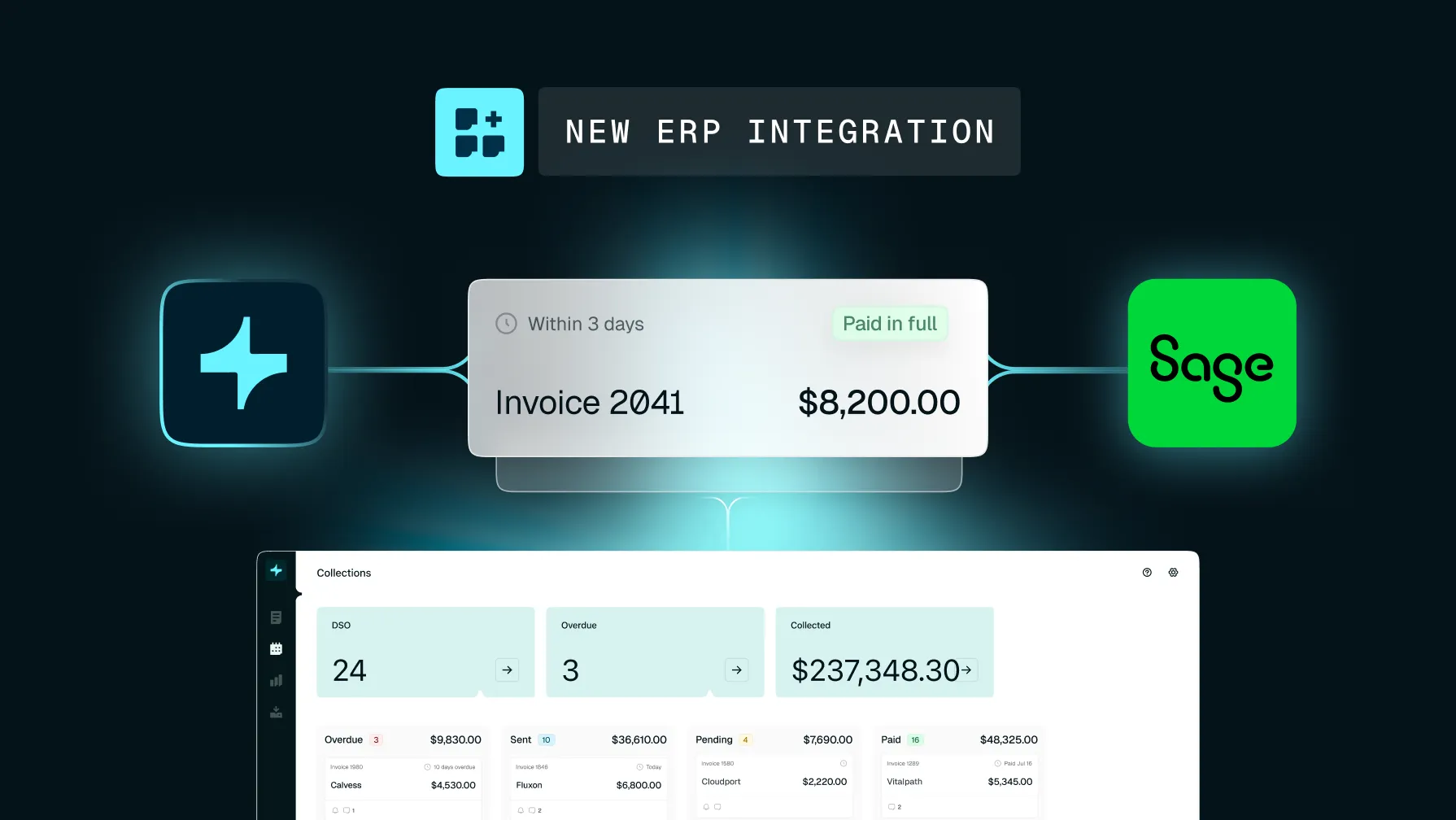
Ensure ERP and CRM integration. Choose a platform with native connectors to your existing finance stack. Tabs integrates with systems like NetSuite, QuickBooks, and Sage Intacct, synchronizing contract, billing, and payment data across your finance stack—without changing how your sales team operates.
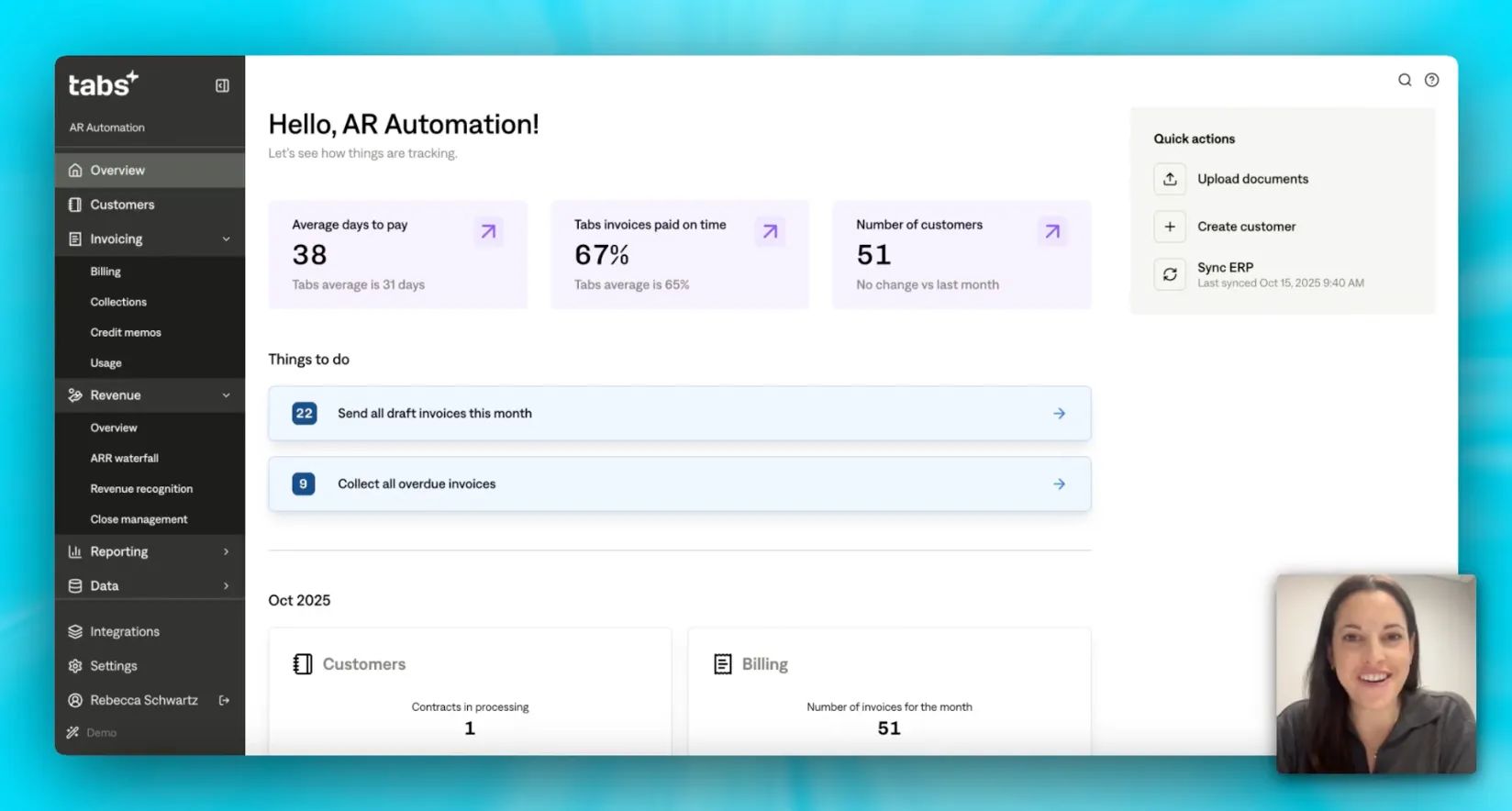
Define success metrics before you start. Track DSO, straight-through processing rate (the share of payments applied without a manual touch), and time-to-close before and after implementation. Without baseline measurements, you can't demonstrate ROI or identify areas for improvement.
Plan for exceptions. Establish human-in-the-loop workflows for disputes and edge cases that require judgment. AI handles the routine work, but your team still needs clear processes for the situations that require human expertise.
Change management matters as much as technology selection. Clearly communicate that AI exists to handle repetitive matching, not to replace financial expertise. When your team understands that automation frees them to focus on complex dispute resolution and strategic analysis, adoption rates increase dramatically.
Challenges of AI in accounts receivable
Transitioning to AI-powered revenue operations comes with real obstacles. Understanding these challenges helps you choose the right technology partner and set realistic expectations.
Data quality limits accuracy. AI learns from your historical data. If your contract terms are scattered across email threads, your payment records are incomplete, or your customer data is inconsistent, the AI will struggle to make accurate decisions. Garbage in, garbage out applies here as much as anywhere.
Integration complexity varies widely. Connecting AI to modern cloud ERPs is straightforward. Connecting to legacy systems or homegrown databases requires more configuration. Evaluate your current tech stack honestly before committing to an implementation timeline.
Explainability matters for compliance. Finance teams need to understand why AI made a decision, especially during audits. If you can't explain how an invoice was generated or why a payment was applied a certain way, you have a compliance problem. Look for platforms that provide audit-grade transparency into every automated decision.
Change management requires investment. AR teams may resist automation if they fear job displacement rather than augmentation. Address this directly by showing how AI handles the tedious work while creating opportunities for more strategic contributions.
Tabs addresses these challenges through transparent audit trails and flexible integrations. You always maintain visibility into how contract terms translate into billing actions, ensuring you can explain every automated decision to an auditor or customer.
Data silos present another major obstacle for B2B companies with complex pricing structures. If your consumption data lives in a proprietary product database while your contracts live in a CRM, generic AI cannot reconcile them. Overcoming this requires a platform specifically designed to unify disparate revenue streams into a single, coherent view of each customer relationship.
Future trends in AI for accounts receivable
The landscape of B2B finance is shifting as technology evolves. Forward-thinking teams are preparing for the next wave of revenue automation.
AI Agents are a major shift on the horizon. KPMG's Global AI in Finance report found that organizations deploying agentic AI for finance outperform others by 32 percentage points on average. Agentic AI proactively manages workflows—sending reminders, escalating issues, and resolving disputes without requiring someone to initiate each action. This moves finance from reactive to proactive.
Real-time payments are accelerating globally. As payment rails (the networks that move money) speed up, AR systems must match payments to invoices instantly. The gap between when a customer pays and when that payment is reconciled will shrink from days to seconds.
Embedded finance builds billing and collections capabilities directly into the products customers use. Instead of sending invoices through email, companies will surface payment options within their own applications—reducing friction and accelerating collection.
Conversational interfaces let finance teams query AR data through natural language. Instead of building reports manually or navigating complex dashboards, you'll ask questions and get answers immediately.
These advancements will blur the lines between product, sales, and finance operations. When systems communicate seamlessly, Revenue Recognition becomes a continuous, automated process rather than a frantic month-end scramble.
The companies that build intelligent revenue infrastructure today will be positioned to take advantage of these capabilities as they mature. Those still relying on manual processes and disconnected systems will find themselves falling further behind.
Frequently asked questions
How does AI for accounts receivable connect to existing ERP systems like NetSuite or QuickBooks?
Modern AR platforms offer native connectors to major ERPs including NetSuite, QuickBooks, and Sage Intacct. Tabs provides pre-built integrations and developer-friendly APIs for custom connections, allowing you to layer intelligence over your existing finance stack without replacing it.
Will AI for accounts receivable eliminate AR team jobs?
AI augments AR teams by handling repetitive tasks so collectors can focus on strategic work like relationship management and complex negotiations. The goal is higher productivity per person, not headcount reduction—your team spends less time on data entry and more time on work that requires human judgment.