





For finance teams at B2B companies managing complex billing models, manual payment matching drains hours from strategic work and inflates DSO. This guide explains how AI cash application automates the match between incoming payments and open invoices, covering the core challenges, how the technology works, and what capabilities to prioritize when evaluating solutions.
What is AI cash application?
AI cash application is the use of machine learning to automatically match incoming payments to open invoices. This means your finance team no longer has to manually hunt down remittance details, cross-reference spreadsheets, or guess which invoices a payment should close—EY reports that 80–90% of manual processes can now be automated.
The core problem is simple: payments arrive with incomplete, inconsistent, or missing information. A wire transfer hits your bank account with no context. A check references an internal PO number instead of your invoice number. Your AR team spends hours piecing together what should be a straightforward reconciliation.
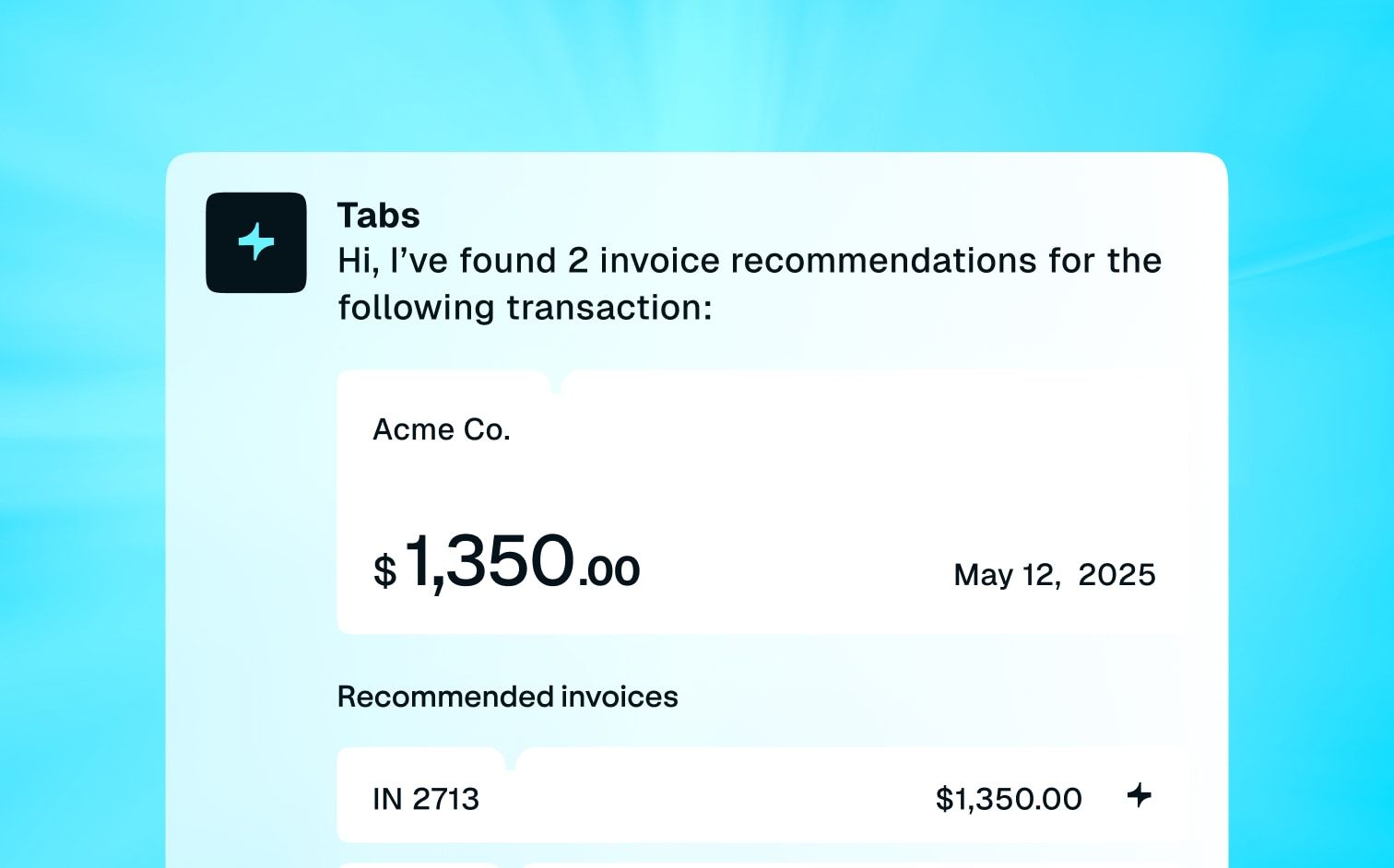
AI cash application solves this by interpreting payment context automatically. It extracts remittance data from emails, PDFs, and bank files—then matches that information to your open invoices for high-confidence cases, routing the rest to review.
But here's what separates modern Revenue Automation platforms from basic automation tools: commercial context. Generic cash application software matches payments based on reference numbers alone. Tabs goes further by using commercial context from your signed contracts—terms, schedules, and pricing logic—to drive accurate billing workflows. This means the system can apply a payment based on the contract terms and invoicing logic behind it—not just the reference number on the transaction.
Common cash application challenges
Manual cash application breaks down as your business scales. What works with 50 invoices per month becomes unsustainable at 500. And the problems compound—every hour spent chasing payment details is an hour not spent on strategic work.
Decoupled remittance
Customers rarely send payments and remittance details together. The money arrives in your bank account, but the explanation of what it's for comes separately—if it comes at all.
This forces your team into detective mode:
- Email hunting: Searching inboxes for remittance advice that may or may not exist
- Portal hopping: Logging into customer payment portals to find transaction details
- Reference translation: Converting customer PO numbers into your invoice numbers
Every minute spent searching delays cash posting and inflates your days sales outstanding (DSO).
Lump-sum payments
A customer sends one payment covering five invoices. Sometimes with partial payments. Sometimes with deductions or credits applied. Without clear remittance, your team has to guess which invoices to close and how to allocate the amounts.
This guesswork leads to misapplied payments, frustrated customers, and reconciliation headaches at month-end.
Fragmented systems
Payment data lives across disconnected tools—bank portals, lockbox files, ERP systems, and email inboxes. These systems don't talk to each other natively.
Tabs solves this by unifying contract terms, billing data, and payment information in one place. Because Tabs sits downstream of your CRM, it operationalizes signed contracts quickly—so you can apply cash based on the agreement's terms, not best guesses.
Cut DSO with AI cash application
How AI cash application works
Understanding the mechanics helps you trust the output.
Pull quote: "Match rates matter—but audit-grade traceability is what keeps close clean."
AI cash application follows a traceable workflow—and you can audit how matches were made. It follows a structured sequence to process payments with precision.
Data centralization
The process starts by aggregating payment data from every source into a single view. Bank feeds, lockbox files, payment portals, and remittance emails all flow into one system.
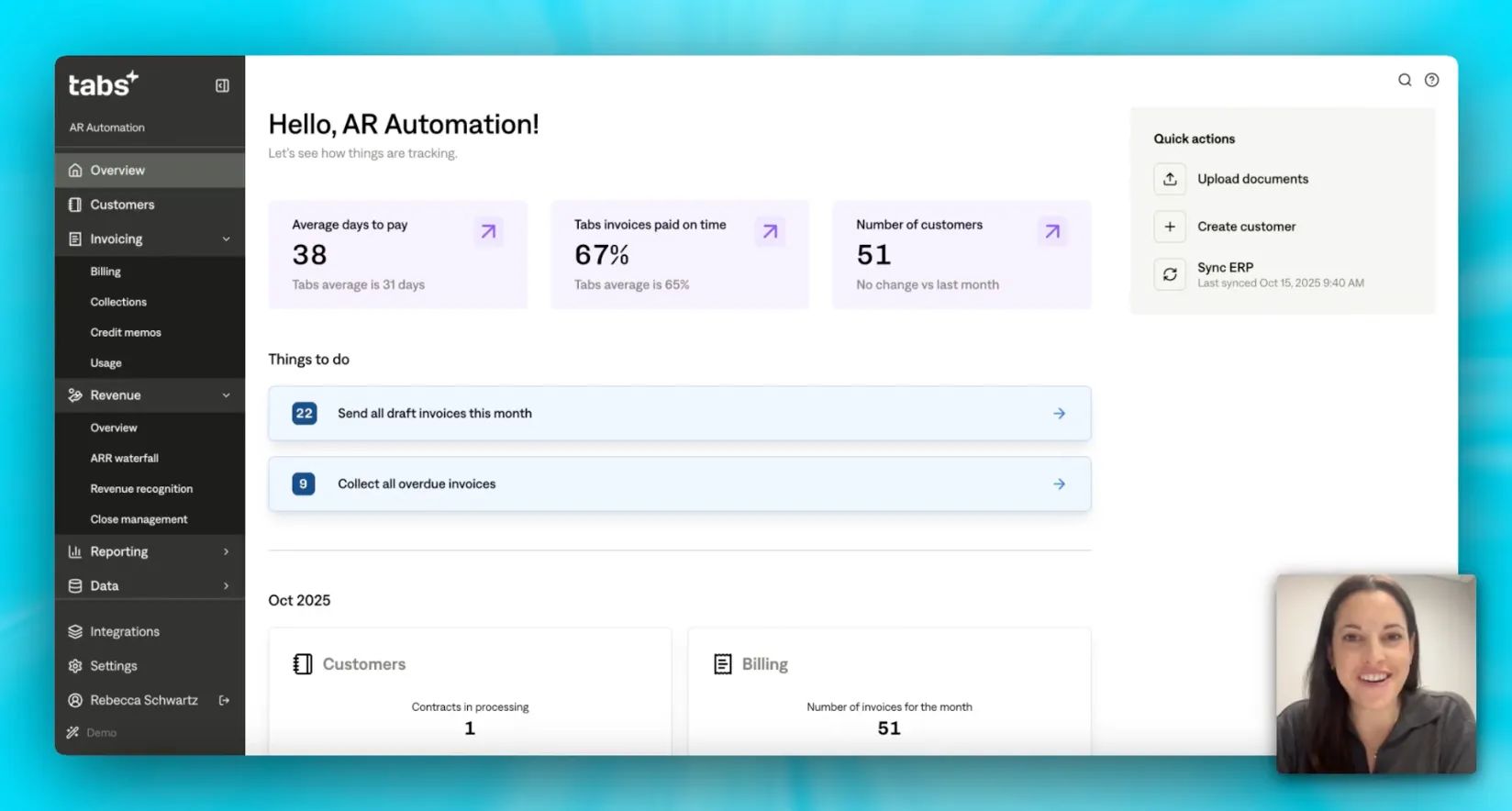
You no longer toggle between six browser windows and portals to find a missing payment. Everything lives in one cash application dashboard, updated continuously as new files and remittance arrive.
Remittance capture
Next, the system extracts details from unstructured formats. It uses optical character recognition (OCR) and natural language processing (NLP) to read PDFs, email bodies, and scanned documents.
Trained models extract invoice numbers, payment amounts, and customer references—even when formatting varies significantly between customers. Unlike rigid rules engines, this technology adapts to different document layouts without requiring custom templates.
Semantic matching
Once data is extracted, the system compares it against your open invoices. It uses fuzzy matching and entity resolution to link payments to the correct accounts—even when reference numbers don't match exactly.
Every match gets a confidence score. High-confidence matches post automatically. Low-confidence matches route to an exception queue for human review.
Tabs takes this further by incorporating commercial context—contract terms, billing schedules, and payment history—into matching and exception workflows. This helps you match payments in complex scenarios—like a customer who typically pays about 15 days after the due date, or one who consistently takes early payment discounts.
| Approach | Data sources | Matching logic | Exception handling |
|---|---|---|---|
| Manual | Spreadsheets, email searches | Reference number lookup | Ad-hoc investigation |
| AI-powered | Centralized feed | Semantic matching with confidence scoring | Automated exception queue |
AI cash application benefits for finance teams
Speed is table stakes. Accuracy and auditability are the differentiators.
The best finance teams don't just close faster—they close with confidence. Mordor Intelligence reports that mid-sized companies deploying intelligent AR suites shave seven days off average DSO and save $440,000 annually. No surprises. No reinstatements. No audit concerns. AI cash application delivers this by fundamentally changing how your AR team operates.
Cash flow control
Automated cash application accelerates the time between payment receipt and cash posting—PwC finds that structured automation workflows may accelerate payment approvals by 2–5 days. This gives you an accurate, real-time picture of available cash—critical for forecasting and working capital management.
Modern revenue automation platforms don't just show when invoices are due. They forecast when cash will actually land, based on historical payment behavior and contract terms. Can your current stack answer how much cash you have available confidently right now?
Exception detection
AI surfaces anomalies before they become reconciliation headaches. Short pays, duplicate payments, and unapplied credits get flagged the moment they enter the system.
Because exceptions come with context—which customer, which invoice, and what the likely issue is—resolving them often takes minutes instead of hours. This keeps your audit trail clean and reduces write-offs.
Key capabilities to evaluate in AI cash application software
Choosing the right cash application software requires looking past marketing claims.
Why it matters: If your tool can't handle partial pays, deductions, and missing remittance, you'll still be stuck in exceptions at month-end.
Basic automation tools can't handle the nuance of modern B2B billing. Here's what actually matters.
Invoice matching accuracy
Match rate is the primary performance metric. But accuracy matters more than speed. You need to know how the system handles:
- Partial payments: When customers pay less than the invoice amount
- Deductions: When customers take discounts or dispute line items
- Missing remittance: When payments arrive with no context at all
Tabs achieves high match rates by leveraging the Commercial Graph—a unified customer record that connects contract terms, billing history, and payment patterns. The system understands the commercial reality behind each transaction, not just the numbers.
ERP integration depth
Your cash application software must write back to your ERP cleanly. It's not enough to read data—the system needs to post payments automatically.
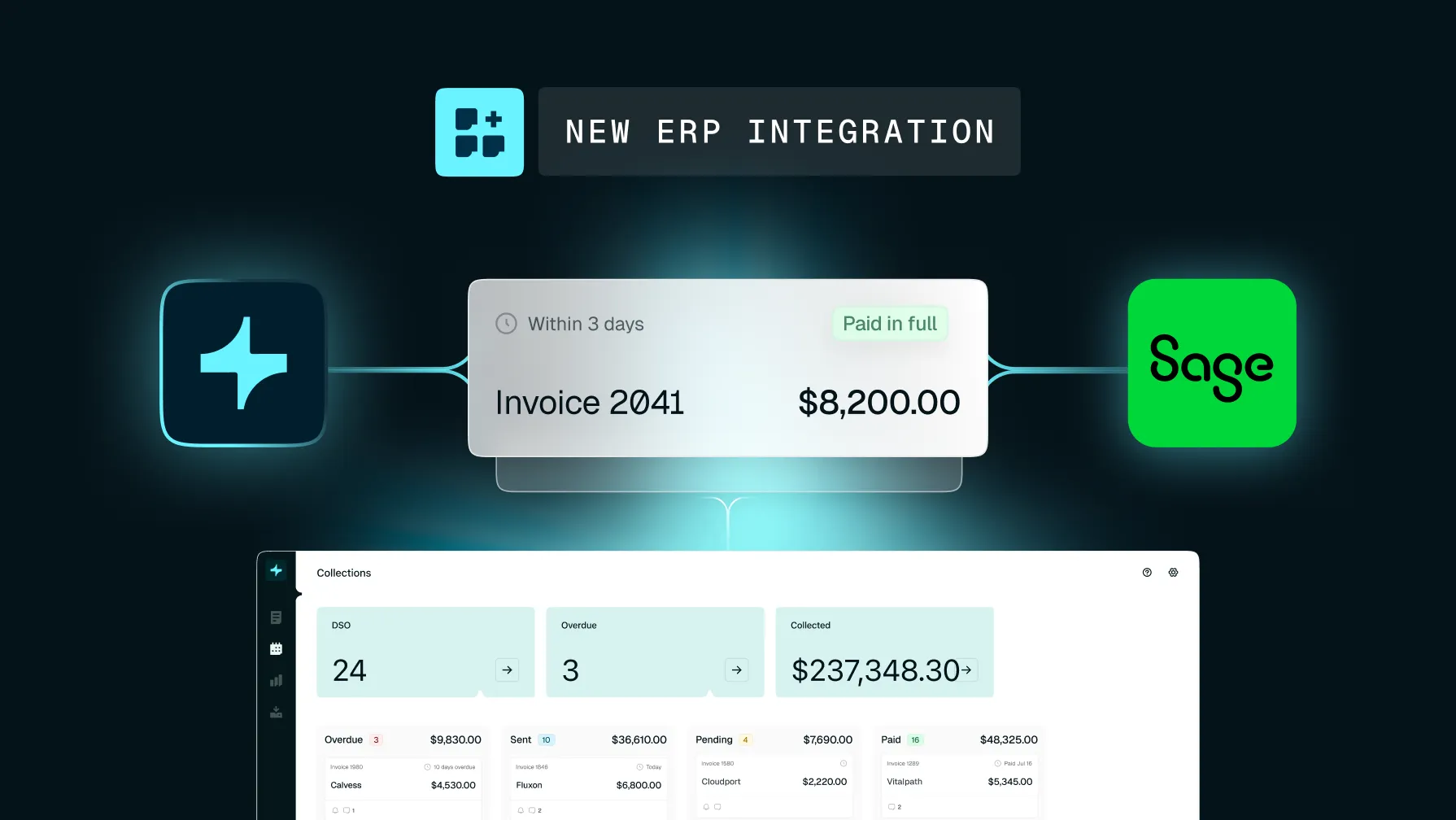
Look for prebuilt integrations with systems like Oracle NetSuite, QuickBooks, and Sage Intacct. The platform should also support standard file formats:
- BAI2 and MT940: For bank statement data
- Electronic data interchange (EDI) 820): For electronic remittance advice
- API connectivity: For custom payment sources and downstream systems
Without deep ERP integration, you're often just moving manual work from one system to another.
Tabs AI cash application and Revenue Automation
Tabs helps B2B teams run contract-to-cash by operationalizing signed contracts downstream of your CRM and CPQ, with commercial context that carries through billing, collections, and cash application. We believe finance is the connective tissue of modern business—and deserves tools that move at the speed of change.
AI contract ingestion
Tabs automatically extracts billing terms, payment schedules, and pricing logic directly from signed contracts. PDFs, Word documents, and email threads—the data is captured as soon as the agreement is finalized.
But Tabs doesn't just extract data. It structures contract terms into billing logic and Revenue Recognition-ready schedules, so invoices align to the negotiated agreement. This ensures every invoice matches the negotiated agreement, whether you're billing subscriptions, Usage-Based Billing, or hybrid models.
Why it matters: Eliminates manual contract re-keying and the downstream billing errors that create reconciliation problems in the first place.
Commercial Graph context
The Commercial Graph is Tabs' unified customer record. It brings contracts, usage data, invoices, payments, and terms into a single view that supports billing, cash application, and exception management.
This context enables accurate cash application by understanding:
- Contract terms: Payment schedules, billing frequencies, escalation clauses
- Billing history: Invoice amounts, due dates, prior payment patterns
- Payment data: Preferred methods, timing, deduction history
- Customer relationships: Parent-child hierarchies, multi-entity structures
Tabs uses commercial context to determine when to apply credits, route potential chargebacks, and flag matches for review based on confidence scoring and contract terms. This is what separates Tabs from generic automation tools that lack financial depth.
FAQ
How long does AI cash application implementation typically take?
Implementation timelines vary based on your existing systems and data quality. Tabs customers typically go live in <30 days, with Tabs supporting complex billing models—including subscription, usage-based, and hybrid arrangements—from day one.
Can AI cash application handle international payments with multiple currencies?
Yes. Modern cash application software processes payments in multiple currencies and handles the complexity of exchange rate fluctuations, though you should verify specific currency support during vendor evaluation.
What happens when AI cash application encounters a payment it cannot match?
Low-confidence matches route to an exception queue with relevant context—customer details, potential invoice matches, and the reason for uncertainty. Your team reviews and resolves these exceptions manually, and those outcomes can be used to improve future matching through configured feedback and model tuning.