




For finance leaders at B2B companies, manual billing is one of the most expensive problems hiding in plain sight — costing $15–16 per invoice before a single payment lands. Modern AI billing and automated billing software now cover the full contract-to-cash workflow, from term extraction and invoicing to payment reconciliation and ASC 606 compliance. This guide covers how to evaluate platforms that eliminate revenue leakage and scale with your business.
What is AI billing?
AI billing uses trained models and automation to streamline key contract-to-cash steps. This includes extracting terms from signed contracts to generating invoices, applying cash, and supporting Revenue Recognition rules. Unlike traditional billing software that follows rigid, pre-programmed rules, AI billing solutions use trained models to classify inputs, route exceptions, and automate workflows with minimal human intervention.
Traditional billing systems only do what you explicitly configure them to do. If a contract has a unique clause or a complex usage tier, someone on your finance team must manually calculate the invoice or build a custom workaround. AI billing changes this by ingesting raw contracts and usage data to generate invoices that align with the signed terms.
Tabs takes this further by applying commercial context. Tabs' contract ingestion capability doesn't just extract a date from a contract — it maps that date to downstream actions, such as billing start, proration, and Revenue Recognition timing under ASC 606. This distinction matters because generic automation tools often miss the nuances that create billing errors downstream.
The terms AI billing software and automated billing software are often used interchangeably, but the best platforms go well beyond scheduling — they interpret contracts, apply commercial context, and execute the full contract-to-cash workflow autonomously.
Why AI billing solutions matter for B2B finance
Modern B2B finance teams face a compounding problem: revenue complexity is scaling faster than headcount. As companies adopt hybrid business models — combining subscriptions, Usage-Based Billing, and milestone payments — the manual effort required to bill accurately increases sharply.
The primary value of AI billing isn't just speed. It's reducing revenue leakage. When humans manually transfer data from a signed contract to a billing schedule, errors are inevitable. These errors result in under-billing, delayed payments, and damaged customer trust.
- Revenue leakage: 42% of companies experience revenue leakage from billing errors, manual contract interpretation, or missed usage data.
- Invoice processing costs: Manual invoice processing costs $15–16 per invoice; AI-powered platforms bring that to roughly $3 — an 80% reduction that compounds across thousands of invoices per month.
- Slow cash cycles: Delayed invoicing and reactive collections extend your Days Sales Outstanding (DSO).
- Audit risk: Manual, disconnected revenue recognition processes make it harder to provide the traceability auditors require.
- Scaling bottlenecks: Without automation, finance headcount grows faster than revenue.
The impact is measurable. Statsig eliminated 100% of aged receivables and tripled invoice volume without adding headcount. Cortex cut overdue invoices by 50%. Both results came from automating the full contract-to-cash workflow with Tabs.
Modern Revenue Automation platforms don't just show when invoices are due. They forecast when cash will actually land, based on historical payment behavior and contract terms.
Key AI technologies in billing
Knowing what powers AI billing helps you separate real capabilities from vendor claims. In a recent McKinsey survey, 44% of CFOs reported using AI for more than five use cases — up from 7% the year prior. Adoption is accelerating, but understanding the underlying technologies still matters when evaluating vendors.
- Natural language processing (NLP): Reads and parses contract language to extract terms and obligations from PDFs, Word documents, and emails.
- Optical character recognition (OCR): Converts scanned documents into machine-readable text so NLP models can process them.
- Classification models: Categorize data points — matching a bank deposit to a specific invoice or classifying revenue as recurring versus one-time.
- Anomaly detection: Monitors transaction patterns to flag billing discrepancies or unusual usage spikes before they become accounting problems.
Large language models (LLMs) are now enhancing these capabilities, improving extraction and classification for complex, non-standard contract language that older rules-based tools struggle to parse.
Core capabilities in AI billing solutions
AI billing is not a single feature. It's a suite of capabilities spanning the entire contract-to-cash process. When evaluating solutions, look for a platform that integrates these modules rather than treating them as isolated tasks. The value of integration is compounding — when contract ingestion feeds directly into invoicing, which feeds into collections, which feeds into revenue recognition, every handoff is automated and every data point is traceable.
AI contract ingestion and term extraction
The process begins after a contract is signed in your CRM or configure, price, quote (CPQ) system. Finance needs to operationalize it. AI contract ingestion eliminates manual PDF review by automatically capturing terms from signed contracts. The system scans the document, identifies key commercial terms, and maps them to your billing schedule.
This includes extracting pricing structures, payment terms, renewal clauses, and billing triggers like "bill upon implementation completion." It also captures nuances that manual processes routinely miss — pro-rata calculations for mid-cycle starts, automatic escalator adjustments, and multi-year ramp schedules that change billing amounts over time.
Tabs applies commercial context here — translating legal language into executable billing logic so that complex escalator clauses automatically adjust invoice amounts in future periods. The distinction is important: generic extraction tools can pull a date or a dollar amount from a PDF, but they don't understand what that term means for your billing schedule, revenue recognition timeline, or collections workflow.
Why it matters: Eliminates manual contract re-keying and the downstream billing errors that come with it — errors that often go undetected until a customer disputes an invoice or an auditor flags a discrepancy.
Automated invoicing and rating
Once terms are extracted, the system generates invoices. "Rating" is the calculation of charges based on pricing logic and consumption. This handles tiered pricing, minimum commitments, and volume discounts while reducing reliance on spreadsheets — reducing manual handling by 40–60% according to PwC. This is what modern invoice automation looks like in practice.
The result is clean, accurate invoices that reflect exact contract terms — including custom line items, descriptions, and customer-specific formatting — without manual overrides. For finance teams processing hundreds or thousands of invoices per month, the compounding time savings are substantial.
Why it matters: Removes calculation errors and accelerates time-to-invoice, reducing cycle times by up to 80% (PwC).
Usage metering and consumption billing
For companies with usage-based or hybrid models, metering is essential. AI billing platforms act as a mediation layer, ingesting raw usage data from your product, normalizing it, and matching it to the correct customer and price plan.
AI invoice processing at the usage layer handles the aggregation, normalization, and rating calculations that previously required custom engineering work. This supports real-time aggregation from product telemetry and seamlessly combines recurring subscription fees with variable usage charges on a single invoice. For companies running multiple pricing models simultaneously — a common reality for B2B SaaS companies offering both seat-based and usage-based tiers — this consolidation eliminates the need for separate billing workflows and the reconciliation headaches that come with them.
Why it matters: Enables flexible pricing models without engineering bottlenecks.
Payment reconciliation and matching
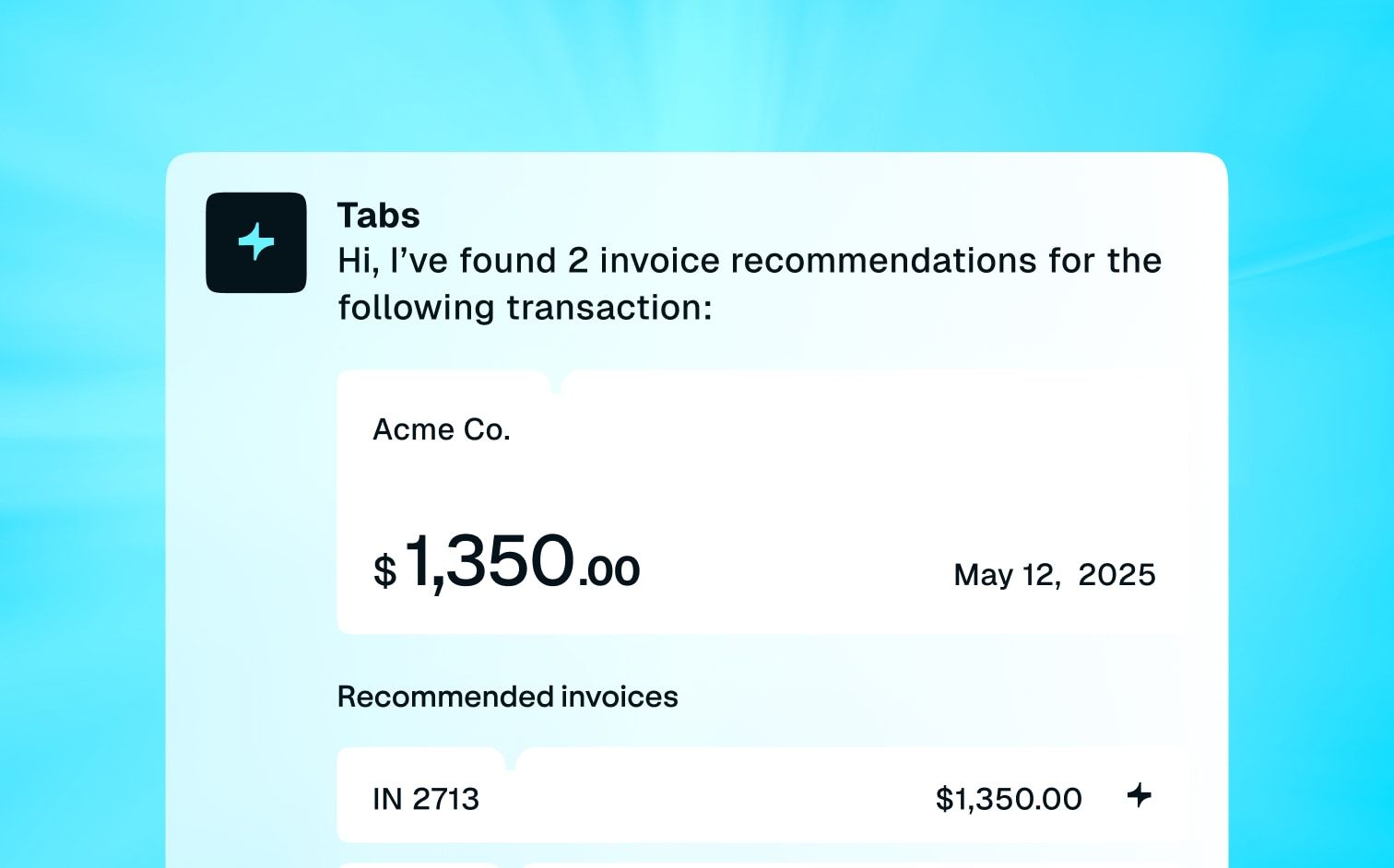
Sending the invoice is only part of the work. AI streamlines payment reconciliation by automatically matching incoming payments to open invoices based on reference numbers, amounts, and customer names.
The system identifies partial payments, overpayments, and unallocated cash for review. It also triggers automated dunning workflows through the collections layer — not a one-size-fits-all reminder cadence, but smart escalation based on customer segment, invoice age, and payment history. High-value accounts get personalized outreach; smaller balances get automated sequences.
Faster cash application directly reduces your DSO — the average number of days to collect on an invoice — which is a primary KPI for any CFO. This is the accounts receivable (AR) automation layer of the contract-to-cash stack, where AI reduces the manual work that finance teams currently manage through spreadsheets and disconnected tools.
Why it matters: Accelerates cash application, reduces manual AR work, and shortens your collection cycle.
Revenue recognition and compliance
AI billing platforms automate Revenue Recognition schedules and related journal entries under ASC 606. This ensures compliance without massive spreadsheets at month-end — and without the manual rework that happens when upstream billing errors cascade into incorrect revenue schedules.
The system generates Revenue Recognition waterfall reports based on service periods, recognizes revenue when milestones are met, and maintains audit trails that connect every entry to source contracts. For hybrid and usage-based models, this is especially valuable: the Revenue Recognition treatment often varies by charge type within a single contract, and manual tracking of these distinctions is error-prone at scale.
Why it matters: Reduces close time, simplifies audit preparation, and ensures your revenue numbers are defensible — not just directionally correct.
How leading AI billing platforms compare
Not all billing solutions are equal. When assessing the landscape, distinguish between legacy systems with bolted-on automation and true AI-native platforms. The difference matters because bolted-on AI typically automates one step — like invoice generation — without understanding the upstream context from contracts or the downstream implications for revenue recognition. A purpose-built platform treats the entire contract-to-cash workflow as a connected system.
| Evaluation dimension | What to look for | How Tabs delivers this |
|---|---|---|
| Automation depth | Contract ingestion, touchless invoicing | Tabs ingests raw contracts — including non-standard terms and escalator clauses — without manual reconfiguration. |
| Contract-to-cash coverage | Full workflow vs. point solution | Tabs covers the full workflow: contract ingestion, invoicing, collections, and revenue recognition, with no data handoff gaps. |
| Billing model flexibility | Subscription, usage, hybrid support | Tabs supports subscription, usage-based, and hybrid models natively, with a single invoice combining all charge types. |
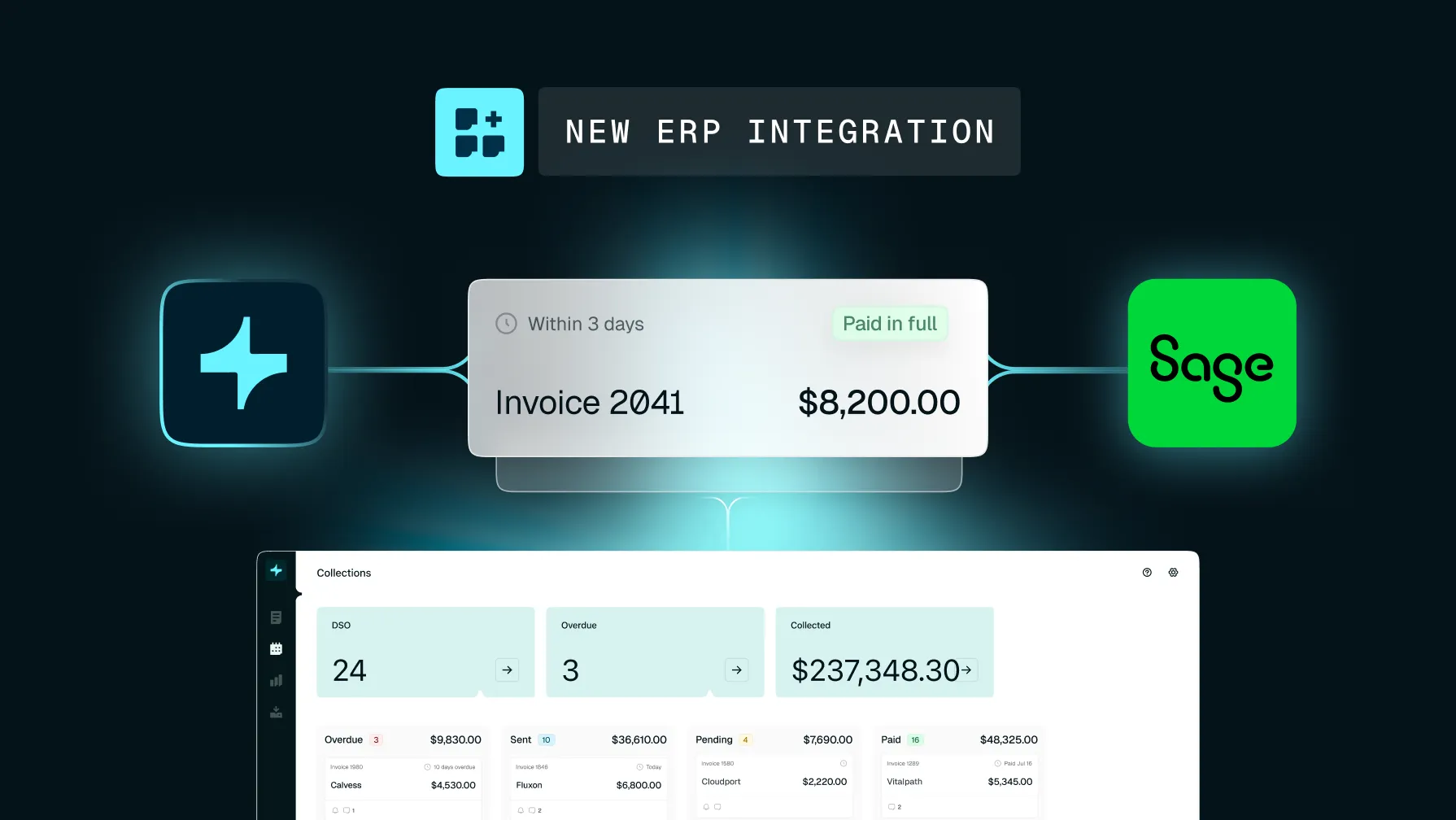
| Integration architecture | Native ERP/CRM connectors, APIs | Native integrations with NetSuite, QuickBooks, Sage Intacct, and Salesforce — plus developer-friendly APIs. |
| Compliance | ASC 606 automation, audit trails | Automated revenue schedules, journal entries, and full audit trails from contract to cash. |
Automation depth and AI scope
True AI billing handles judgment-heavy tasks. Look for platforms that interpret non-standard contract language and handle exceptions intelligently — not just process standard templates. The difference between shallow and deep automation shows up in edge cases: escalator clauses, mid-term amendments, retroactive credits, and multi-entity contracts. A platform that requires manual intervention for every non-standard scenario isn't truly automated — it's semi-automated with AI branding.
Contract-to-cash coverage and workflows
Point solutions that only do collections or only do invoicing create fragmentation. A platform covering the full workflow — from contract ingestion through revenue recognition — ensures data consistency and eliminates manual reconciliation between systems. When your billing platform, collections tool, and RevRec system don't share a unified data model, you spend month-end reconciling discrepancies instead of closing books.
Usage-based billing and pricing models
Legacy systems struggle with usage-based pricing elasticity. If you plan to introduce usage-based or hybrid models, you need a platform built for high-volume data processing. This means real-time metering, flexible rating engines that support tiered and volume-based calculations, and the ability to combine recurring and variable charges on a single invoice without custom development.
ERP and CRM integrations and APIs
Your billing platform should connect your CRM (where deals close) to your ERP (where books close). Look for robust APIs and native integrations with systems like Salesforce, NetSuite, and QuickBooks. Bi-directional sync is critical — invoices, payments, and journal entries need to flow automatically so your ERP stays current without manual data entry or CSV imports.
How to match your billing pain point to the right capabilities
Feature comparisons are useful, but the right platform ultimately depends on where your contract-to-cash process breaks down. Use this framework to map your primary pain point to the capabilities that matter most when evaluating AI billing platforms:
- "We're manually re-keying contracts into our billing system" — Prioritize contract ingestion with commercial context, not just data extraction. The platform should interpret terms and map them to billing logic automatically.
- "Our invoices have errors that customers dispute" — Prioritize automated rating and touchless invoice generation with audit trails. Every invoice should trace back to specific contract terms.
- "Our DSO is growing and collections are reactive" — Prioritize AR automation, smart dunning, and payment reconciliation. Look for platforms that escalate based on customer behavior, not just calendar dates.
- "We can't support usage-based or hybrid pricing without engineering help" — Prioritize a usage metering layer with native billing model flexibility. Pricing changes should be a configuration change, not a development project.
- "Our month-end close takes too long and auditors keep asking for documentation" — Prioritize automated Revenue Recognition with ASC 606 compliance, audit trail generation, and journal entry sync to your ERP.
Buying criteria for AI billing platforms
Selecting a revenue automation platform is a strategic decision. Deloitte found companies with robust revenue operations are 1.4x more likely to exceed revenue goals. Beyond feature checklists, evaluate the platform's ability to scale with your business.
- Data model flexibility: Can the platform handle your contract complexity without custom code? Look for native support for tiered pricing, minimum commitments, escalator clauses, and multi-product contracts. If every edge case requires a workaround, you'll outgrow the system before it pays off. Ask to see how the platform handles a real contract from your pipeline — not a demo with clean, pre-formatted data.
- Implementation timeline: Modern AI billing platforms should go live in weeks, not the 6–9-month cycles typical of legacy ERP-adjacent implementations. Ask vendors for a realistic timeline with named milestones, not a range. A phased approach — starting with one billing model or customer segment — reduces risk and delivers measurable results faster. Over 30% of Tabs customers adopted usage-based models in
- Security posture: Require SOC 2 Type II compliance, encryption at rest and in transit, and role-based access control. These are table stakes for any platform touching financial data. Ask for the most recent audit report and confirm the vendor's incident response process meets your risk team's requirements.
- Integration readiness: Look for native connectors to the CRMs and ERPs your team already uses — Salesforce, HubSpot, NetSuite, Sage Intacct, QuickBooks. The fewer custom API projects required, the faster you go live and the fewer data discrepancies you introduce at launch. Bi-directional sync matters: invoices and payments should flow automatically between your billing platform and general ledger without manual exports.
- Billing model coverage: Can the platform support your pricing today and tomorrow? If you plan to introduce usage-based or hybrid pricing, confirm the platform handles high-volume metering without custom engineering. Pricing model changes should be a configuration change, not a development project. This is especially critical for companies evolving from flat-rate subscriptions toward usage-based or hybrid models — the billing platform should accelerate that transition, not constrain it.
- Vendor stability: Track record with B2B companies at your growth stage matters more than brand name recognition. Ask for customer references in your revenue range and pricing model complexity. Evaluate how the vendor's product roadmap aligns with your finance team's evolving needs over the next 12–24 months.
Solve challenges in AI billing adoption
Implementing AI billing delivers measurable gains in accuracy, speed, and scale — but the path to those results requires planning. Understanding these obstacles upfront helps you plan around them rather than discover them mid-implementation. Most relate to data hygiene and process change rather than the technology itself.
- Data quality: AI is only as good as its inputs. Start with structured contract data and clean customer records. If your contracts live in a mix of PDFs, emails, and shared drives, plan for a data cleanup sprint before — or in parallel with — implementation.
- Legacy migration: A phased rollout — starting with new contracts while backfilling historical data — reduces risk. Don't try to migrate everything on day one. The best approach is running new contracts through the AI billing platform while gradually importing historical data in batches.
- Exception handling: Keep humans in the loop for edge cases. No AI handles every scenario perfectly, and your finance team needs clear escalation paths for non-standard situations. The goal is reducing volume of manual work, not eliminating human judgment entirely.
- Change management: Position automation as eliminating drudgery, not threatening jobs. Teams that have made the transition — like Statsig and Cortex — consistently report that the productivity gains made automation straightforward to champion internally.
- Model transparency: Avoid black-box systems. You need to understand why an invoice was generated for a specific amount — and so do your auditors. Look for platforms that provide clear audit trails connecting every billing decision back to specific contract terms and data inputs.
Security and compliance requirements for AI billing
Finance data — contracts, invoices, payments, and revenue records — is among the most sensitive and regulated data in your organization. Any platform that touches contracts, invoices, and revenue data must meet enterprise-grade security standards that match or exceed your existing ERP. Here are the non-negotiable requirements:
- SOC 2 Type II: Validates audited security controls and operational practices.
- Encryption: Data encrypted at rest and in transit.
- Role-based access control: Granular permissions for invoice approval and billing changes.
- Audit trails: Complete traceability from contract to cash.
- Data residency: Compliance with regional requirements like GDPR. If you operate across the EU or handle data from EU-based customers, confirm the vendor's data residency and subprocessor policies meet GDPR requirements — not just their general security posture.
Future of AI billing in revenue operations
AI billing is moving the industry toward a "continuous close." Instead of waiting for month-end to reconcile books, finance teams gain real-time visibility into financial standing.
Expect billing to trigger automatically upon service delivery. Autonomous workflows will handle routine tasks, escalating only complex issues to your finance team. Event-driven architecture will enable instant billing from product telemetry. And the lines between billing, revenue recognition, and financial planning will continue to blur — creating a unified revenue intelligence layer that gives CFOs real-time confidence in their numbers rather than month-end surprises.
How to start with AI billing solutions
Transitioning to AI-powered Revenue Automation doesn't require replacing your entire finance stack. You can layer intelligence over existing tools to solve immediate pain points — and expand from there as results compound. The most successful implementations follow a structured four-step approach that balances speed with risk management.
1. Define requirements and KPIs
Start with business outcomes, not feature lists. Identify the specific metrics you want to improve — DSO, time-to-invoice, billing error rate, and aged receivables as a percentage of AR are the four metrics most teams start with. Document your current numbers so you have a clear before-and-after to measure ROI. This baseline also helps you build the internal case for expansion: when you can show a 50% reduction in billing errors or a measurable DSO improvement after a pilot, the business case for full rollout writes itself.
2. Centralize contract and usage data
AI billing requires clean inputs. Audit where contract data lives today — your CRM, shared drives, email inboxes, or a mix of all three. Most B2B finance teams discover that contract terms are scattered across multiple systems with no single authoritative source. Create a plan to consolidate so the AI has a single source of truth. This step often reveals how fragmented the current process really is, which strengthens the case for automation. For usage-based models, also map where product telemetry originates and how it currently flows into billing — this data pipeline is the foundation of accurate consumption billing.
3. Run a pilot and measure impact
Start with a specific customer segment or new product line. Run AI billing alongside your current process to verify accuracy before expanding. Most teams pilot with their most complex billing model first — if the platform handles that cleanly, simpler models are straightforward. Measure against the KPIs you defined in step one. Track time-to-invoice, error rates, and any manual interventions required during the pilot. A successful pilot gives you the data to build the business case for full rollout.
4. Validate integration readiness
Before go-live, confirm your CRM and ERP connections are mapped and tested. Native integrations with Salesforce, HubSpot, NetSuite, or Sage Intacct eliminate the most common source of data discrepancies at launch. Run end-to-end tests that trace a contract from CRM through invoicing and into your general ledger to verify data flows cleanly. Pay special attention to journal entry sync — this is where most reconciliation issues surface if the integration isn't properly configured.
Frequently asked questions
Can AI billing platforms handle contracts with hybrid subscription and usage pricing?
Yes. Modern AI billing platforms like Tabs natively support hybrid models combining recurring subscriptions with usage-based overage, milestone payments, and tiered pricing without custom logic.
How do AI billing platforms sync invoices and payments with NetSuite or Sage Intacct?
AI billing platforms connect through native integrations and APIs, syncing invoices, payments, and journal entries automatically while keeping the ERP as your general ledger system of record — and Tabs as the system of intelligence that operationalizes signed contracts.
What audit controls ensure ASC 606 compliance in AI billing systems?
AI billing platforms maintain complete audit trails linking every revenue entry to source contracts, billing events, and payment data — providing documentation auditors require without manual reconciliation.
Which finance metrics typically improve first after deploying AI billing?
Most teams see immediate improvements in time-to-invoice and error rates, followed by DSO reductions as automated collections and payment reminders take effect.
How quickly can a business see ROI from AI billing?
Faster than most finance teams expect. When manual invoice processing costs $15–16 per invoice and AI-powered platforms reduce that to roughly $3, the cost savings compound immediately at scale. Beyond direct cost reduction, the downstream effects accelerate returns: fewer billing disputes mean faster collections, automated dunning reduces DSO, and accurate invoices eliminate the rework that eats up your AR team's time. Statsig eliminated 100% of aged receivables and tripled invoice volume without adding headcount. Cortex cut overdue invoices by 50%. Modern platforms go live in weeks, not months — meaning you can measure impact within your first quarter.
How is contract-to-cash different from quote-to-cash?
Quote-to-cash begins at the quoting or CPQ stage and covers the entire sales-to-payment lifecycle — from configuring a deal through to cash collection. Contract-to-cash picks up after the contract is signed — from operationalizing the signed agreement through invoicing, collections, and revenue recognition. The distinction matters because for most B2B finance teams, the signed contract is where billing complexity actually begins. Pricing tiers, escalator clauses, usage commitments, and multi-year ramps all need to be translated into accurate billing logic. Contract-to-cash platforms focus specifically on these operational and accounting challenges that follow the close.
Can AI billing software work with my existing ERP and CRM systems?
Yes. Modern AI billing platforms connect via native integrations and APIs rather than requiring you to rip and replace your existing finance stack. Common connectors include Salesforce, HubSpot, NetSuite, Sage Intacct, and QuickBooks. The key is bi-directional sync: invoices, payments, and journal entries should flow automatically between systems so your ERP stays current without manual data entry. Tabs specifically syncs bi-directionally with these systems — keeping the ERP as your general ledger and Tabs as the intelligence layer that operationalizes contract terms.
Is AI billing scalable for growing businesses?
Yes — the key is selecting a platform built on flexible data models rather than rigid rule sets. AI billing handles pricing model changes (adding usage tiers, hybrid structures, milestone-based payments) as configuration, not custom development. As your revenue grows, the platform should handle increasing invoice volume, more complex contract terms, and new pricing models without requiring additional finance headcount or custom engineering. Statsig tripled its invoice volume without adding headcount — a direct result of a platform designed to scale with revenue complexity, not just transaction volume.
What is the difference between billing automation and revenue automation?
Billing automation handles invoice generation, payment processing, and collections — the operational mechanics of getting paid. Revenue automation extends further: it includes Revenue Recognition, compliance reporting, financial forecasting, and real-time visibility across the full contract-to-cash lifecycle. Think of billing automation as one layer within a broader revenue automation platform. Tabs covers both layers, which is why customers see improvements in AR metrics, close speed, and audit readiness simultaneously rather than optimizing one function at a time. For a deeper comparison, see our guide to the best AI billing software.