





How AI is transforming accounts receivable management tools for B2B companies
Key Takeaways
- AI in accounts receivable combines three technologies (machine learning for cash application matching, NLP for parsing customer communications and disputes, and predictive analytics for cash forecasting) while routing true exceptions to your team for review.
- 99% of AR teams using AI report accelerated payment speeds, and AI lets teams handle rising invoice volume without proportional headcount growth.
- Risk-based dunning means low-risk accounts get automated, gentle reminders while high-risk accounts are flagged for human attention so collectors spend time on at-risk balances instead of routine payments that resolve themselves.
- The biggest implementation hurdles are data quality, integration complexity across ERP/CRM/banking systems, and change management, not the underlying AI technology itself.
- Best practice is to pilot on one customer segment or bank account first, track metrics like DSO and straight-through processing rate against a baseline, then scale systematically once the pilot proves out.
Modern accounts receivable management tools now use machine learning, natural language processing, and predictive analytics to automate key parts of the invoice-to-cash workflow. This is especially valued for high-volume, rules-light tasks like invoice creation, collections workflows, and cash application, while escalating true exceptions for review.
This means your finance team no longer has to manually key in contract details, chase down payments, or reconcile cash in spreadsheets. The system automates the repetitive steps and routes exceptions to your team.
This guide shows finance and accounting teams at B2B companies how AI transforms accounts receivable—from invoice generation and cash application to collections and forecasting—so you can collect faster, close cleaner, and scale without adding headcount.
Why use AI in accounts receivable management tools?
Traditional automation relies on rigid if-then rules. If the invoice is 30 days past due, send reminder email A. But B2B billing is rarely that simple.
Subscription-based billing contracts have custom terms that evolve with renewals and expansions. Customers pay multiple invoices with one wire transfer. Usage-based charges fluctuate month to month.
AI-powered systems use trained models to detect recurring patterns in your data and apply probabilistic matching and recommendations, especially when the inputs are inconsistent or incomplete.
But here's what separates effective AR automation from generic tools: commercial context. It changes when you can recognize revenue and when you should expect cash.
Systems without this context create downstream errors that compound through your close.
5 benefits of AI tools for accounts receivable management
The shift from manual AR processes to AI-powered automation delivers measurable outcomes across your entire finance operation. Here's what changes:
- Faster cash collection: AI identifies at-risk accounts early and triggers timely, context-aware follow-ups—99% of AR teams using AI have accelerated their payment speeds. You collect what you're owed faster, reducing Days Sales Outstanding (DSO) without adding headcount.
- Reduced manual work: No more copying contract terms into billing systems, manually matching payments, or building one-off spreadsheets for complex invoices. The system handles the repetitive work.
- Fewer errors: Human data entry introduces mistakes. AI reads contracts and applies cash with consistent accuracy, eliminating the billing errors that damage customer relationships and delay payments.
- Reliable forecasting: Predictive models replace gut-feel estimates with data-backed projections. You know what's coming in—and when—with confidence.
- Scalability: As your business grows, invoice volume grows with it. AI handles the increase without requiring proportional headcount growth. Your team focuses on exceptions and strategy, not data entry.
Types of AI tools for accounts receivable management
Three core technologies power modern AR automation. Understanding what each does—and where it applies—helps you evaluate whether a tool will actually solve your problems or just add another layer of complexity.
Machine learning for payment matching
Machine learning (ML) is a type of AI that learns from historical data to make predictions. In accounts receivable, ML models analyze your past payment patterns to automatically match incoming cash to open invoices.
This matters because real-world B2B payments are messy. Customers combine multiple invoices into one check. They short-pay without explanation or forget to include reference numbers. Traditional systems flag these as exceptions requiring manual review.
ML-powered cash application handles this complexity automatically. The model cross-references payment amounts, timing, customer history, and remittance details to find the correct match—even when the data is incomplete. Your team only reviews the true exceptions.
Why it matters: Higher straight-through processing rates mean faster closes and fewer hours spent reviewing unapplied cash reports.
Natural language processing for customer communication
Natural language processing (NLP) allows computers to interpret human language well enough to classify it, extract key fields, and route items into structured workflows. In AR, this technology parses unstructured data—email threads, PDF remittance advice, dispute notes—and extracts actionable information.
When a customer emails "We're disputing the overage charges on invoice #4521," NLP identifies the invoice number, flags it as a dispute, and categorizes the issue type. Your team gets structured data they can act on instead of digging through email chains.
NLP also supports smarter dunning automation. Instead of sending generic past-due notices, the system varies messaging and cadence based on objective signals like prior responses, dispute status, payment promises, and historical payment behavior.
Why it matters: Automated correspondence that feels human—not robotic—preserves customer relationships while accelerating collections.
Predictive analytics for payment forecasting
Predictive analytics use historical data to forecast future outcomes. Traditional systems show you when invoices are due based on contract terms. But due dates rarely reflect when cash actually lands.
Modern revenue automation platforms don't just show when invoices are due—they forecast when cash will actually arrive, based on historical payment behavior and contract terms. If a customer consistently pays 12 days late, the system factors that into your cash flow projection.
This gives you an accurate picture of working capital. You can make confident decisions about hiring, inventory, and investments without padding your forecasts with guesswork.
Why it matters: Accurate cash forecasting transforms finance from a reporting function into a strategic planning partner.
Accelerate cash with contract-aware AR automation
AI use cases for accounts receivable teams
Understanding how to automate accounts receivable starts with mapping where AI applies across your contract-to-cash cycle. Each stage presents opportunities to eliminate manual work and reduce errors.
Automate invoice generation and reminders
The billing process begins the moment a contract is signed. A tool like Tabs sits downstream of your CRM and CPQ, pulls the signed contract data—whether for seat-based billing with variable user counts or fixed-fee arrangements—and uses AI to extract billing terms and generate invoices—with exceptions routed to your team for review when terms are ambiguous or data is missing.
This reduces the tedious work of reviewing PDFs, copying pricing details into spreadsheets, and manually creating invoices in your billing system while still giving you a review path for non-standard terms.
Once invoices go out, automated reminder sequences handle follow-up. These sequences adapt based on customer payment history. A customer who always pays on day 28 gets a different cadence than one who consistently goes 60 days overdue.
Why it matters: Clean invoices sent on time—with intelligent follow-up—accelerate cash collection without burdening your team.
Match cash to invoices with straight-through processing
Cash application is where many finance teams lose hours every week. Payments arrive via ACH, wire, and check. Reference numbers are missing or wrong. Amounts don't match open invoices exactly.
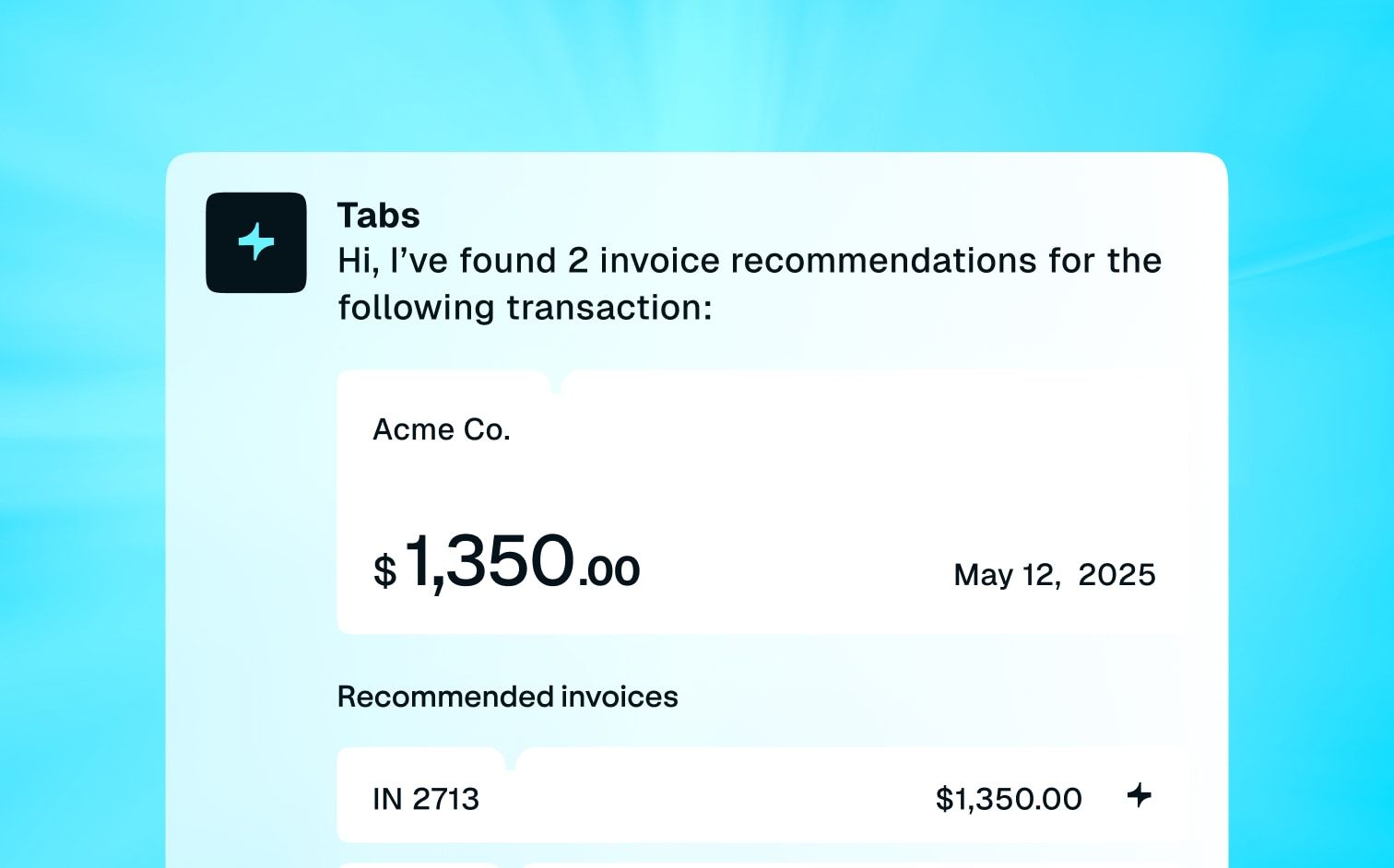
AI-powered cash application applies probabilistic matching and learned heuristics to propose matches, post them automatically when confidence is high, and queue low-confidence items for review—so you can increase straight-through processing without losing control.
Partial payments, combined payments, and short-pays can be matched automatically when confidence is high, with the remaining items routed to your team as true exceptions.
Why it matters: Automated cash application means faster closes and accurate AR aging reports throughout the month.
Prioritize collections with risk-based dunning
Not every overdue invoice requires the same response. A customer who's three days late but always pays doesn't need an aggressive collections call. A customer showing signs of financial distress does.
AI scores accounts based on payment risk using behavioral signals and historical patterns. This means low-risk accounts receive automated, gentle reminders, while high-risk accounts get flagged for immediate human attention.
This prioritization ensures your collectors spend their time where it matters—securing large, at-risk balances rather than chasing routine payments that will resolve themselves.
Why it matters: Risk-based prioritization maximizes collector effectiveness and protects your cash flow.
Score credit and approve accounts in real time
Manual credit evaluation slows down sales cycles and introduces inconsistency. Different analysts apply different standards. Approvals take days when they should take minutes.
AI evaluates credit applications using multiple data sources and your historical risk profiles. It recommends appropriate credit limits dynamically, balancing growth objectives with exposure management.
New customers get onboarded faster. Your finance team maintains control over risk without becoming a bottleneck.
Why it matters: Real-time credit decisions accelerate revenue while protecting against bad debt.
Challenges with AI in accounts receivable
Implementing AI in your finance stack isn't without hurdles. Understanding the common challenges helps you plan for them.
Data quality is the most frequent obstacle. AI models are only as good as the data they learn from. If your historical invoices, payment records, and contract terms are incomplete or inconsistent, the system's predictions will reflect those gaps.
Integration complexity comes next. Your AR automation needs to communicate with your ERP, CRM, and banking systems. Poorly designed integrations create data silos and manual workarounds that defeat the purpose of automation.
Change management matters too. Your team needs to trust the system before they'll rely on it. That means clear visibility into how decisions are made and easy access to override when necessary.
Data privacy and security
AR data includes sensitive customer information, banking details, and confidential contract terms. Any system processing this data must meet strict security standards.
Look for tools that maintain SOC 2 compliance and implements enterprise-grade security with encryption and audit-ready controls. Role-based access ensures team members see only what they need. Complete audit trails track every action for compliance and review.
Why it matters: Security isn't optional when you're handling enterprise revenue data. Your AI platform must meet the same standards as your core financial systems.
3 steps for implementing AI-driven accounts receivable management tools
Moving from manual processes to AI-powered automation requires a structured approach. Rushing the transition creates more problems than it solves.
1. Assess current workflows and pain points
Start by mapping your existing contract-to-cash process. Document exactly where your team spends time on manual work: contract review, invoice creation, cash application, collections follow-up.
Identify the specific pain points. Are billing errors causing customer disputes? Is cash application taking days instead of hours? Are collectors spending time on low-value accounts?
This baseline tells you where automation will have the biggest impact—and gives you metrics to measure success.
2. Pilot and measure before scaling
Don't overhaul your entire finance operation at once. Begin with a focused pilot: automate collections for one customer segment, or test cash application on a single bank account.
Establish clear success metrics before you start. Track DSO changes, straight-through processing rates, and time saved during close. Measure rigorously against your baseline.
Once the pilot proves successful, expand systematically. Each phase builds confidence and surfaces integration issues before they affect your entire operation.
3. Select vendors and integration approach
Your AI solution must integrate seamlessly with your existing finance stack. Evaluate vendors based on ERP integration depth, API flexibility, and security posture.
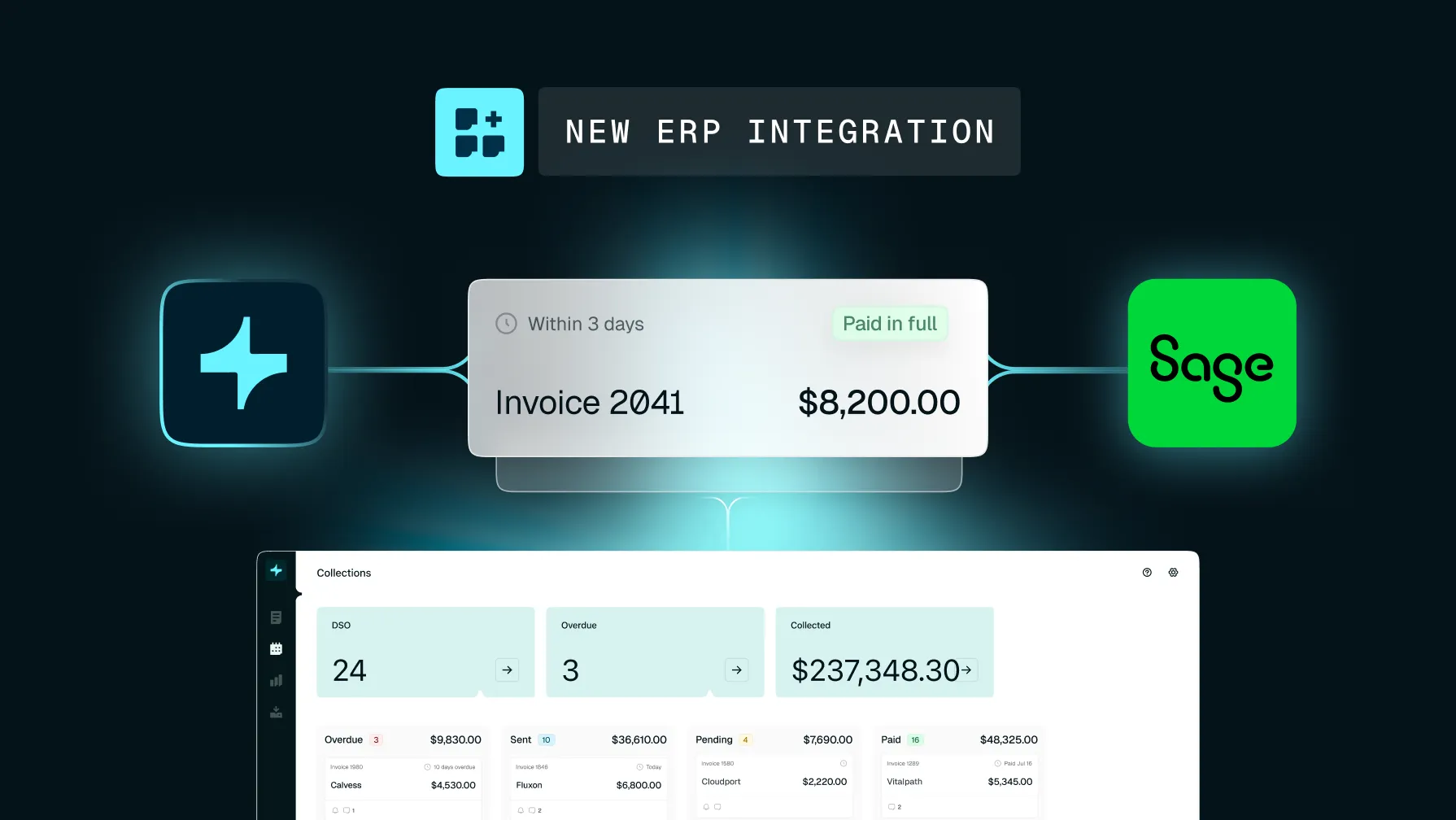
Tabs offers native integrations with widely used accounting and ERP systems, including QuickBooks, NetSuite, and Sage Intacct. Developer-friendly APIs let you extend functionality and connect additional systems without brittle, one-off integrations.
Avoid tools that force you to replace your core accounting system. The right platform enhances your existing stack—it doesn't demand you rebuild it.
Future trends in AI for accounts receivable
The landscape of revenue operations continues to evolve. Finance teams that adopt intelligent systems now position themselves to leverage the next wave of capabilities.
- Autonomous exception handling: Deloitte predicts 50% of GenAI users will experiment with Agentic AI by 2027. AI models will handle a larger share of routine deductions and matching exceptions by recommending resolution paths, auto-applying low-risk outcomes, and routing higher-risk disputes for approval—improving over time based on historical outcomes.
- Generative AI for correspondence: Systems will draft customer-specific replies to billing inquiries using approved templates, account history, and policy guardrails—optionally requiring human approval before sending for higher-risk messages.
- Real-time payment integration: As instant payment rails become standard, AI will reconcile transactions the moment they hit your bank account—not hours or days later.
The finance teams that thrive will be those who build the infrastructure now—74% of AI's economic value is captured by just 20% of organizations. Clean data, integrated systems, and intelligent automation create the foundation for whatever comes next.
Automate your accounts receivable management tools with Tabs
Manual AR work doesn't scale — copying contract terms into spreadsheets, chasing missing reference numbers, and guessing when cash will actually land all become bigger problems as invoice volume grows.
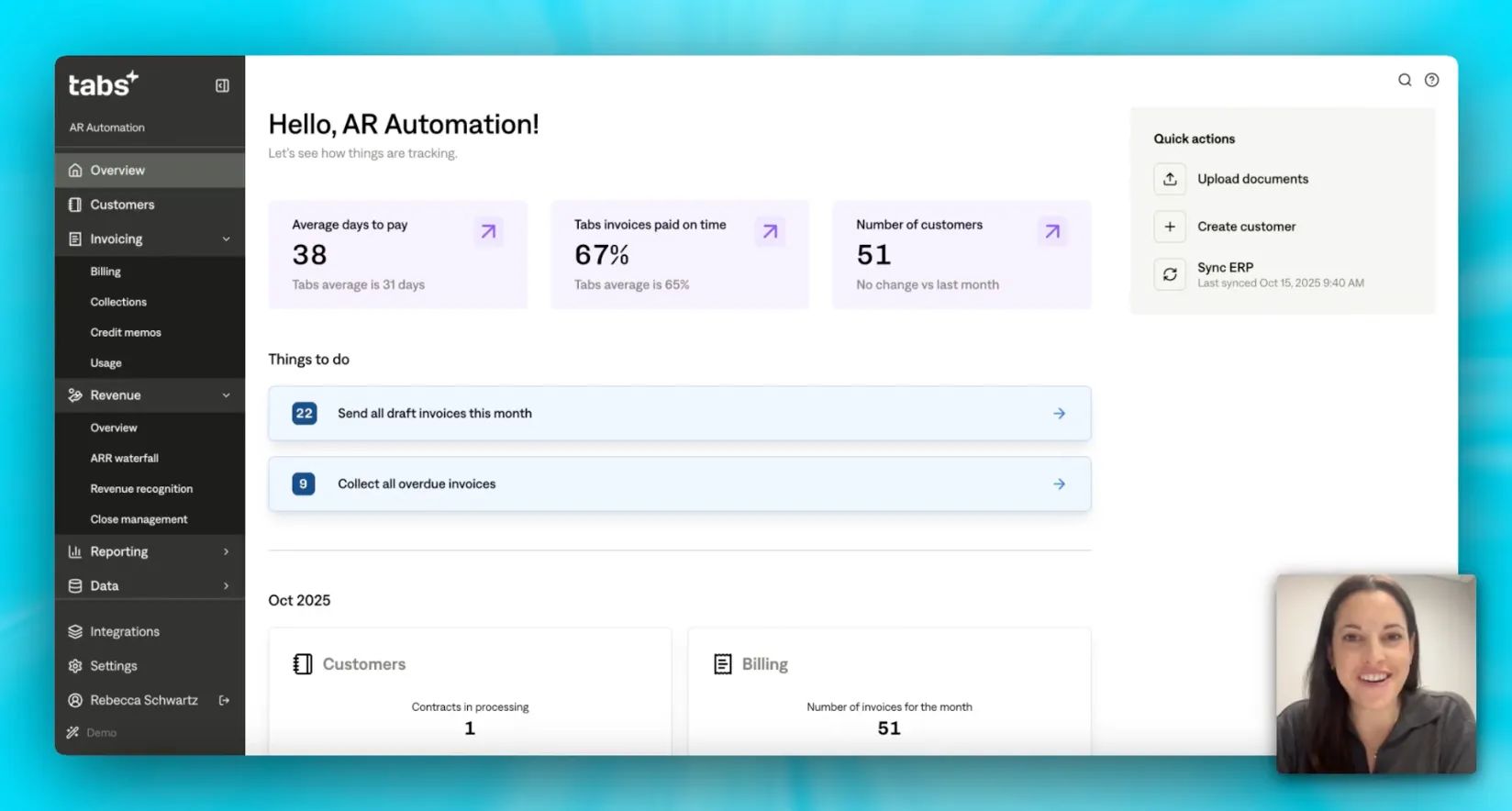
Tabs sits downstream of your CRM and CPQ to automate invoice generation, straight-through cash application, and risk-based collections — while preserving the commercial context that generic extraction tools miss. With native integrations into QuickBooks, NetSuite, and Sage Intacct, plus SOC 2-grade security, teams get faster closes and lower DSO without adding headcount.
See how Tabs automates invoice-to-cash. Get a demo.
Frequently asked questions
Will AI in accounts receivable replace my finance team?
No. AI handles routine data entry, payment matching, and follow-up communication. Your team focuses on complex disputes, strategic credit decisions, and customer relationships—work that requires human judgment.
What data quality is required before implementing AR automation?
You need clean historical invoices, accurate payment records, complete contract terms, and up-to-date customer master data. Gaps in this foundation directly impact the accuracy of AI predictions and matching.
How does AI handle partial payments and short-pays without reference numbers?
Machine learning models analyze payment amounts, timing, customer history, and any available remittance details to identify the most likely match. The system learns from your historical exception handling to improve accuracy over time.
How does AI improve cash forecasting accuracy?
Predictive analytics factor in a customer's actual payment behavior — like consistently paying 12 days late — rather than relying only on stated due dates, giving a more accurate working capital picture.
What security standards should an AI-powered AR platform meet?
At minimum, SOC 2 compliance, encryption, role-based access, and complete audit trails, given the sensitivity of AR data and banking details involved.