





How AI agents for finance teams accelerate company revenue
Key Takeaways
- AI grows revenue three ways for finance teams: increasing what you earn (better pricing, conversion, churn prediction), reducing what you spend (less manual billing/collections work), and expanding margin (handling more volume without proportional headcount growth).
- 93% of US companies are already deploying or scaling AI in finance. the differentiator is whether it targets workflows that actually move the P&L rather than sitting in isolated pockets.
- Most generic AI tools stop at extracting fields from a contract. The harder (and more valuable) problem is mapping those fields to commercial logic, turning an escalator clause into a billing schedule that triggers correctly and recognizes revenue properly under ASC 606.
- AI compounds in value when applied across the full customer lifecycle rather than in one isolated stage like lead scoring alone.
- Pricing is a high-leverage lever: a 1% price increase can translate to 8.7% higher operating profit, and AI-powered forecasting can improve pipeline accuracy by up to 40% by incorporating leading indicators like usage and payment behavior, not just pipeline snapshots.
- Complex billing models (usage-based tiers, hybrid structures, annual escalators) are where generic automation breaks down.
Finance teams at B2B companies face mounting pressure to do more with less while managing increasingly complex billing models, collections workflows, and ASC 606 compliance. This guide breaks down exactly how AI transforms revenue operations across the customer lifecycle—from smarter pricing and forecasting to faster cash collection and lower DSO—so you can identify where automation will deliver the greatest impact for your business.
How AI agents drives company revenue and profit
AI-powered workflows grow company revenue in three primary ways: increasing what you earn, reducing what you spend, and improving the margin on every dollar that flows through your business. Finance teams sit at the intersection of contracts, cash, and compliance—which makes them uniquely positioned to capture value from AI investments.
The question isn't whether AI is profitable—93% of US companies are deploying or scaling AI in finance. It's whether your AI investments target the workflows that actually move your P&L.
- Revenue uplift: AI improves pricing decisions, increases conversion rates, and predicts which customers are likely to churn before they leave. Each of these directly increases the money coming in.
- Cost reduction: AI automates manual billing, collections, and reconciliation work. This means fewer hours spent on data entry and more time spent on strategic analysis.
- Margin expansion: AI helps you scale operations without scaling headcount proportionally. You can handle three times the invoice volume without tripling your team.
But here's where most AI tools fall short. Generic automation extracts fields from documents. It typically stops short of mapping those fields to commercial logic—billing schedules, invoice construction, and Revenue Recognition under ASC 606.
Tabs takes a different approach. Tabs uses trained models to classify signed contract terms and translate them into executable billing schedules and Revenue Recognition under ASC 606—so finance can operationalize what was sold without rebuilding logic in spreadsheets. An escalator clause isn't just text to extract. It's a billing schedule that needs to trigger automatically at the right time, with the right amount, recognized correctly under ASC 606. That commercial context is what separates Tabs from generic extraction tools—Tabs sits downstream of CRM and CPQ to operationalize signed contracts into billing, collections workflows, and Revenue Recognition, without creating new reconciliation work.
Revenue growth levers with AI agents across the customer lifecycle
Revenue doesn't happen in a single moment. It builds across the entire customer journey—from the first touchpoint through renewal and expansion. AI compounds its impact when you apply it across this full lifecycle rather than in isolated pockets.
| Lifecycle Stage | Traditional Approach | AI-Powered Approach |
|---|---|---|
| Acquisition | Broad targeting, manual lead scoring | Propensity modeling, intent signals |
| Activation | One-size-fits-all onboarding | Personalized journeys, next-best action |
| Retention | Reactive churn response | Predictive churn models, proactive intervention |
| Expansion | Manual upsell identification | Customer lifetime value modeling, automated triggers |
Personalize customer experiences
Personalization means showing each customer the right message, offer, or product at the right time. AI makes this possible at scale by analyzing behavior patterns and predicting what individual users want next.
This isn't about invasive tracking. It's about relevance. When your product surfaces the right feature at the right moment, customers get value faster. When your pricing page shows tiers that match a prospect's actual needs, they convert more often.
- Product recommendations: Surface relevant offerings based on what similar customers have purchased or used.
- Dynamic content: Adjust messaging based on where someone sits in their journey with your product.
- Contextual pricing: Show pricing options that align with the customer's profile and likely willingness to pay.
Why it matters: Personalization directly increases conversion rates and average deal sizes without requiring more sales touches.
Optimize marketing performance
Marketing teams generate demand. But without AI, it's hard to connect spend to revenue in a way finance can trust—especially when you're modeling CAC payback and unit economics.
AI-powered attribution modeling can improve how you tie marketing spend to closed-won revenue by weighting multi-touch journeys and reconciling outcomes against CRM data. This means you can shift budget toward what works and away from what doesn't. The result is lower customer acquisition costs and more efficient growth.
- Attribution modeling: Understand which touchpoints actually influence buying decisions, not just which ones happen to occur before a sale.
- Audience segmentation: Identify high-value customer profiles and target campaigns specifically toward them.
- Creative testing: Run experiments on messaging and creative at scale to find what resonates with different segments.
Why it matters: Better attribution means every marketing dollar works harder, directly improving your unit economics.
Equip sales teams with lead scoring
Lead scoring is the process of ranking prospects based on how likely they are to buy. AI makes this dramatically more accurate by analyzing patterns across thousands of historical deals.
Traditional lead scoring relies on simple rules—company size, industry, job title. AI-powered scoring incorporates behavioral signals like product usage, content engagement, and timing patterns. This means your sales team spends time on prospects who are actually ready to buy.
- Prioritized outreach: Focus rep time on opportunities with the highest probability of closing.
- Improved forecasting: Ground pipeline projections in data rather than gut feel, with up to 40% improvement in accuracy.
- Faster cycles: Reduce time wasted on leads that were never going to convert.
Why it matters: When reps focus on the right deals, win rates go up and sales cycles get shorter.
Reduce DSO with AI-powered billing. Get a demo.
AI agents for dynamic pricing and revenue forecasts
Pricing is one of the most powerful levers for revenue growth—a 1% price increase can translate to 8.7% higher operating profits—and one of the hardest to get right. AI enables dynamic pricing by analyzing demand signals, competitive positioning, and willingness to pay in real time.
Instead of setting prices once and hoping for the best, AI-powered pricing can recommend adjustments based on demand signals, competitive context, and willingness-to-pay data—while modeling the margin and retention impact before changes go live. This doesn't mean changing prices constantly. It means having the intelligence to know when adjustments make sense and what the impact will be.
Revenue forecasting benefits from the same underlying capability. Traditional forecasts rely on pipeline snapshots and historical averages. AI-powered forecasts incorporate leading indicators—usage patterns, engagement metrics, payment behavior—to predict what will actually happen.
Modern Revenue Automation platforms don't just show when invoices are due—they forecast when cash will actually land, based on historical payment behavior and contract terms. That's the difference between a calendar and a cash flow model.
- Pattern recognition: Identify seasonality and trends that humans miss when looking at spreadsheets.
- Leading indicators: Incorporate signals beyond the pipeline, like product usage and engagement data.
- Scenario modeling: Test forecasts against different assumptions to prepare for multiple outcomes.
AI automation that accelerates cash flow and lowers DSO
Days sales outstanding (DSO) measures how long it takes, on average, to collect payment after you've billed a customer. Lower DSO means faster cash conversion and healthier working capital.
The contract-to-cash process—everything from signing a deal to collecting payment—is historically manual, error-prone, and slow. Contracts live in PDFs. Billing logic lives in spreadsheets. Payment tracking lives in someone's inbox. AI changes this by automating the entire workflow.
When a contract includes a usage-based component with overage tiers and an annual escalator, generic tools break down. Tabs uses trained models to interpret those terms in commercial context and translate them into the correct billing schedule and Revenue Recognition entries automatically.
- Contract ingestion: Extract billing terms from PDFs, Word documents, and emails without manual review.
- Invoice generation: Create accurate invoices based on contract terms, billing schedules, and usage data.
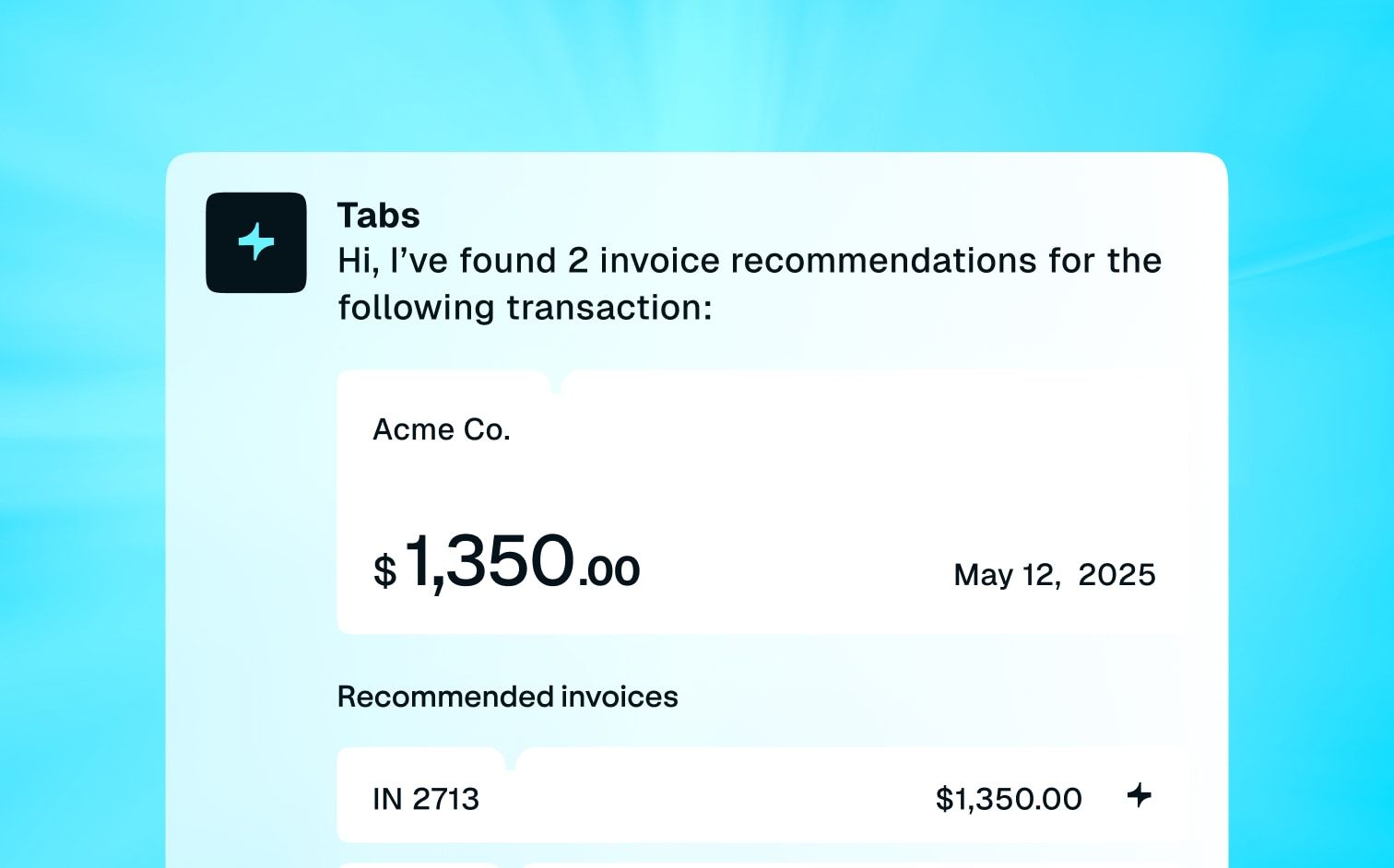
- Payment matching: Reconcile incoming payments to open invoices automatically.
- Collections automation: Trigger context-aware follow-ups based on customer payment history.
The result is faster cash collection, fewer billing errors, and finance teams that can handle growth without drowning in manual work.
Revenue protection with AI risk and fraud controls
Protecting revenue is just as important as generating it. AI helps finance teams identify anomalies, flag potential fraud, and maintain compliance—all without creating friction for legitimate customers.
Anomaly detection works by establishing baseline patterns and alerting when something deviates significantly. This could be an unusually large transaction, a sudden spike in refund requests, or a payment pattern that doesn't match historical behavior.
Precision is the goal. Overly aggressive fraud controls block legitimate customers and create support headaches. AI-powered systems reduce false positives by considering context—not just whether a transaction looks unusual, but whether it makes sense given everything else you know about that customer.
- Anomaly detection: Flag unusual patterns in transactions or billing data before they become problems.
- Fraud scoring: Assess transaction risk in real time to prevent unauthorized charges.
- Compliance monitoring: Automate checks for regulatory requirements and maintain audit-ready records.
Product and service innovation with AI revenue models
AI-native products—inference calls, API usage, vector storage—don't fit neatly into traditional pricing models like seat-based billing.
Usage-Based Billing charges customers for what they use, rather than a flat monthly fee. This aligns your revenue with the value customers receive, which typically increases retention and expansion. But it also creates billing complexity that traditional systems often struggle to handle at scale—especially when you add tiers, minimums, credits, and proration.
Tabs natively supports subscription-based billing, usage-based, and hybrid billing models. This means your product team can launch new pricing strategies without waiting for engineering to build custom billing logic. And your finance team can recognize revenue correctly without building complex spreadsheet models.
- Usage-based billing: Charge for actual consumption—API calls, compute cycles, active users.
- Hybrid models: Combine base subscriptions with usage components and overage tiers.
- Feature gating: Monetize specific capabilities through tiered access without custom development.
When your billing infrastructure supports experimentation, your product team can iterate on pricing as fast as they iterate on features.
The impact on company revenue with AI agents for finance teams
AI investments in finance operations should deliver measurable returns. The metrics that matter are straightforward: How fast do you close the books? How quickly do you collect cash? How much volume can your team handle?
Cortex reduced overdue invoices by half after implementing Tabs. Statsig dramatically reduced aged receivables and now handles triple their previous invoice volume without adding headcount. These aren't theoretical benefits—they're operational realities.
- Faster close: Reduce the time from month-end to financial close by eliminating manual reconciliation.
- Lower DSO: Accelerate cash collection through automated dunning and intelligent payment tracking.
- Headcount efficiency: Handle volume growth without proportional team expansion.
- Audit readiness: Maintain complete, traceable records that reduce audit prep time.
The finance teams that adopt AI-powered Revenue Automation consistently outperform those relying on disconnected tools and manual processes. The gap will only widen as billing complexity increases and usage-based models become standard.
Put AI agents to work across your revenue operations
AI isn't optional for finance teams anymore. 93% of US companies are already deploying or scaling it. The teams pulling ahead are using platforms that understand commercial context, from escalator clauses to usage-based tiers, and translate that understanding into accurate billing, faster cash collection, and compliant revenue recognition.
Tabs operationalizes your signed contracts into invoicing, collections, and ASC 606-compliant Revenue Recognition — all in one system, without rebuilding logic in spreadsheets every time a deal gets complex. Teams like Cortex and Statsig have already cut overdue invoices and scaled invoice volume without adding headcount.
See what AI-powered Revenue Automation can do for your contract-to-cash cycle. Get a Tabs demo.
AI agents for finance teams FAQs
How does AI actually increase company revenue for finance teams?
AI drives revenue by improving pricing and conversion decisions, automating manual billing and reconciliation work, and letting teams scale volume without scaling headcount proportionally. Finance sits at the intersection of contracts, cash, and compliance, making these workflows especially high-leverage for AI investment.
What's the difference between generic AI extraction tools and a platform like Tabs?
Generic tools extract fields like dates and dollar amounts but stop short of mapping them to commercial logic. Tabs classifies contract terms and translates them directly into executable billing schedules and ASC 606-compliant revenue recognition.
Can AI actually improve pricing decisions, not just automate billing?
Yes — AI-powered pricing analyzes demand signals, competitive positioning, and willingness-to-pay data to recommend adjustments while modeling the margin and retention impact before changes go live.
How does AI improve revenue forecasting accuracy?
AI-powered forecasting incorporates leading indicators like usage patterns and payment behavior, rather than just pipeline snapshots, which can improve accuracy by up to 40%.
Does Tabs support usage-based or hybrid billing models?
Yes. Tabs natively supports subscription, usage-based, and hybrid billing models — including tiers, minimums, credits, and proration — without custom engineering work.