




Usage-based billing software promises to align revenue with value delivered, but most platforms stop at counting events and leave finance teams to manually interpret contract terms, chase discrepancies, and reconcile invoices against complex commercial agreements. Unlike subscription billing — where charges are fixed and predictable — usage-based billing must track real-time consumption, apply contract-specific pricing logic, and reconcile variable charges against committed spend. This guide breaks down how usage-based billing actually works, what to look for when evaluating platforms, and how modern finance teams can turn billing from an operational burden into a strategic advantage.
What is usage-based billing software?
Usage-based billing software calculates what customers owe based on what they actually consume — API calls, storage, tokens, or seat-based pricing — rather than a flat monthly fee. This means your invoices reflect real value delivered, not arbitrary subscription tiers.
For finance teams, this software bridges the gap between engineering systems that track product usage and accounting systems that recognize revenue. Without it, you're stuck exporting data into spreadsheets and manually calculating bills. That process breaks down fast when you're handling hundreds of customers with different pricing terms.
But here's what most platforms miss: counting usage events is only half the job. The real challenge is applying the right contract terms to that usage. Tabs approaches this differently by providing commercial context — using AI to extract, classify, and map minimum commitments, volume discounts, and custom clauses from signed contracts into billing logic. The invoice matches the deal. And your team spends far less time interpreting custom terms — because exceptions are flagged for review instead of hidden in spreadsheets.
How usage-based billing works
The workflow moves from raw product data to recognized revenue in five steps.
Why it matters: If any step isn't auditable, you'll spend month-end chasing discrepancies — across usage logs, invoices, cash, and Revenue Recognition.
Define your pricing model
First, you configure how usage translates into charges. Will you bill per unit? In tiers? With prepaid credits? This logic typically requires coordination between finance, product, and sales.
Tabs reduces this setup burden by using AI to ingest executed contracts and translate deal terms into billing configuration. You can review and approve the generated logic — so you keep control while avoiding manual rebuilds.
Ingest and meter usage events
Your product sends usage data to the billing system via APIs or batch uploads. The system must handle duplicates gracefully. If the same event gets sent twice, it should only bill once.
Rate, invoice, and collect
The platform applies your pricing rules to the metered data and generates an invoice. Automated dunning workflows then track payment status and follow up on overdue balances without manual intervention.
Recognize revenue accurately
Usage-based Revenue Recognition is complex because you recognize revenue as consumption occurs — not when time passes. The Financial Accounting Standards Board's (FASB) converged Revenue Recognition standard introduced complex, detailed requirements that span dozens of implementation guides. This requires real-time synchronization between billing and your general ledger.
Set spend controls and alerts
Finally, you set thresholds and alerts to catch unexpected usage spikes before they become billing disputes. These controls protect both your customers and your cash flow.
Usage-based pricing models for software as a service (SaaS) and AI
Most B2B companies don't use a single pricing model. They combine approaches to balance predictability with growth potential — OpenView's research on usage-based pricing found hybrid models achieve stronger median growth, outperforming pure subscription or pure usage approaches. Here are the most common models:
- Per-unit pricing: A fixed rate for each unit consumed — one API call, one token, one gigabyte. Simple and scales linearly. Best suited for products with predictable, uniform consumption patterns.
- Tiered pricing: Different rates as usage crosses thresholds. For example, the first 1,000 units cost more per unit than the next 5,000. Works well when you want to incentivize higher volume while maintaining margins at lower tiers.
- Volume pricing: The rate is based on total volume, applied retroactively to all units. Unlike tiered pricing, every unit costs the same — the rate just depends on how many you use. Ideal for enterprise contracts with large, predictable consumption.
- Prepaid credits: Customers buy credits upfront and draw down as they consume. This gives finance teams cash flow predictability while preserving usage-based flexibility for the customer. Common in AI and infrastructure products where consumption varies month to month.
- Hybrid subscription plus usage: A base platform fee plus variable usage charges. This is the fastest-growing model in B2B SaaS because it combines revenue predictability with upside from customer expansion.
- Committed spend: Customers commit to a minimum amount. Usage applies against that commitment, with overages billed at negotiated rates. Particularly common in enterprise deals where procurement requires budget certainty.
Tabs supports all these models natively. Product teams can launch new pricing strategies without waiting for custom development — and finance doesn't inherit a manual reconciliation burden.
Pros and cons of usage-based billing
"Revenue aligns with value. But variable consumption makes forecasting harder — finance teams need infrastructure purpose-built for usage models."
Usage-based billing is a powerful monetization strategy, but it introduces trade-offs that finance teams should evaluate honestly before committing.
Pros:
- Revenue aligns with value delivered. Customers pay for what they use, which reduces churn from perceived overpayment and strengthens long-term retention.
- Natural expansion revenue. As customers grow their usage, revenue grows without requiring a new sales motion — your billing model becomes a built-in upsell engine.
- Lower barrier to entry. New customers can start small and scale up, shortening sales cycles and reducing procurement friction.
- Fairer pricing builds trust. Customers who feel they're paying proportionally to value received are less likely to churn and more likely to advocate internally for expansion.
Cons:
- Revenue unpredictability. Variable consumption makes forecasting harder — especially in early-stage companies without historical patterns. Tabs forecasts cash based on historical consumption patterns and contract terms, reducing the unpredictability gap.
- Billing complexity requires specialized tooling. Rating engines, metering pipelines, and contract-aware invoicing aren't features you bolt on to a subscription platform. Finance teams need infrastructure purpose-built for usage models.
- Customer bill shock risk. Without proper controls, customers can receive unexpectedly high invoices — damaging trust and triggering disputes. See the bill-shock prevention section below for how modern platforms manage this risk.
Usage metering and real-time data accuracy
If metering is wrong, invoices are wrong. Customer trust evaporates.
If you can't reconcile usage to invoices, you can't defend revenue. Finance teams need a single source of truth for consumption data.
Ingestion methods and pipelines
Data flows in through real-time event streaming or batch processing. Real-time is often preferred because it provides up-to-the-minute visibility — your finance team can see consumption trends as they develop, not after the billing cycle closes. The pipeline must also handle late-arriving data — usage that happened yesterday but wasn't reported until today — without double-counting or creating reconciliation gaps. For high-volume products, this means processing millions of events per hour with deduplication logic that scales.
Real-time visibility and alerts
You can't wait until month-end to see usage totals. Real-time dashboards show consumption trends as they happen, letting you spot accounts approaching credit limits, identify churning customers before they leave, and flag contracts where actual usage is tracking well below committed spend — a leading indicator that the next renewal conversation will be difficult.
Anomaly detection and controls
Advanced platforms flag billing anomalies before invoices go out. If a customer's usage spikes unexpectedly, the system should pause for review rather than automatically generating a massive bill. This includes mediation — validating and standardizing raw usage records before they enter the rating engine — which catches data quality issues at the source rather than downstream in invoicing.
Billing, invoicing, and Revenue Recognition automation
The real value of usage-based billing software lies in connecting metering to the financial ledger — so your contract-to-cash process holds up from usage capture through invoicing, cash, and recognized revenue.
Automated invoicing logic
The platform generates invoices that reflect each customer's specific contract terms — proration for mid-cycle upgrades, true-ups for minimum commitments, and complex overage logic. Billing automation eliminates the manual spreadsheet work that slows down cycles and introduces errors. Tabs references its Commercial Graph — a unified record of contracts and usage — to align each line item to the underlying terms, with audit trails and exception workflows when data doesn't reconcile.
Smart collections and dunning
Getting the invoice out is half the battle. Collecting payment is the other half. Automated workflows send reminders based on due dates, escalate overdue balances through configurable sequences, and adapt follow-up timing based on customer payment history. Embedded payment links let customers pay immediately via credit card or Automated Clearing House (ACH) — removing friction that delays cash collection.
ASC 606 Revenue Recognition
Under Accounting Standards Codification (ASC) 606, you recognize revenue as the performance obligation is satisfied — which means as usage occurs, not on a straight-line basis over the contract term. This creates a unique challenge: Step 3 of the ASC 606 framework requires estimating variable consideration, and usage-based revenue is inherently variable. Finance teams must continuously re-estimate transaction prices as consumption data arrives — a process that's error-prone and audit-intensive when handled manually.
The compliance burden is real. Auditors expect detailed documentation of how variable consideration was constrained, how standalone selling prices were allocated, and how revenue was recognized at each reporting period. Tabs automates Revenue Recognition schedules and journal entries based on real-time consumption data, maps each usage event to its performance obligation, and maintains the audit trail your auditors need — reducing month-end spreadsheet reconciliation from days to hours.
Pricing optimization and bill-shock prevention
Bill shock — when customers receive unexpectedly high invoices — kills relationships. Finance teams must prioritize transparency.
Customer-facing usage visibility
Customers should see the same usage data you do. A self-serve portal where they track consumption builds trust and reduces support tickets.
Thresholds and spend controls
Configure alerts when customers reach 50%, 80%, or 100% of their committed spend. Hard caps can trigger alerts — or, when integrated with your product entitlements, enforce usage limits — protecting customers from runaway costs.
Version testing and backtesting
Before rolling out new pricing, run the logic against historical usage data. See what invoices would have looked like under the new model. Which customers would pay more? Which would pay less? What's the net revenue impact? This modeling is essential for optimizing pricing without risking current revenue — and it gives your team the confidence to iterate on pricing strategy without guesswork.
Use cases in AI and SaaS companies
Different industries apply usage-based models in unique ways. The billing logic that works for a developer platform charging per API call looks nothing like an AI company billing per inference token — and hybrid enterprise contracts add another layer of complexity entirely.
AI tokens and inference workloads
AI companies bill based on tokens, compute seconds, or inference calls. This usage is highly variable — a single customer might consume 10x their typical volume in one week, then drop back the next. The system must handle micro-transactions at scale, aggregate them into comprehensible monthly bills, and apply contract-specific pricing logic to each event. Companies like Statsig and Cursor rely on Tabs to manage this complexity — turning unpredictable inference-based consumption into accurate, contract-aligned invoices without manual intervention.
API and platform consumption
Developer platforms bill for API requests, bandwidth, or active connections — over 40% of SaaS companies now use consumption elements in their pricing. These high-volume, low-value transactions must be aggregated accurately — and failed API calls should be filtered out so customers aren't charged for errors. The billing system also needs to distinguish between different API endpoints that may carry different pricing, and handle rate-limiting scenarios where usage is capped but still needs to be tracked.
Hybrid enterprise contracts
Large enterprises negotiate custom contracts with committed spend, volume discounts, and specific overage rates. A single contract might include a base platform fee, tiered usage charges for API calls, prepaid credits for compute, and quarterly true-ups against a minimum commitment. Managing these hybrid agreements requires a platform that handles both recurring and variable logic simultaneously — and reconciles them against the actual contract terms, not a simplified approximation.
Integrations with ERP, CRM, and data pipelines
Your billing software shouldn't be an island. It must connect sales, engineering, and finance across your entire finance stack. Without tight integrations, you're back to manual data entry and CSV exports — the exact problem usage-based billing software is supposed to solve.
ERP integrations and postings
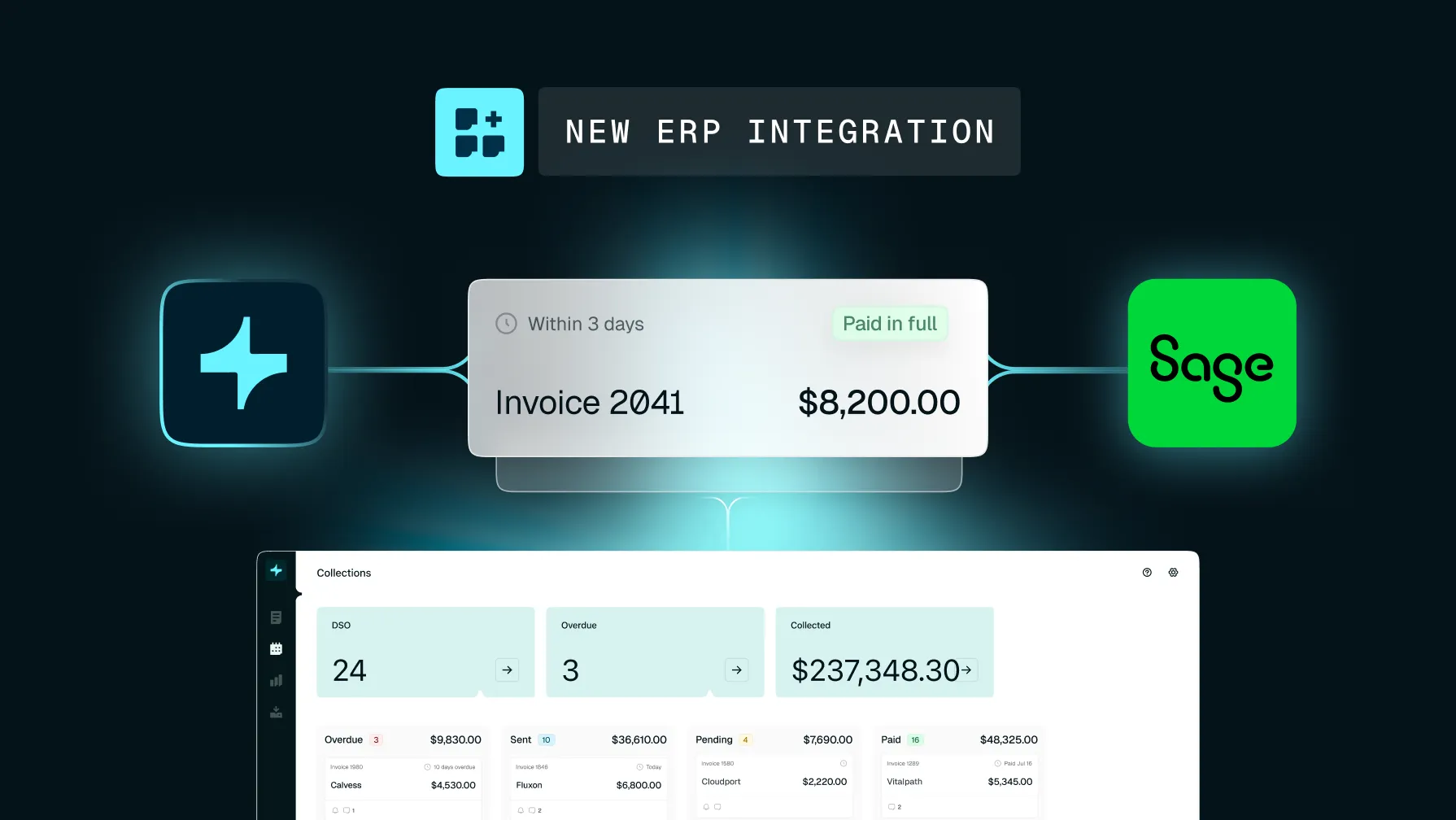
Billing data flows into your ERP to update the general ledger — invoices, payments, and revenue schedules. Tabs offers native integrations with NetSuite, QuickBooks, and Sage Intacct that automate these postings.
CRM integrations and contracts
The contract is the source of truth for billing. Tabs uses AI to extract terms from signed contracts attached to CRM records or stored in your contract repository, so billing logic stays aligned to the executed agreement — with approvals and audit trails for changes.
Data pipelines and warehouses
For deep analysis, usage and billing data should export to data warehouses like Snowflake or BigQuery. This enables complex queries on customer behavior, unit economics, and cohort-level revenue trends that inform pricing strategy and capacity planning.
Results finance teams achieve with usage-based billing
The right software drives measurable outcomes — and real proof points from finance teams already running usage-based models.
"Usage-based billing done right turns billing from a cost center into a growth engine — automating the contract-to-cash workflow so finance teams can close faster and capture more revenue."
Days sales outstanding (DSO) reduction and cash acceleration
Automated invoicing and collections reduce the time it takes to get paid. Embedded payment links and automated follow-ups improve working capital. Statsig achieved a 100% reduction in aged receivables after switching to Tabs — eliminating the overdue invoices that had been dragging out their cash cycle. When invoices are accurate and delivered on time, customers pay faster.
Billing accuracy and revenue capture
Manual processes are error-prone, often resulting in under-billing. Automation ensures every billable event is captured and invoiced according to the contract. Cortex reduced overdue invoices by 50% by moving from manual billing workflows to Tabs — catching revenue that had previously slipped through the cracks due to misapplied contract terms and delayed invoicing.
Close speed and team efficiency
Automated Revenue Recognition and ERP reconciliation let finance teams close in days rather than weeks — and handle growth without adding headcount. Statsig handled 3x their previous invoice volume without adding a single finance hire, freeing their team to focus on strategic work instead of manual reconciliation. That's the difference between a billing tool and a revenue platform.
How Tabs approaches usage-based billing software differently
Tabs focuses on commercial context, not just event counting.
AI contract ingestion and configuration
Tabs uses AI to extract billing terms from signed contracts — PDFs, Word docs, or emails. The AI is specifically trained on B2B revenue model nuances, so it can distinguish between a committed spend clause and a simple minimum, or between a tiered overage rate and a flat surcharge. This eliminates manual data entry and configuration, letting you go from signed contract to active billing in minutes — not the weeks of setup that traditional billing platforms require.
Commercial Graph and context
Tabs builds a Commercial Graph for every customer, unifying contracts, usage data, payments, and terms into a single intelligent record. This isn't just a database — it's a system of intelligence that understands the business implications of contract terms. When a customer's usage crosses a tier threshold or triggers an overage clause, Tabs applies the correct commercial logic automatically. Billing logic always reflects the current commercial reality.
Finance-grade automation and control
Tabs is built for finance teams. It prioritizes audit trails, approval workflows, and strict compliance over simple payment processing. Every contract, amendment, and billing event is logged and traceable — giving your team and your auditors the transparency they need without sacrificing the speed that modern billing demands.
How to choose usage-based billing software
What features should you look for in usage-based billing software? Selecting the right platform depends on your business stage and complexity. Use this as an evaluation checklist — and for a deeper comparison, see the Tabs buyer's guide to billing platforms — the right answer varies by company, but every usage-based billing platform should be assessed against these dimensions.
Annual recurring revenue and complexity
Early-stage startups may get by with simple tools. But as annual recurring revenue (ARR) grows, the cost of billing errors increases — a single misapplied pricing tier on a six-figure contract can mean weeks of back-and-forth with the customer and their procurement team. Enterprise companies need deep configurability: support for custom rate cards, negotiated discounts, and contract amendments that take effect mid-cycle.
Sales motion and contracts
Sales-led motions with negotiated contracts need platforms that handle custom terms — minimum commitments, volume discounts, overage rates, and escalation clauses that vary deal by deal. Product-led growth (PLG) companies need strong self-serve infrastructure with real-time metering and transparent billing portals. Tabs supports both, ingesting contract terms from signed agreements and applying them automatically to usage data.
Technical resources and ownership
Some billing tools require engineering resources to maintain — every pricing change becomes a development ticket. Tabs is designed for finance ownership. Your team can manage billing logic, launch new pricing models, and configure contract terms without constant engineering support.
Collections and Revenue Recognition requirements
Don't just evaluate invoice generation. Consider the entire contract-to-cash lifecycle: collections workflows, dunning automation, and ASC 606 Revenue Recognition. Avoid stitching together multiple point solutions — each integration point is a place where data can fall out of sync, creating reconciliation work that defeats the purpose of automation.
Scale, security, and compliance
As usage volumes grow from thousands to millions of events per day, your platform must keep pace without degrading accuracy or latency. Demand strict uptime SLAs from your vendor — billing is mission-critical infrastructure, and downtime means you can't collect cash or close the books. Your billing platform should maintain SOC 2 compliance with encryption at rest and in transit, ensuring your financial data is audit-ready from day one. Ask about event throughput capacity, disaster recovery procedures, and how the platform handles usage spikes during peak periods.
Frequently asked questions
What is usage-based billing?
Usage-based billing is a pricing model where customers are charged based on their actual consumption of a product or service — such as API calls, storage, or compute time — rather than paying a flat subscription fee regardless of how much they use.
Can usage-based billing handle enterprise contracts with committed spend and overages?
Yes — modern platforms like Tabs manage hybrid models combining subscriptions, committed spend, and usage-based overages within a single contract.
How do finance teams prevent customers from receiving unexpectedly high invoices?
Customer-facing usage dashboards, threshold alerts, and spend caps provide visibility and control before invoices are generated.
What data sources does usage-based billing software require to generate accurate invoices?
Platforms need usage event data from product systems, contract terms from CRM or document sources, and payment data from processors or banks.
How does usage-based billing handle Revenue Recognition under ASC 606?
Revenue is recognized as consumption occurs — not on a straight-line basis over the contract term. Modern platforms automate journal entries in sync with real-time usage data, mapping each event to its performance obligation and maintaining the audit trail required for compliance.