





Revenue systems are straining. There’s a good chance yours is working harder than it should. Most finance teams I talk to are still relying on tooling that assumes revenue behaves in neat, predictable ways.
For decades, we operated in a world of upfront deals and annual subscriptions. Revenue followed a linear path, making it straightforward to reconcile with few surprises.
Today’s revenue, by contrast, is dynamic. Pricing models are evolving fast, especially as more companies try to tie what they charge to the value they create. AI infrastructure bills per token. Customer support platforms charge per resolution. Cloud platforms and multi-product suites meter and bill usage in every direction.
And yet most companies are still using platforms built for the subscription era. From 2015 to 2022, the market moved quickly to unbundle the ERP and automate basic workflows. That worked… until usage, hybrid contracts, and AI-native products made revenue too dynamic for static rules.
To see how far this shift has gone, just look at how software leaders are pricing today. Salesforce introduced a credit-based model where customers pay per action. Intercom now charges $0.99 per resolution for its FinAI Agent. Newer AI-native platforms are leaning even further into performance-based pricing. Chargeflow takes 25% of every successful chargeback it recovers. FlyCode only charges on revenue recovered above a customer’s existing baseline.
Every company is a usage-based company. Or they will be.
This shift is one of the most exciting changes in software. But it’s also one of the most painful—especially for the teams responsible for making it all work.
The Current State: Usage Pricing Is Easy to Sell, Hard to Operationalize
When usage is your pricing model, your contract is just the starting point. Every API call or milestone hit becomes part of your financial platform. Your ability to get paid, close the books, forecast accurately, and stay compliant now depends on how well you can process that data at scale without sacrificing accuracy or control.
Most finance platforms weren’t built for this. They treat usage as an edge case for accounting, relying on brittle integrations, duct-taped spreadsheets, and manual reconciliation across ingestion, billing, and rev rec. When usage volumes spike or pricing logic changes mid-cycle, the whole system starts to fracture. And when that happens:
- Forecasting breaks.
- Audit risk increases.
- Close cycles slow down.
In practice, this is one flavor of that reactive operating model:
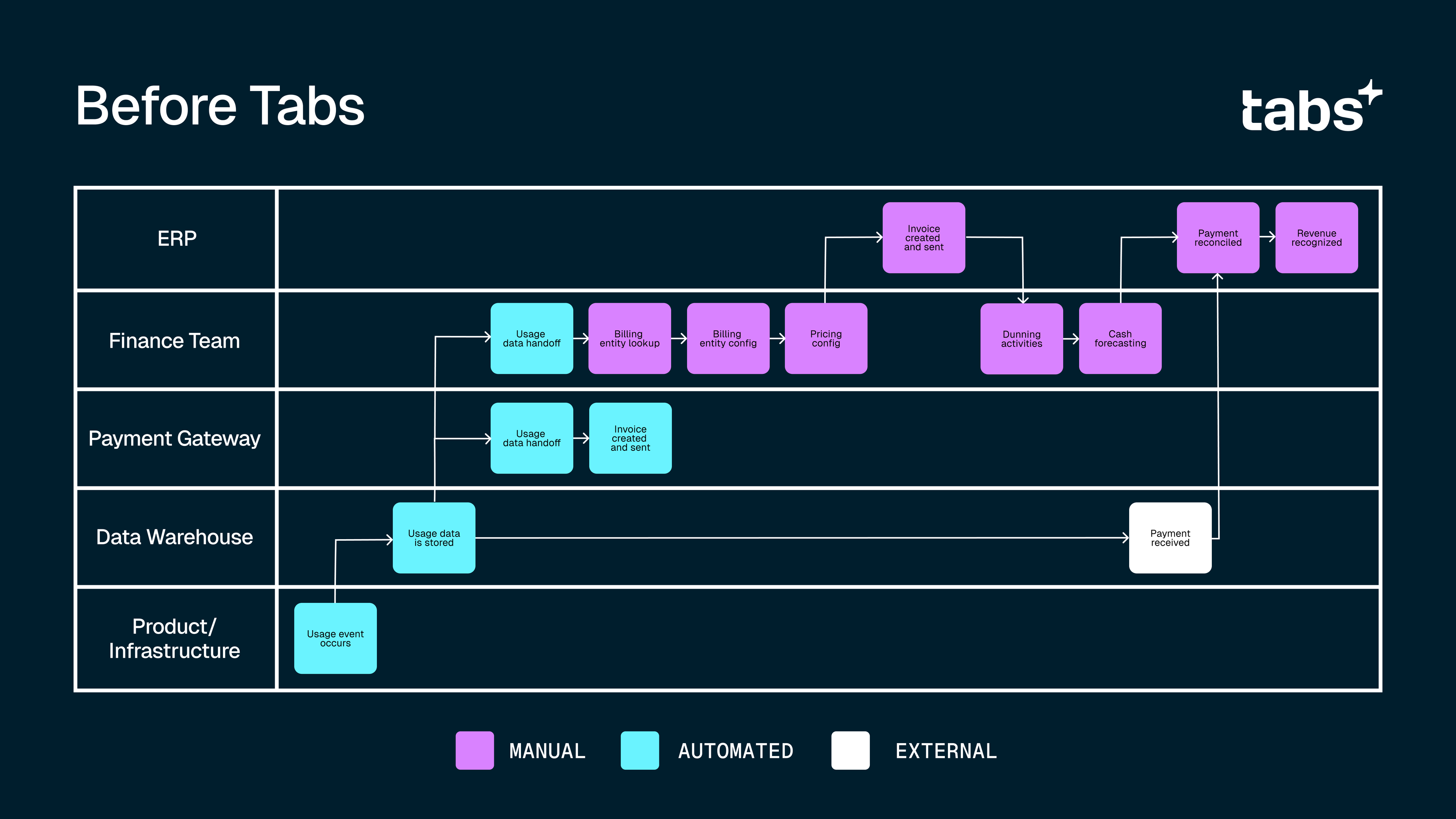
A single usage event sets off a chain of work across Engineering and Finance to turn usage into reliable revenue. In most organizations, that end-to-end process is stitched together from patchwork systems and brittle handoffs. The result is a fragmented billing and revenue workflow that slows finance teams down and makes accurate, timely closes harder than they should be.
To see where this process breaks down, it helps to break the journey of a single usage event into five distinct steps:
- The product is used: A customer uses your product and the associated raw usage event, which captures and represents the usage in its simplest form, is generated.
- Usage is metered: The raw usage event is counted, unit logic is applied to it, and the total amount of usage that occurred over a period of time is usually aggregated in this stage.
- Metered usage handoff from Engineering to Finance: The aggregated usage is handed off to the Finance team in a spreadsheet, or pushed to the solution Finance uses via API/some form of integration.
- Usage is invoiced: Finance invoices the customer who used the product for the proper amount they consumed.
- Revenue for the usage is recognized: Revenue made from usage of the product is properly recognized according to ASC 606.
Usage As A Collaborative Process
Usage-based pricing is, by definition, a cross-functional effort. Product and Engineering generate and meter usage, but Finance owns the responsibility of turning that usage into revenue that’s accurate, auditable, and compliant. One team can’t succeed without the other.
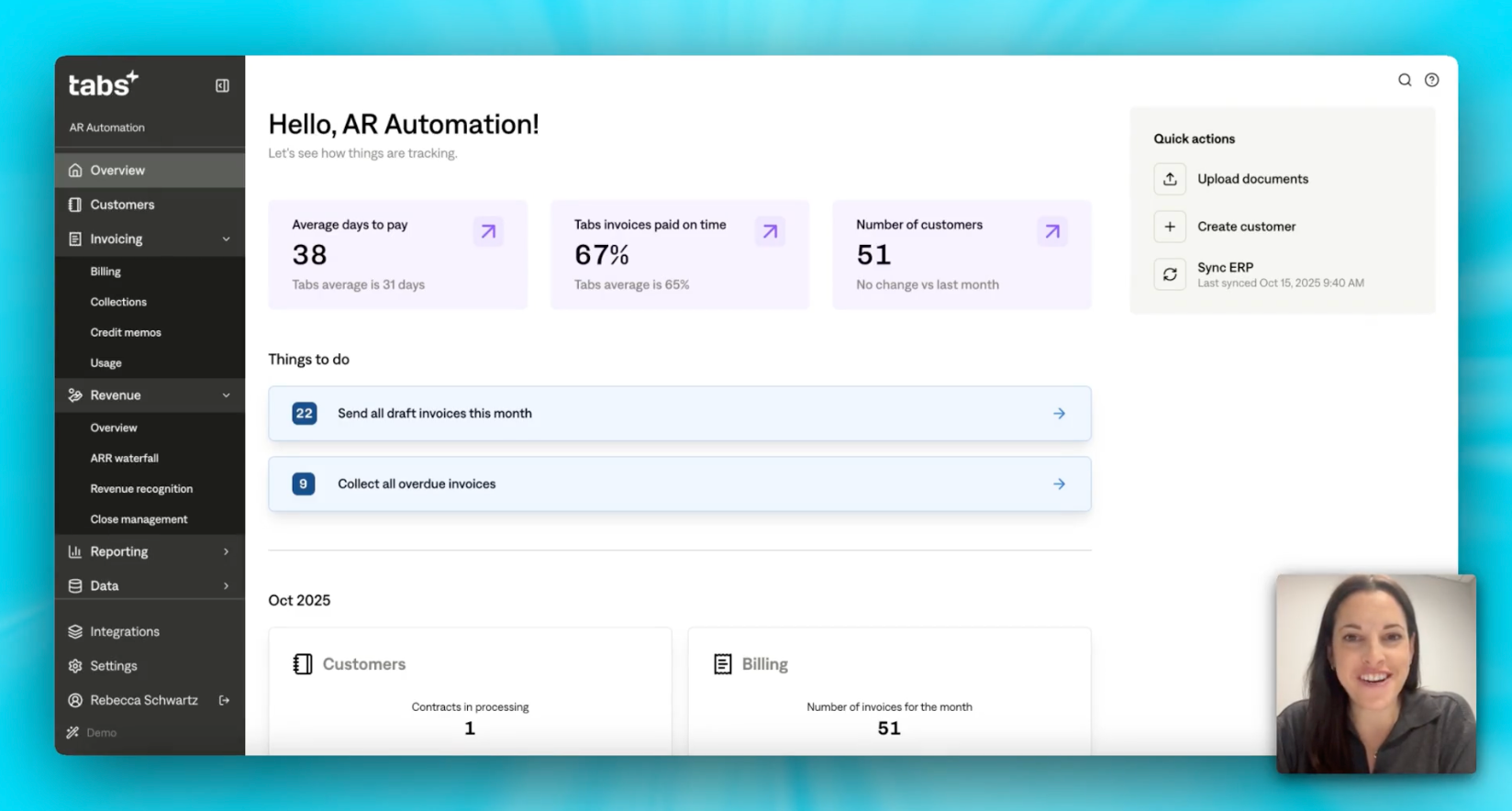
Tabs bridges that gap by simplifying the handoff from Engineering to Finance. Engineering can confidently pass metered usage and move on, while Finance takes full ownership of billing, collections, and revenue recognition in a single platform built with the controls, auditability, and flexibility their function demands.
When that collaboration works, usage-based revenue becomes a seamless process instead of a series of fragile handoffs. But the real challenge isn’t the complexity of usage itself: it’s that Finance is being asked to own revenue outcomes without platforms designed to support them. Once usage data leaves Engineering, Finance needs more than raw numbers; they need structure, rules, and traceability they can trust.
That shift defines what modern finance teams need to operate usage-based pricing at scale.
What Finance Teams Need
To reliably run billing and revenue for usage-based pricing, they need a platform that treats usage as first-class financial data and not just an edge case bolted onto legacy billing and accounting tools. That starts with ingesting usage in real-time and tying it directly to pricing logic, commitments, and contractual terms.
From there, the best teams are following these key practices:
- Centralize pricing and billing logic in one platform. Billing entities, price configuration, commitments, and exceptions should be enforced in software, not split across spreadsheets, configs, and tribal knowledge.
- Tie every revenue outcome back to the contract. Contracts must define how usage is billed and when revenue is earned, with clear rules that apply consistently across billing and revenue recognition.
- Operate in real time, not after the close. Usage spikes, retroactive pricing changes, and contract amendments should update billing and revenue automatically as they happen, not weeks later through reconciliation.
- Invest in a platform built for usage from day one. Supporting usage-based pricing at scale requires more than integrations and workarounds. It requires a platform designed to own usage end to end. That’s why leading teams are investing in Tabs, the category leader in usage-based billing and revenue automation.
Usage as First-Class Data with Tabs
This is what the workflow looks like when usage is treated as first-class financial data:
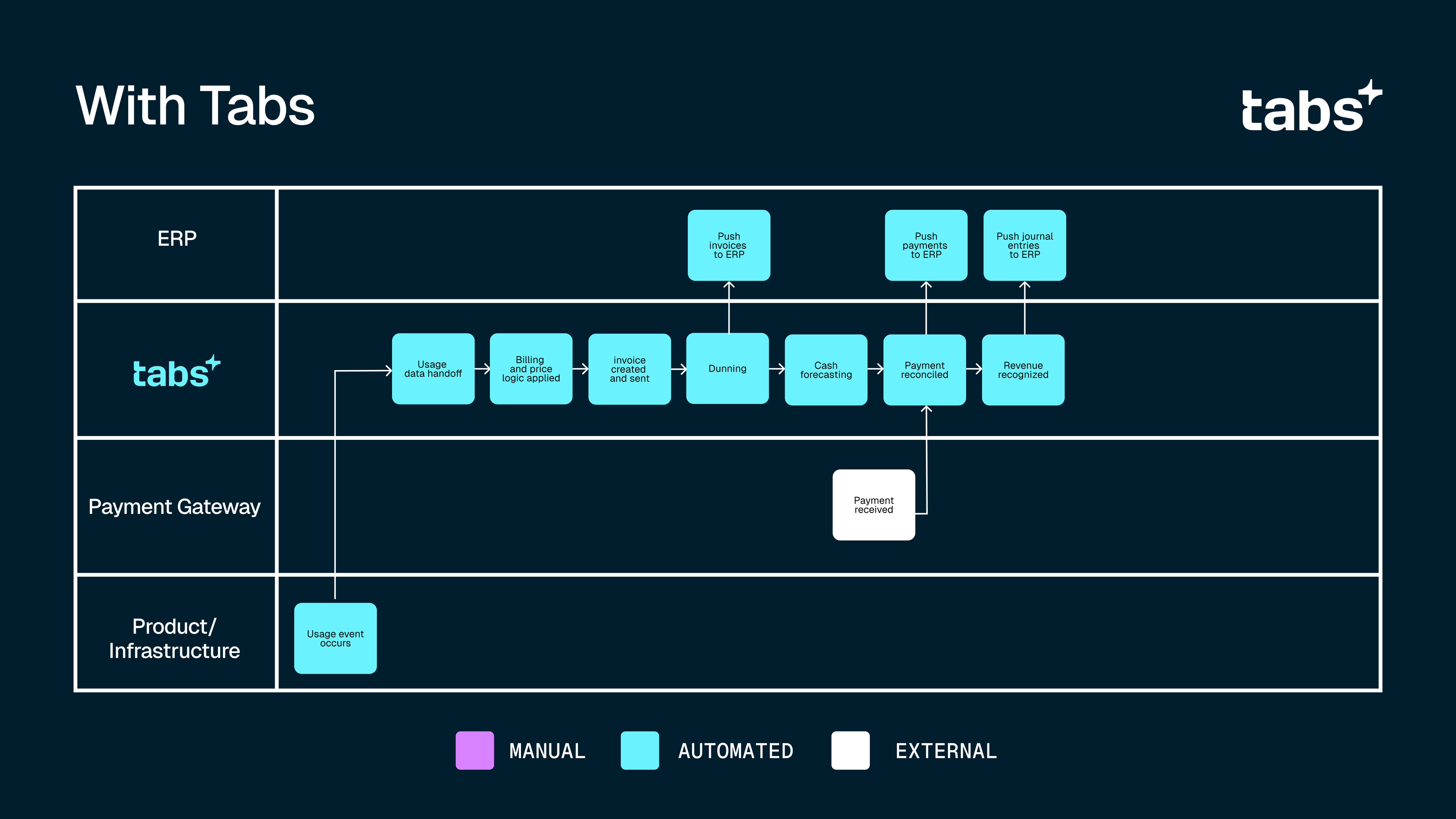
Instead of bouncing between different platforms, usage events flow directly into a centralized billing engine. The moment usage is pushed to the billing engine, it’s interpreted in the context of the contract. That’s because pre-defined billing and pricing logic live in one place, not scattered across tools and spreadsheets.
Invoices are created automatically and correctly the first time. There’s no need to look up billing entities, reapply pricing rules, or reprocess data downstream. The logic that determines how usage turns into dollars is enforced in-platform, consistently, every time.
Because billing, pricing, and usage are unified, everything downstream becomes simpler. Payments are automatically reconciled cleanly. Dunning operates off accurate, real-time balances. Cash forecasting reflects what’s actually been earned.
Revenue recognition is no longer an after-the-fact exercise. It runs alongside billing, driven by the same usage data and performance obligations outlined in the contract. Commitment burndown is no longer a black box, with clear visibility into how customers are consuming against their commits. Usage-based revenue is calculated automatically, with a clear audit trail back to the original usage event and associated invoice.
The biggest shift is ownership. There are fewer handoffs, fewer external dependencies, and far less manual intervention. Usage doesn’t get passed around; it gets processed systematically. Finance moves from stitching platforms together to overseeing a workflow that runs end-to-end.
A New Category Is Forming
When usage is tied to value, pricing becomes a growth lever. But only if finance can trust the data, explain the logic, and scale the system without burning out.
Over the last decade, every major shift in the business stack has produced a new category leader. Payments needed speed and programmability; Stripe emerged. Spend needed control and visibility; Brex and Ramp followed. Workforce management needed to be rethought; Rippling won.
Billing and revenue is next.
Usage, hybrid contracts, and AI-native products have broken the assumptions baked into legacy billing and ERP systems. What’s left is a fragmented category – billing in one place, revenue recognition in another, contracts somewhere else – held together by spreadsheets and manual work.
Tabs exists to close that gap.
The future of revenue is usage-based. The winners will be the companies that can trust it. That’s the category Tabs is building, and why we believe it will define the next generation of finance infrastructure.