





For B2B finance teams managing complex billing models, the month-end close can consume days of manual reconciliation and last-minute scrambling. This guide walks you through seven steps to streamline your close process, reduce errors, and deliver accurate financials faster.
What is the month-end close process?
The month-end close process is a recurring accounting procedure that finalizes your company's financial records for the prior month. This means recording every transaction, reconciling all accounts, posting adjusting entries, and producing accurate financial statements. When done well, it gives leadership a clear picture of cash flow and financial health.
Your general ledger (GL) serves as the foundation—it's the master record of all financial transactions. You pull data from subledgers (detailed records for specific accounts like accounts receivable (AR) or accounts payable (AP)) to build a complete trial balance. The trial balance is a list of all account balances where total debits should equal total credits.
For B2B companies with complex billing models, the close also requires reconciling contract terms, usage data, and revenue recognition schedules. Modern revenue automation platforms don't just show when invoices are due — they forecast when cash will actually land, based on historical payment behavior and contract terms. Tabs provides this commercial context by translating signed contracts into accurate billing workflows downstream of your CRM and CPQ—so finance operationalizes what was sold without re-keying terms.
Why the month-end close matters
A disciplined close delivers decision-useful data. Leadership relies on timely financials to allocate resources, forecast growth, and make confident decisions—yet EY's CFO Barometer found 70% of finance teams have no time for analysis during the close. Delays or errors cascade into quarterly reporting problems, covenant compliance issues, and board-level credibility gaps.
For B2B finance teams, the close is the moment of truth for revenue recognition accuracy. This becomes especially critical when contracts include Usage-Based Billing, milestone payments, or hybrid pricing structures.
- Audit readiness: A clean close reduces scramble during external audits and Sarbanes-Oxley (SOX) reviews.
- Stakeholder confidence: Investors, lenders, and boards expect accurate, on-time reporting.
- Compliance: Covenant reporting and regulatory filings depend on reliable month-end data.
- Internal controls: The close process surfaces control gaps before they become material issues.
Month-end close steps
Every organization's close varies, but most follow a common sequence. The goal is to move systematically from transaction recording through final review—minimizing rework and late adjustments.
Step 1: Record all transactions
Start by ensuring every transaction from the period is captured in the general ledger. This includes invoices, payments, expenses, and payroll. Gaps here create downstream reconciliation issues that delay everything else.
For B2B companies, you must capture all contract-related billing events before cutoff. This includes usage charges, milestone triggers, and subscription upgrades. Missing these events distorts your revenue picture.
Step 2: Reconcile bank and credit card accounts
Bank reconciliation means matching your GL cash balance to bank statements and resolving discrepancies. You investigate uncleared items, timing differences, and errors. Credit card reconciliations follow the same logic—ensuring all charges are recorded and categorized correctly.
Automating bank feeds can significantly accelerate this step. Clean cash reconciliations form the foundation of a trustworthy balance sheet.
Step 3: Reconcile accounts receivable and accounts payable
Accounts receivable (AR) reconciliation confirms that customer balances match invoices issued and payments received. Accounts payable (AP) reconciliation ensures vendor balances align with invoices received and payments made.
Review aging reports to surface overdue items requiring follow-up or write-off consideration. For B2B teams, AR reconciliation is especially critical when contracts include variable billing or usage-based components.
Step 4: Review balance sheet accounts and prepare adjustments
Review each balance sheet account and prepare rollforward schedules. A rollforward shows the beginning balance, activity during the period, and ending balance. This includes prepaid expenses, accrued liabilities, fixed assets, and deferred revenue.
For B2B companies with subscription or usage-based revenue, deferred revenue and unbilled AR require particular attention. These balances must align with your ASC 606 revenue recognition policies.
Step 5: Record adjusting journal entries
Adjusting entries capture non-cash items and timing differences. These include depreciation, amortization, accruals, deferrals, and reclassifications. Each entry should be documented with supporting detail for audit purposes.
Revenue recognition adjustments are a common source of complexity for B2B finance teams. Contracts spanning multiple periods require precise amortization schedules that manual spreadsheet calculations often get wrong.
Step 6: Prepare financial statements
Generate the income statement, balance sheet, and cash flow statement. Review these for reasonableness by comparing to prior periods, budgets, and expectations.
Perform flux analysis—comparing actuals to prior periods—to surface anomalies requiring investigation. If an expense category jumped significantly month-over-month, you need to know why before finalizing.
Step 7: Conduct final review and lock the period
The final step involves senior review of all reconciliations, adjustments, and financial statements. The controller or CFO signs off on the complete package. Once approved, lock the period in your accounting system to prevent further changes.
Archive all documentation—sign-offs, supporting schedules, and evidence attachments—for future audit purposes. A hard period lock ensures your historical data remains unchanged and audit-ready.
Streamline your close with Tabs
Month-end close checklist
A well-designed checklist assigns tasks, owners, and deadlines to create accountability. It prevents critical steps from falling through the cracks during high-pressure days.
| Category | Key tasks | Owner |
|---|---|---|
| Cash and banking | Bank reconciliation, credit card reconciliation | Treasury |
| Receivables | AR aging review, payment application, bad debt assessment | AR Manager |
| Payables | AP aging review, invoice processing, accrued expenses | AP Manager |
| Revenue | Revenue recognition entries, deferred revenue rollforward | Revenue Accountant |
| Fixed assets | Depreciation entries, asset additions and disposals | Fixed Asset Accountant |
| Final review | Trial balance review, flux analysis, period lock | Controller |
Checklist item: Cash and bank reconciliations
Complete cash and bank reconciliations early in the close to surface discrepancies immediately. Unreconciled items delay downstream work and create audit risk. Automating bank feeds and matching rules accelerates this step dramatically.
Checklist item: Accruals and deferrals
Accruals represent expenses incurred but not yet invoiced. Deferrals represent revenue or expenses recognized in future periods. These entries ensure financials reflect economic reality, not just cash movement.
For B2B companies, deferred revenue schedules must align perfectly with contract terms and revenue recognition policies.
Checklist item: AR and AP aging reviews
Aging reviews identify overdue balances requiring follow-up, write-off consideration, or escalation. AR aging directly impacts cash flow forecasting and collections prioritization. AP aging ensures vendor relationships remain healthy.
Common month-end close challenges
Even well-intentioned finance teams face obstacles. Data silos, manual processes, and reconciliation backlogs constantly threaten to derail the timeline.
- Data silos: Information scattered across spreadsheets, emails, and disconnected systems creates reconciliation headaches.
- Manual processes: Reliance on manual data entry introduces errors and slows the close.
- Late adjustments: Last-minute changes from sales or legal disrupt the timeline and force rework.
- Cutoff errors: Transactions recorded in the wrong period distort financials and require correction.
- Reconciliation backlog: Unresolved items accumulate, creating a growing tail of open issues.
For B2B companies, complex billing models—including seat-based pricing—and contract variability add layers of difficulty that generic tools weren't designed to handle.
Best practices for a faster, more accurate close
Why it matters: A continuous-close approach reduces late adjustments, improves audit readiness, and gives leadership decision-useful numbers earlier—without adding headcount.
Improving the close requires standardization, early reconciliation, and clear ownership. Build a continuous accounting mindset where work spreads evenly throughout the month rather than piling up at period end.
- Standardize procedures: Document each step in a written standard operating procedure (SOP) with clear ownership and deadlines.
- Establish a close calendar: Sequence tasks and set target completion dates to create accountability.
- Reconcile continuously: Shift reconciliation work earlier in the month rather than waiting until period end.
- Set materiality thresholds: Define thresholds for adjustments to avoid chasing immaterial items.
- Conduct preclose reviews: Review preliminary financials before the official close to catch issues early.
Standardized procedures and a close calendar
Written SOPs and a close calendar create a predictable rhythm. A close calendar assigns specific tasks to specific days. Standardization also simplifies onboarding and cross-training, reducing key-person risk.
How long should month-end close take?
Leading organizations target a close of five business days or fewer. Ledge's 2025 benchmarking study found only 18% of finance teams close in three days or less. Others may take two weeks or longer depending on complexity, team size, and automation maturity. Speed is table stakes. Cleanliness is the differentiator.
| Close duration | Typical profile |
|---|---|
| 3–5 days | Mature processes, automation, continuous reconciliation |
| 6–10 days | Moderate complexity, some manual steps |
| 10+ days | High complexity, heavy manual effort |
Benchmark your close duration against peers to identify improvement areas. Workload smoothing and a strict cutoff schedule are critical for reducing time-to-close.
How automation and AI accelerate the month-end close process
Automation and AI-powered tools address the root causes of slow, error-prone closes. According to PwC's Pulse survey, 58% of CFOs are investing in AI and advanced analytics. The goal isn't to replace finance teams—it's to eliminate manual work so teams can focus on judgment and analysis. KPMG's Elevating Finance Survey found leading organizations achieve 70%+ automation of transactional processes.
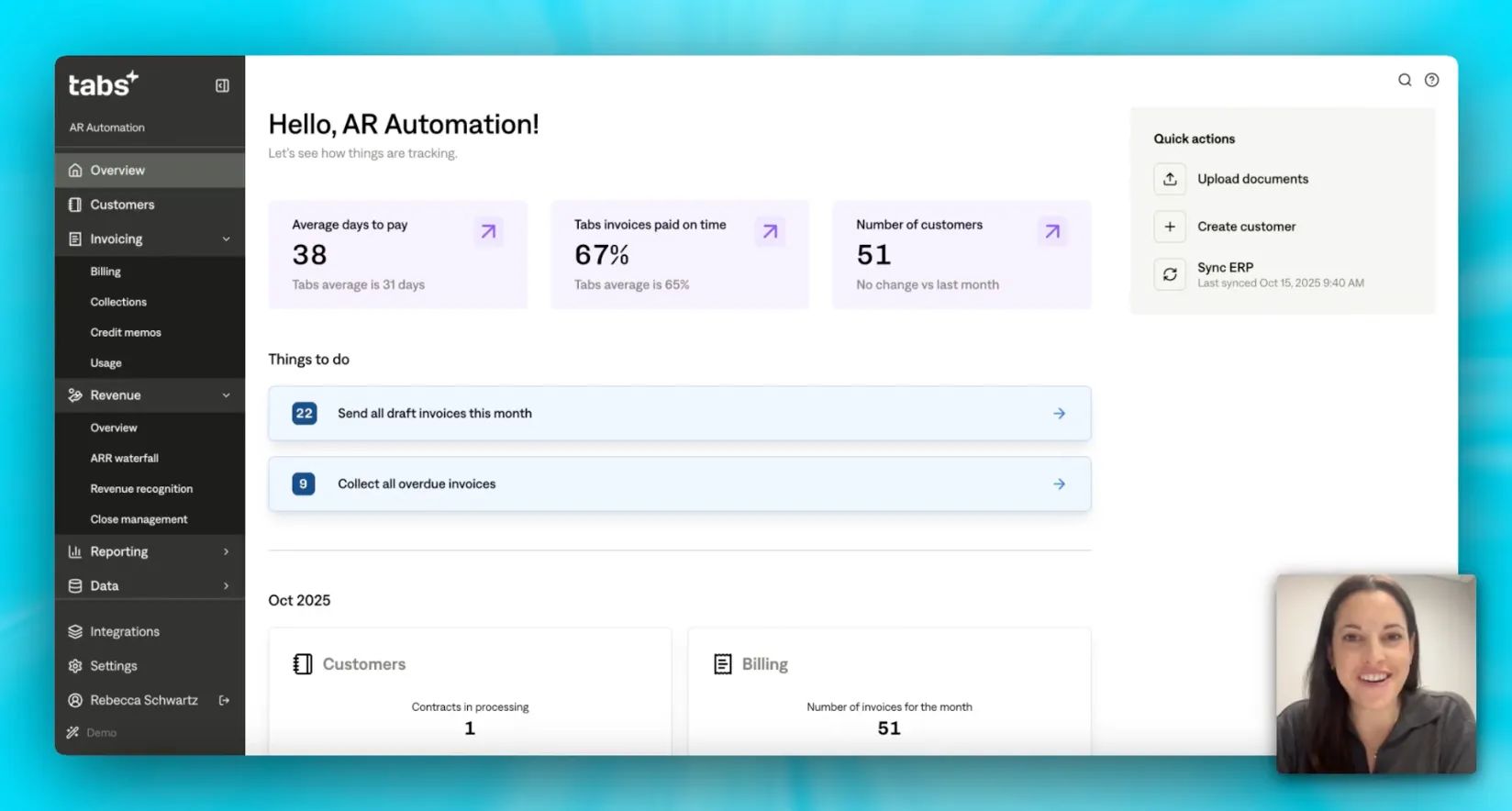
Tabs is a Revenue Automation platform that sits downstream of your CRM, focused entirely on operationalizing signed contracts. It uses AI to automate the most painful parts of the contract-to-cash process — providing commercial context, not just data extraction, so your Revenue Automation workflows stay aligned to what was signed. Tabs uses trained AI models to interpret contract terms and translate them into accurate billing workflows and Revenue Recognition journal entries.
- Contract ingestion: Extract billing terms, pricing schedules, and renewal clauses from signed contracts—reducing manual review.
- Invoice generation: Tabs generates invoices based on contract terms and usage data—reducing billing errors and rework.
- Collections automation: Send automated reminders and offer embedded payment links—accelerating cash collection.
- Revenue Recognition: Generate ASC 606–aligned journal entries with an audit trail and review workflow.
- Real-time reporting: Surface AR, cash, and recognized revenue in dashboards—without waiting for the close.
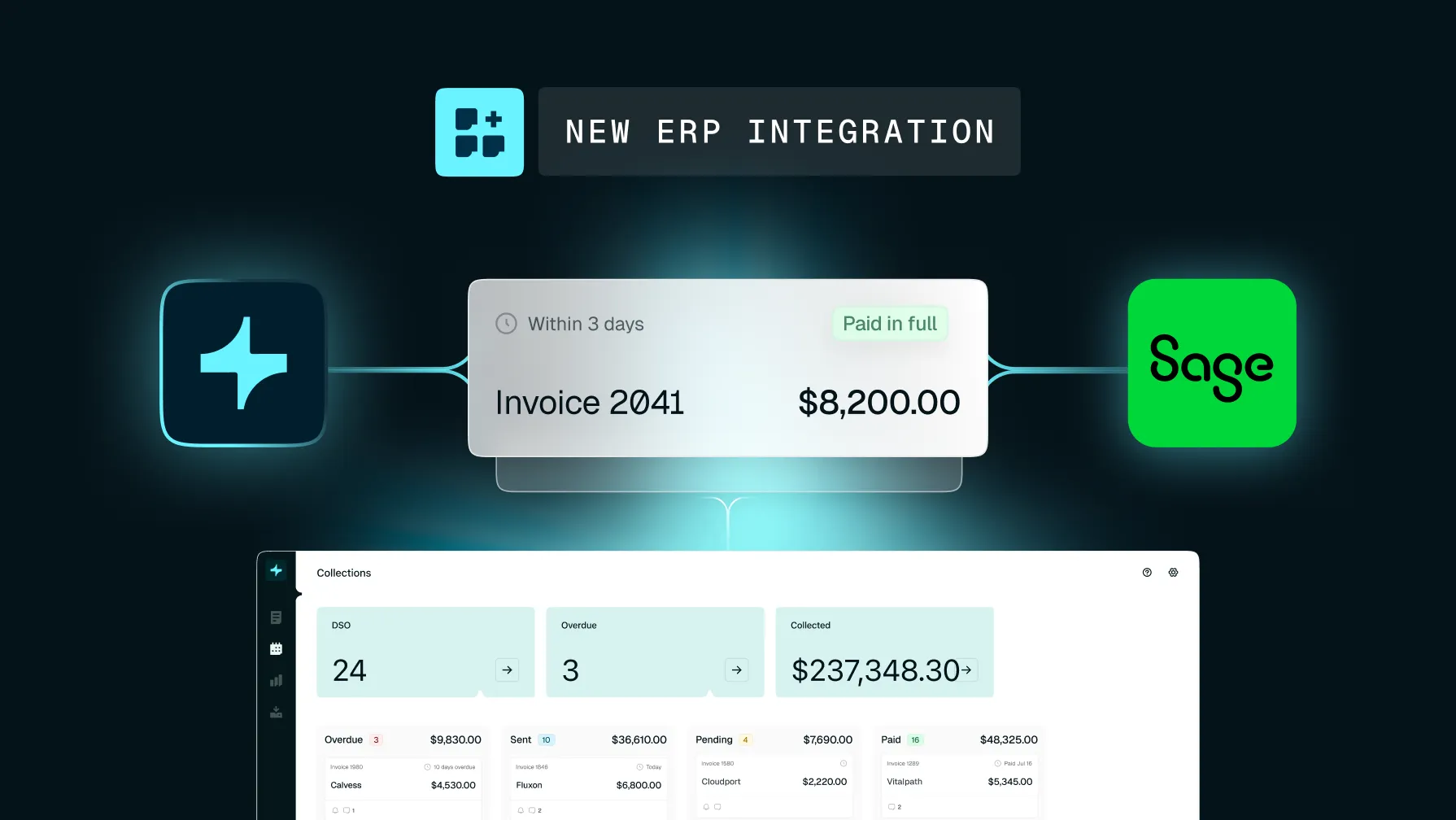
Tabs integrates with major ERPs like QuickBooks, Oracle NetSuite, and Sage Intacct—so you can modernize without abandoning your existing finance stack.
AI contract ingestion and accurate invoicing
Tabs uses trained AI models to capture pricing, billing frequency, usage thresholds, and renewal terms from signed contracts, then translates those terms into invoice logic—so the invoice matches what was signed without manual re-keying.
Frequently asked questions
What is the difference between month-end close and quarter-end close?
Month-end close finalizes a single month's records, while quarter-end close aggregates three months and includes additional procedures like external reporting and board packages. A disciplined month-end close simplifies quarter-end by reducing the backlog of unresolved items.
Which month-end close tasks benefit most from AI automation?
Tasks involving high-volume data entry, pattern matching, and document extraction—such as contract ingestion, bank reconciliation, and invoice generation—benefit most. AI is particularly effective when it applies commercial context to interpret contract terms and generate accurate billing and revenue recognition entries.