






Subscription billing was never supposed to be this complicated
Subscription businesses have grown 4.6x faster than the S&P 500 over the last decade, according to Zuora's Subscription Economy Index. But that growth has come with a cost most finance teams did not anticipate: operational complexity that scales faster than revenue.
Every B2B finance leader knows this feeling: a customer's contract includes a base subscription, usage-based pricing tied to API calls, a metered overage component, and milestone payments for implementation — and the billing system can only handle one of those at a time. What was once a straightforward recurring charge has become a web of hybrid contracts, metered consumption, milestone billing, and mid-cycle amendments that most finance teams were never equipped to handle.
A subscription management tool is software that automates the end-to-end lifecycle of recurring revenue — from contract terms and billing schedules through payment collection, revenue recognition, and financial reporting. It replaces the manual work of tracking who owes what, when, and under which terms. But today's subscription management tools need to do far more than generate invoices on a schedule.
Two forces are driving the complexity. First, the shift from flat-rate annual subscriptions to dynamic pricing models — usage-based pricing, hybrid billing, credits, and prepaid commitments — means that a single customer contract can contain multiple billing schedules with different triggers. Second, the explosion of contract variations across enterprise deals and product-led growth motions means no two customers look alike. A billing engine built for uniform recurring charges cannot keep up.
The subscription management platforms that win in this environment share a common trait: they do not just process transactions. They understand the commercial context behind every contract term — the business implications of a mid-cycle upgrade, the revenue recognition impact of a usage threshold, the collections risk of a disputed invoice. Commercial context — not just data extraction or generic automation — is what separates modern subscription management from legacy billing.
This guide breaks down what to look for in a subscription management tool — and what happens when you get it right.
Why your current billing setup can't keep up
The shift from simple subscriptions to dynamic pricing
This shift is permanent — and it is accelerating. Companies adopt usage-based and hybrid models because they align revenue with the value customers actually receive. Once a company moves to value-aligned pricing, it does not go back. And every contract amendment, pricing threshold, and usage event adds operational complexity that compounds over time.
The tools most B2B subscription billing teams rely on were not built for this reality:
- Spreadsheet-driven billing cannot handle mid-cycle amendments, usage calculations, or proration across multiple pricing components within the same contract
- Payment-processor-only setups work well for self-serve subscriptions but lack the contract awareness, revenue recognition, and ERP integration that B2B finance requires at scale
- Legacy subscription platforms bolt on usage-based capabilities as afterthoughts, creating data gaps between billing, collections, and revenue recognition that surface at the worst possible time — quarter close
The result: most billing systems treat each invoice as an isolated transaction. They do not connect a contract amendment to its downstream impact on revenue schedules, collections timelines, and financial reporting. That disconnect is where errors — and revenue leakage — hide.
The question is no longer "do we need a tool?"
When evaluating subscription management software today, the checklist has changed. It is no longer enough to ask whether a tool can generate recurring invoices. The question is whether it can connect contract terms to billing schedules, collections workflows, revenue recognition, and reporting in a single automated workflow — without manual reconciliation at every handoff. The sections that follow break down exactly what that looks like in practice.
The real cost of manual subscription management
It is the last week of the quarter. A customer upgraded mid-cycle from a flat subscription to usage-based pricing — but the change was buried in an email thread, never logged in the contract system. The invoice goes out based on the old terms. The customer disputes it. Collections stalls. Revenue recognition is off because the original schedule was never updated. The controller is scrambling to reconcile before close, pulling data from three systems that do not agree.
This is not an edge case. It is a Tuesday.
The root cause is not your team. It is your system. When subscription billing depends on manual handoffs between sales, finance, and engineering, every amendment, pricing change, and usage event is a potential break point. The people are capable. The infrastructure is not.
Where bad data hides in manual subscription management:
- Contract amendments tracked in email threads or Slack messages instead of the billing system — a classic contract data extraction failure
- Usage data arriving late from engineering, creating a lag between consumption and invoicing
- Billing schedules maintained in spreadsheets that fall out of sync with the source contract
- Payment terms negotiated by sales but never communicated to the AR team
- Revenue schedules built manually in Excel, disconnected from actual billing events
The result is what finance teams call the Frankenstein stack — a patchwork of disconnected tools, spreadsheets, and manual processes held together by institutional knowledge and heroic effort. It works until it does not. And when it breaks, the consequences cascade: delayed book close, manual overrides that introduce new errors, revenue leakage that nobody catches until audit, and eroding trust between finance and the rest of the business.
The fix is not hiring more people to manage the same broken process. It is replacing the process itself.
What a modern subscription management tool actually does
Speed is table stakes. Cleanliness is the differentiator.
Modern finance leaders do not just want faster invoicing. They want confidence — confidence that every contract, usage event, and payment flows cleanly from signature to cash to recognized revenue. No manual reconciliation — and no data gaps between what was sold and what was recognized.
That confidence rests on two pillars: clean input paired with automated workflow (accurate contract and usage data flowing through billing, collections, and rev rec without manual intervention) and auditable end-to-end traceability (every transaction traceable from contract term to journal entry).
Here is what each pillar looks like in practice.
Automate billing across every pricing model
Billing automation is the baseline — but the depth of that automation matters enormously. A subscription management tool must handle the full spectrum of B2B pricing models without requiring custom development or manual workarounds for each one.
What modern billing automation covers:
- Flat-rate subscriptions: Recurring invoices on monthly, quarterly, or annual cycles with automatic proration for mid-cycle changes
- Usage-based pricing: Real-time ingestion of consumption data — API calls, active users, data volume, transactions — with automated calculation and invoicing
- Metered billing: Tiered or volume-based pricing where the rate changes as consumption crosses thresholds
- Hybrid models: Contracts that combine a base subscription with usage-based components, overage charges, or milestone payments — all on a single invoice
- Credits and prepaid commitments: Drawdown tracking against prepaid balances, with automated alerts when credits are running low and overage billing when they are exhausted
The critical test is not whether the tool supports each model in isolation. It is whether it can handle a single customer contract that includes three or four of these models simultaneously — and adjust the invoice automatically when terms change mid-cycle. Most billing tools fail this test — they require custom workarounds or manual reconciliation the moment a contract combines two or more models on a single invoice.
Recognize revenue without the spreadsheet scramble
Revenue recognition is where subscription management complexity compounds. Every pricing model, contract amendment, and billing event has revenue recognition implications — and getting it wrong means compliance risk, restatement risk, and audit findings.
Accounting Standards Codification 606 (ASC 606) and International Financial Reporting Standards 15 (IFRS 15) require companies to recognize revenue as performance obligations are satisfied, not when cash is collected. For subscription businesses, that means:
- Automated revenue schedules that map contract terms to recognition periods — subscription revenue recognized ratably, usage revenue recognized as consumed, milestone revenue recognized at delivery
- Deferred revenue tracking that updates in real time as invoices are generated, payments collected, and amendments applied
- Journal entries generated automatically and synced to your ERP — eliminating the manual creation of rev rec spreadsheets that require weekly rebuilds as contracts evolve
- Amendment handling that recalculates revenue schedules when contract terms change mid-period, without requiring a manual rebuild
Finance teams that still manage rev rec in spreadsheets spend the last week of every quarter reconciling billing data against recognition schedules. A modern subscription management tool eliminates that scramble by connecting billing events directly to revenue schedules — so recognition stays accurate as contracts evolve.
Manage the full subscription lifecycle
Subscription management is not just about billing the first invoice. It covers every stage of the customer relationship — and each stage has operational and financial implications that your tool must handle automatically.
- Onboarding: Converting a signed contract into an active billing schedule, provisioning access, and creating the customer record across billing, collections, and ERP systems
- Renewals: Identifying upcoming renewals, generating renewal invoices or quotes, and flagging accounts with declining usage or engagement — before the renewal date arrives
- Upgrades and expansions: Processing mid-cycle changes — seat additions, plan upgrades, usage tier increases — with automatic proration and updated billing schedules
- Cancellations: Handling early terminations, calculating any remaining obligations, issuing final invoices or credits, and updating revenue schedules accordingly
- Win-back: Tracking churned customers and enabling re-engagement workflows when former customers return — without creating duplicate records or billing conflicts
The lifecycle view matters because each transition is a potential revenue event, a potential error point, and a potential customer experience moment. Tools that treat these transitions as manual processes force your team into reactive mode — chasing amendments instead of managing them proactively.
Recover failed payments before they become churn
Failed payments are the silent killer of subscription revenue. A credit card expires. A bank transfer is rejected. A wire payment gets stuck in processing. If your response is a single automated email followed by manual follow-up, you are leaving money — and customers — on the table.
Modern dunning management goes beyond generic retry logic:
- Smart retry scheduling that times payment attempts based on historical success patterns, not arbitrary intervals
- Personalized dunning sequences that escalate through email, in-app notifications, and direct outreach based on customer segment, payment history, and account value
- Pre-dunning alerts that flag expiring payment methods before they fail — reducing involuntary churn before it starts
- Automated escalation from dunning to collections workflows when payment attempts are exhausted, with full context carried over
The difference between a good dunning system and a great one is context. Sending the same payment reminder to a $500/month self-serve customer and a $50,000/year enterprise account is not just ineffective — it is a brand risk. The best subscription management tools tailor recovery workflows to the commercial relationship, not just the transaction.
Track the metrics that matter
Subscription analytics turn billing data into strategic insight. But most finance teams spend more time calculating these metrics than acting on them. A modern subscription management tool should surface them automatically — in real time, not after a week of spreadsheet work.
The metrics every subscription business must track:
- Monthly recurring revenue (MRR): The normalized monthly value of all active subscriptions — the heartbeat of your subscription business and the foundation for forecasting
- Churn rate: The percentage of customers or revenue lost in a given period — broken down by voluntary churn (cancellations) and involuntary churn (failed payments)
- Customer lifetime value (CLV): The total revenue a customer generates over their relationship with your company — critical for understanding which acquisition channels and segments deliver long-term value
- Customer acquisition cost (CAC): The total cost of acquiring a new customer, including sales, marketing, and onboarding — used alongside CLV to measure unit economics
- Net revenue retention (NRR): The percentage of recurring revenue retained from existing customers, including expansions and contractions — a NRR above 100% means your existing customer base is growing without new sales
Metrics without operational context are just dashboards. When churn rate spikes, you need to see whether it is driven by failed payments (a dunning problem), cancellations in a specific segment (a product or pricing problem), or contract non-renewals (a relationship problem). The subscription management tools that deliver real value connect every metric to the operational lever that moves it — turning numbers into decisions.
Connect your finance stack end to end
A subscription management tool is only as valuable as the systems it connects to. If billing lives in one platform, revenue recognition in a spreadsheet, collections in email, and reporting in a dashboard that refreshes weekly — you have not automated subscription management. You have distributed it.
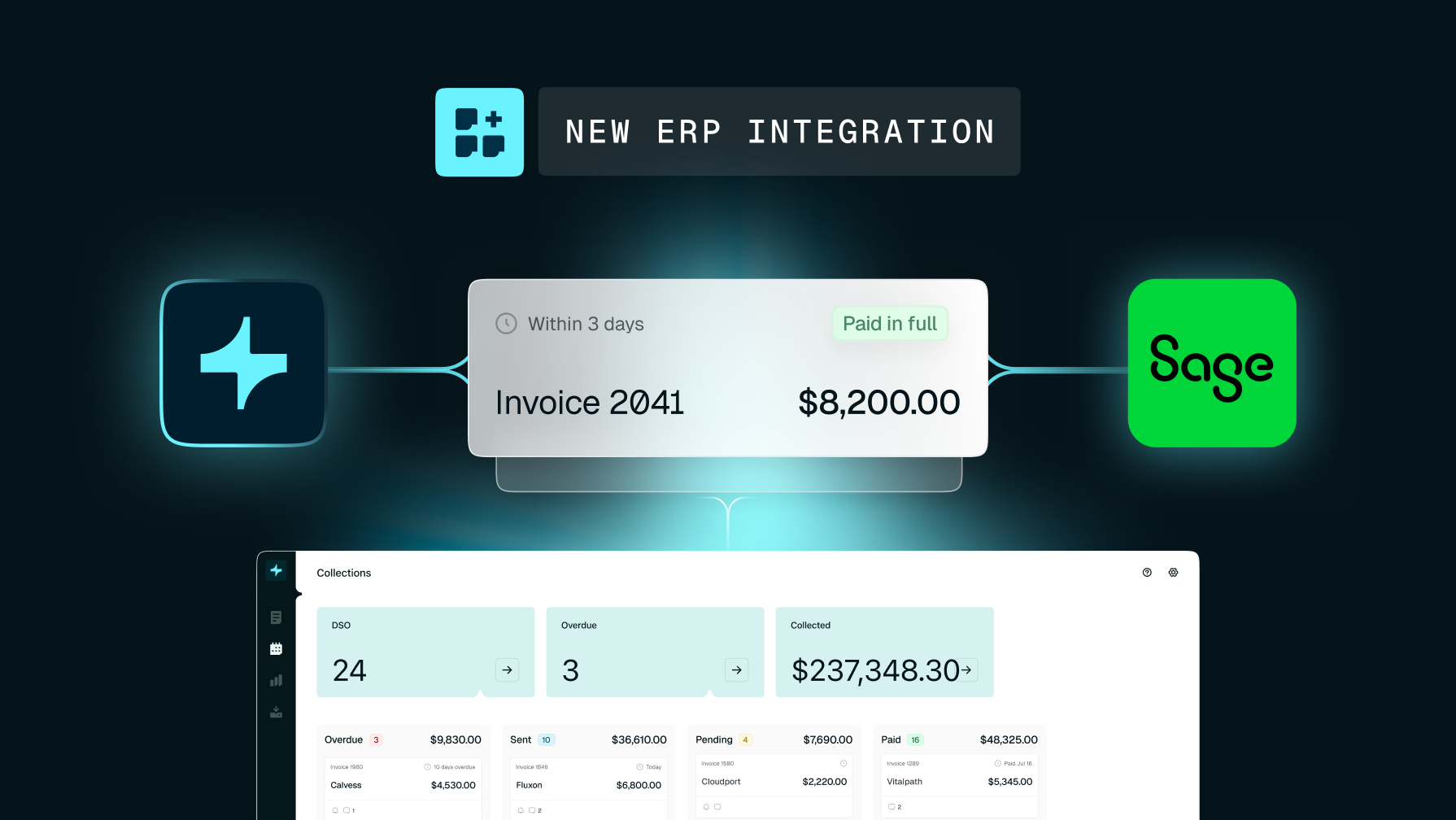
ERP integrations are the backbone. Bidirectional sync with QuickBooks, Oracle NetSuite, or Sage Intacct means invoices, payments, journal entries, and customer records flow automatically between your subscription management tool and your general ledger. No CSV exports. No manual journal entries. No reconciliation surprises at close.
CRM sync ensures that customer data — contract terms, renewal dates, expansion opportunities — stays consistent between your revenue operations and your sales team. When a customer upgrades through a sales conversation, the billing system should know about it without a manual handoff.
Payment processor integration with providers like Stripe, bank transfer networks, and wire transfer systems enables automated payment collection, reconciliation, and fee tracking across payment methods.
Self-service portals give customers direct access to view invoices, update payment methods, download receipts, and manage their own subscription changes. This reduces support ticket volume and accelerates payment collection — without adding a dedicated AR resource.
The test of integration quality is not the number of connectors listed on a website. It is whether data flows bidirectionally, in real time, without manual intervention — and whether every transaction is traceable end to end.
Ensure security and compliance
Any tool that touches financial data and customer payment information must meet rigorous security and compliance standards. These are not optional features — they are requirements.
Payment Card Industry Data Security Standard (PCI-DSS) compliance ensures that payment card data is handled, processed, and stored according to industry security standards. Service Organization Control 2 (SOC 2) certification validates that the platform maintains the operational controls — availability, confidentiality, processing integrity — that enterprise finance teams and their auditors expect. General Data Protection Regulation (GDPR) compliance governs how customer data is collected, stored, and processed across jurisdictions.
Beyond certifications, look for complete audit trails that trace every transaction from contract term to journal entry, and role-based access controls that restrict sensitive financial data to authorized users. When your auditors ask how a specific invoice was generated or why a revenue schedule changed, the answer should be in the system — not in someone's memory.
How Tabs turns contracts into clean, recognized revenue
AI in subscription management is not predictive forecasting layered on top of a legacy billing engine. The most transformative use cases are operational — intelligence woven into every step of the contract-to-cash workflow, not bolted on as an afterthought. What matters is not whether AI is present, but whether it understands the commercial context of the data it processes — the business implications of contract terms, not just the data points themselves.
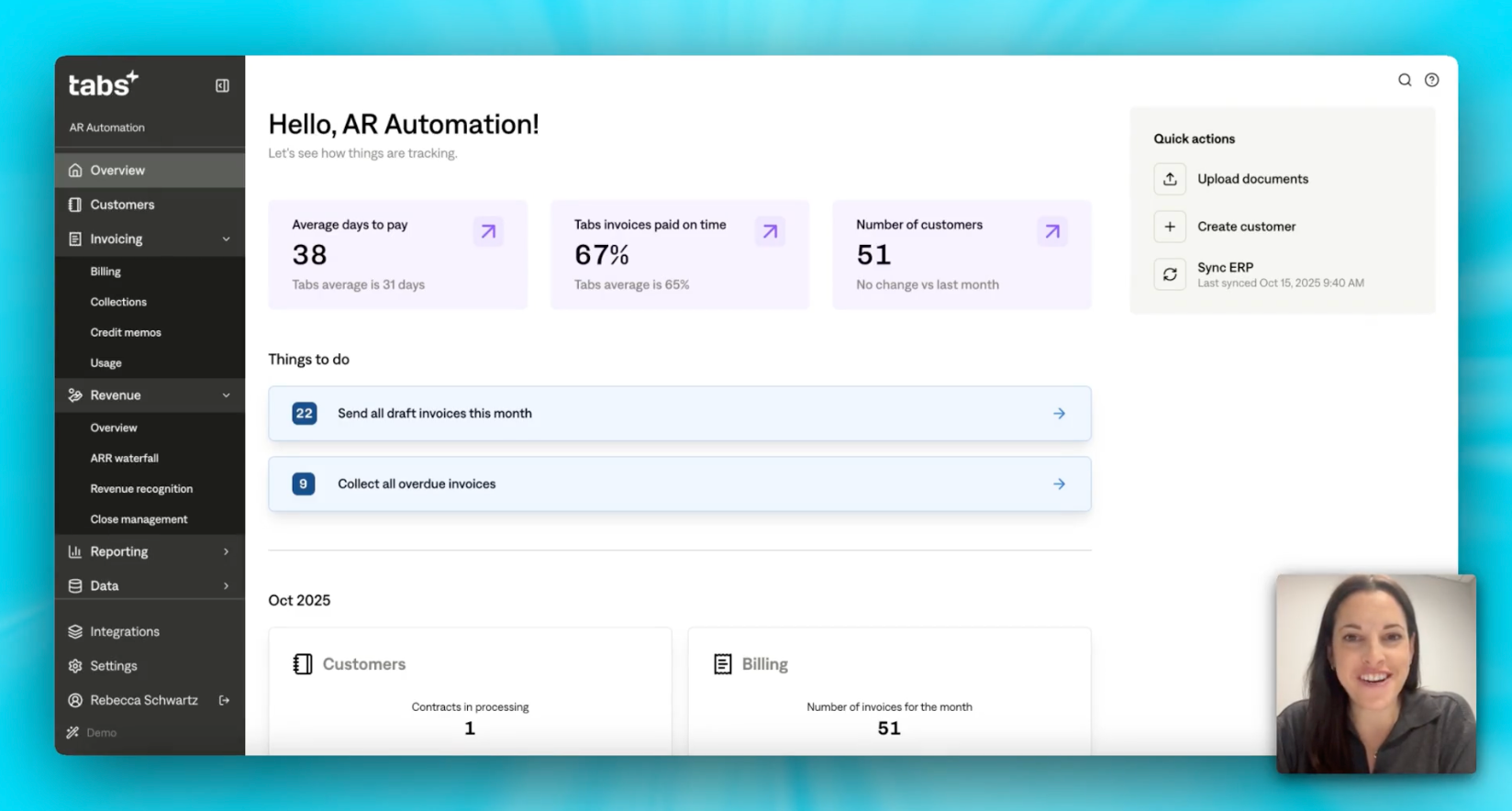
Tabs is an AI-powered Revenue Automation platform built for exactly this kind of complexity. Here is what AI-powered subscription management actually looks like:
- Contract ingestion: AI ingests and parses signed contracts — PDFs, Word documents, emails — and extracts billing terms, pricing models, payment schedules, and amendment details automatically. No manual data entry. No re-keying contract terms into a billing system.
- Billing automation: Invoices auto-generate from contract terms and update continuously as amendments arrive, usage data flows in, and pricing thresholds are crossed. The billing schedule stays in sync with the commercial reality of every customer relationship.
- Collections: Smart dunning sequences personalized by customer payment behavior, account value, and historical patterns — reducing days sales outstanding without manual follow-up. Tabs uses trained models to rank collection efforts by likelihood of payment success — so your team focuses time where it will have the most impact.
- Revenue recognition: When a contract amends mid-period, Tabs automatically recalculates rev rec schedules and posts updated journal entries to your ERP — no manual rebuild required. The system maintains continuous audit readiness across subscription, usage-based, and hybrid revenue streams.
- Real-time reporting: Annual recurring revenue (ARR) visibility, cash flow forecasting, and renewals AI that identifies churn and renewal risk before they become surprises — so finance teams can act on signals, not react to outcomes.
The difference is commercial context. Tabs does not just extract data from contracts — it understands the business implications of every term. A mid-cycle amendment is not just a billing change — it cascades into revenue recognition schedules and collections timelines, with every downstream update reflected automatically. Tabs handles all of those downstream effects automatically because it maintains a single source of truth that connects contracts, usage data, payments, and terms across the entire contract-to-cash workflow.
The results are measurable. Statsig achieved a 100% reduction in aged receivables and handled 3x the invoice volume without adding headcount. Cortex saw a 50% reduction in overdue invoices. And more than 30% of Tabs customers adopted usage-based pricing models in under 30 days — compared to the 9–12 months that traditional tools typically require.
You don't need a new finance stack — you need one that works
The shift to dynamic subscription pricing is permanent. Companies that build their finance infrastructure around this reality will scale cleanly. Companies that keep patching disconnected systems will keep losing time, accuracy, and trust.
What becomes possible when subscription management isn't the bottleneck: month-end close in days instead of weeks. Revenue recognition that stays audit-ready without manual intervention. Pricing flexibility that doesn't require a finance team fire drill every time a contract changes. Cash flow visibility that's real-time, not reconstructed from last month's data.
Getting there is simpler than most teams expect. Start by mapping your current contract-to-cash workflow — where data enters, where handoffs happen, and where manual work creates bottlenecks. Migrate billing and revenue data into a system that connects those steps automatically. Monitor the metrics that tell you whether the new workflow is delivering: days sales outstanding (DSO), close time, invoice accuracy, and the number of manual touches per transaction.
Whether you are a CFO scaling past $10M ARR or a controller preparing for audit — you don't need to rebuild from scratch. You need to modernize what's holding you back.
Frequently asked questions
What is a subscription management tool?
It's software that manages the full contract-to-cash workflow for recurring revenue businesses — automating billing schedules, payment collection, dunning, revenue recognition, and financial reporting. Unlike basic invoicing tools, a modern subscription management platform handles usage-based pricing, hybrid contracts, ASC 606 compliance, and mid-cycle amendments without manual intervention. The goal: every contract term flows cleanly from signature to recognized revenue.
What is the difference between recurring billing and subscription management?
Recurring billing is one function within subscription management — it generates invoices on a set schedule. Subscription management is the broader discipline that encompasses the entire customer revenue lifecycle: contract ingestion, billing across multiple pricing models, payment collection, failed payment recovery, revenue recognition, and financial reporting. A recurring billing tool charges customers on time. A subscription management tool ensures that every billing event connects accurately to collections, rev rec, and your general ledger.
What features should I look for in subscription management software?
Prioritize these capabilities: billing model flexibility (subscription, usage-based pricing, hybrid, metered, and credits within one contract), automated revenue recognition (ASC 606 and IFRS 15 compliance without spreadsheets), dunning and collections automation, bidirectional ERP integration (NetSuite, QuickBooks, Sage Intacct), real-time subscription analytics (MRR, churn, NRR, CLV), a customer self-service portal, and end-to-end audit traceability. The most important test is whether the tool connects these capabilities automatically — not whether each exists as an isolated feature.
How does a subscription management tool reduce churn?
Subscription management tools reduce churn in two ways. For involuntary churn — caused by failed payments, expired cards, or processing errors — smart dunning automation retries payments at optimal times, sends personalized reminders, and flags expiring payment methods before they fail. For voluntary churn, lifecycle management features identify at-risk accounts through usage patterns, engagement signals, and renewal timelines — giving your team time to intervene with targeted offers, plan adjustments, or direct outreach before the customer cancels.
When should I move beyond Stripe for subscription billing?
Stripe excels at payment processing and self-serve subscription billing. You should evaluate a dedicated subscription management tool when your business introduces usage-based pricing, hybrid contracts, or enterprise deals with custom terms — scenarios where Stripe requires significant custom development. Other signals: your team spends hours reconciling Stripe data with your ERP, you need automated ASC 606 revenue recognition, you manage more than one billing model within a single customer contract, or your AR team manually chases payments that a dunning system should handle. Tabs, for example, enabled more than 30% of its customers to adopt usage-based pricing models in under 30 days — a transition that typically takes 9–12 months with traditional tools.
What KPIs should I track for subscription management?
Track five core KPIs: MRR, churn rate (split by voluntary and involuntary), NRR, CLV, and CAC. But the real value is not the numbers themselves — it is connecting them to operational levers. When churn spikes, can you see whether it is a dunning problem, a pricing problem, or a renewal problem? Beyond revenue metrics, track days sales outstanding, invoice accuracy rate, and time-to-close as indicators of billing health. Your subscription management tool should surface all of these automatically — updated continuously, not reconstructed manually at quarter close.
How much does subscription management software cost?
Pricing varies significantly by vendor and model. Most subscription management platforms charge based on revenue processed, number of invoices, or active customers. Some vendors use revenue-based percentages, while others offer flat monthly tiers based on feature access and volume. When evaluating cost, factor in the reduction in manual labor, faster close times, fewer billing errors, and lower involuntary churn — Statsig, for example, handled 3x the invoice volume without adding headcount after switching to Tabs.