





For B2B finance teams managing complex billing models, the right AR collections management tools can transform collections from a manual, reactive process into a strategic driver of cash flow. This guide breaks down what these tools do, the features that actually move the needle on DSO, and how to evaluate vendors based on your specific revenue workflows.
What are AR collections management tools?
AR collections management tools are software platforms that automate the process of tracking and collecting outstanding invoices from your customers. That means, instead of manually sending reminder emails and updating spreadsheets, the software handles follow-ups, monitors payment status, and gives you real-time visibility into what's owed.
For B2B finance teams, these tools solve a fundamental problem: as your customer base grows, manual collections become impossible to maintain. You can't chase down hundreds of invoices with email reminders and expect consistent results. And every day an invoice sits unpaid, your Days Sales Outstanding (DSO) climbs higher—nearly 90% of businesses report that 30% of invoices are paid late.
The best collections management software does more than send automated reminders. It connects to your existing systems—your CRM, your ERP, your billing data—and creates a unified view of each customer's payment behavior. This context matters. A customer who always pays on day 45 requires a different approach than one who's genuinely struggling.
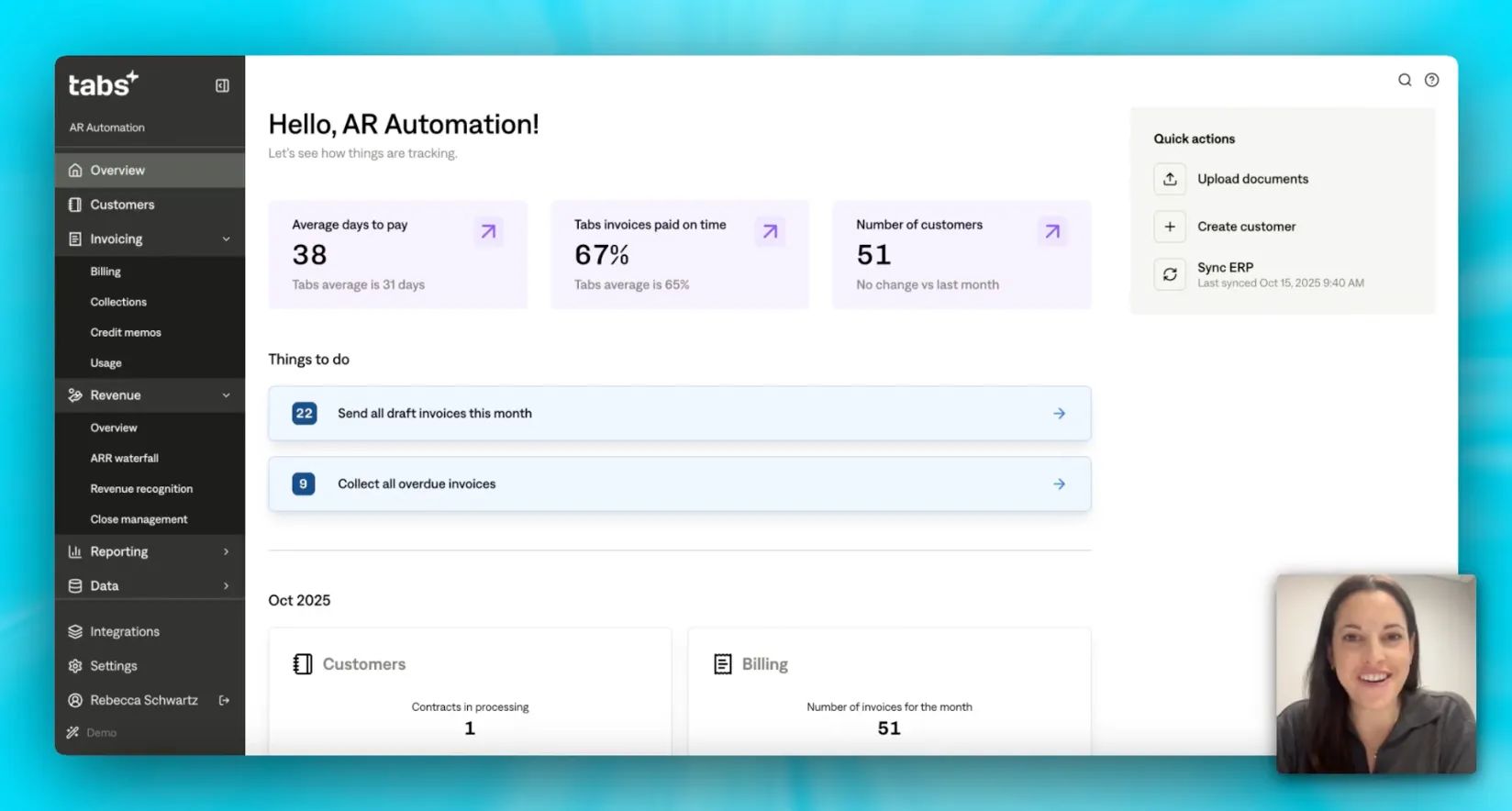
Tabs approaches collections as one part of a unified contract-to-cash system rather than a standalone function. Tabs sits downstream of your CRM and CPQ to operationalize signed contracts, using AI to connect invoices to contract terms, payment history, and customer behavior patterns. This commercial context enables smarter prioritization—your team focuses on the accounts that actually need attention, not just the ones that happen to be oldest.
Here's what AR collections management tools typically handle:
- Invoice tracking: Monitor which invoices are outstanding, approaching due dates, or overdue across your entire customer base
- Automated reminders: Send scheduled dunning communications without manual intervention from your team
- Payment facilitation: Embed secure payment links directly in invoices and follow-up emails
- Aging analysis: Segment receivables by time buckets to prioritize follow-up efforts
- Cash application: Match incoming payments to open invoices automatically
Essential features in AR collections management tools
Not all collections software is built the same. Some tools offer basic automation—scheduled emails, simple aging reports. Others provide the intelligence and integration depth that modern B2B finance teams actually need.
When evaluating features, focus on capabilities that directly impact your core metrics: DSO reduction, cash flow predictability, and the time your team spends on manual work. Generic automation tools often rely on rigid, rule-based workflows that treat every customer identically. But B2B relationships require nuance.
AI-powered account prioritization
Traditional aging reports sort accounts by days overdue. That's it. They treat a consistently late enterprise client the same as a startup that's never missed a payment before.
AI-powered prioritization changes this dynamic in a measurable way—by ranking accounts based on payment risk, contract terms, and past behavior, not just days overdue. Instead of static sorting, trained models analyze historical payment behavior, contract terms, and customer relationship data to surface which accounts actually need immediate attention. This isn't about replacing your team's judgment—it's about giving them better signals.
The difference matters in practice. Your AR team has limited hours in the day. Spending time on accounts that would pay anyway wastes effort that could go toward accounts genuinely at risk.
Tabs uses AI to score accounts based on likelihood to pay, factoring in the commercial context of the original contract. Your team prioritizes the balances most likely to convert with timely outreach—not just the oldest or largest invoices.
Why it matters: AI-powered prioritization means your team focuses effort where it actually improves collections outcomes, rather than working through a static list—which is why 71% of finance leaders plan to increase AI investment in AR.
Automated dunning workflows
Dunning is the process of systematically communicating with customers to collect overdue payments. For growing B2B companies, automating this process is essential—you can't manually track hundreds of follow-up sequences.
Effective dunning workflows include escalation logic that moves from friendly reminders to formal notices based on how long an invoice remains unpaid. They also need pause capabilities—if a customer has an active dispute or a pending contract amendment, you don't want automated emails creating friction.
The key is making automation feel personalized. Generic "your invoice is overdue" messages damage customer relationships. Smart dunning adapts messaging based on the customer segment, invoice size, and payment history.
Tabs automates dunning with awareness of the underlying contract. Reminders reference the correct terms, amounts, and due dates without re-keying data. Tabs adjusts outreach timing based on actual customer payment patterns rather than applying a one-size-fits-all cadence.
Why it matters: Automated dunning that adapts to customer context accelerates collections without damaging relationships.
Embedded payment links and checkout
Friction kills collections. Every extra step between "I should pay this" and "payment submitted" increases the chance that invoice sits unpaid another week.
Embedded payment links solve this by placing a secure payment flow directly inside invoices and reminder emails. Customers click, pay via ACH or credit card, and you're done. No logging into portals. No mailing checks—real-time payments could replace $18.9 trillion in check-based B2B payments by 2028.
For B2B transactions, security is non-negotiable. Any collections platform you choose must maintain PCI DSS compliance and use secure tokenization to protect payment credentials.
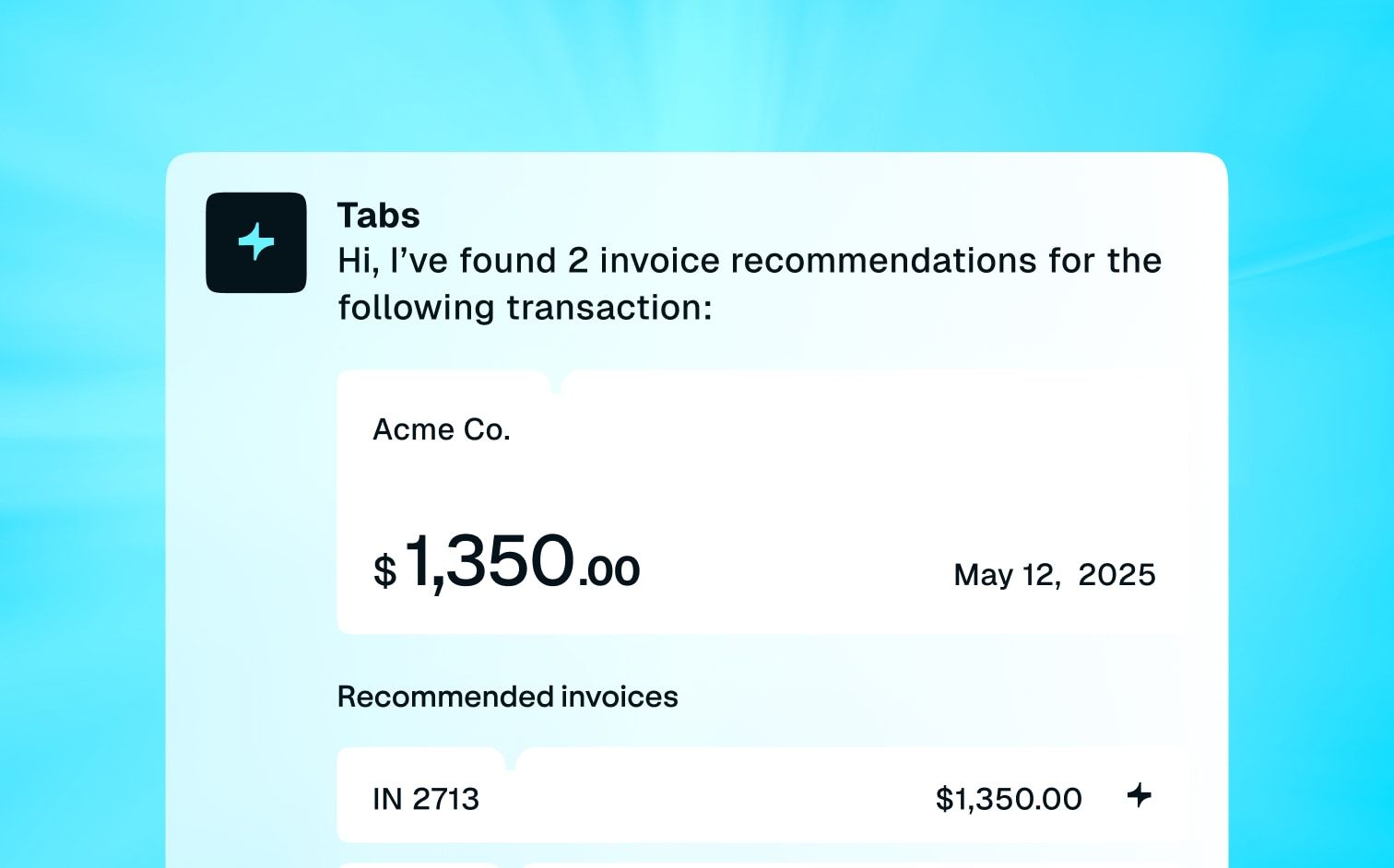
Tabs embeds payment links directly in invoices and dunning communications. When payments land, Tabs automatically reconciles them against open invoices—reducing the manual work of matching payments and giving your team real-time visibility into collection status.
Why it matters: Embedded payments remove friction from the customer experience and eliminate manual reconciliation work for your team.
Cut DSO with AI-driven collections
How to choose AR collections management tools for B2B finance
Selecting the right collections software requires more than comparing feature lists. You need to evaluate vendors based on your specific billing complexity, existing finance stack, and the AR metrics that matter most to your business.
Implementation time and integration depth matter as much as feature breadth. A powerful collections platform is worthless if it takes nine months to deploy and can't communicate with your existing systems.
Step 1: Map contracts, billing models, and data sources
Before evaluating any software, document your current state. What billing models do you support—subscription, usage-based, hybrid? Where do signed contracts live today? Which ERP receives your invoice and payment data?
This mapping exercise reveals your true integration requirements. If your contracts live in Salesforce, your invoices in QuickBooks, and your payment data in spreadsheets, you need a platform that can unify these sources.
Most collections tools require you to manually re-key contract data into their system. This creates errors and delays. Tabs takes a different approach—Tabs ingests signed contracts directly and uses AI to extract key terms and apply commercial context to operational workflows, like billing schedules and revenue-recognition-ready attributes, with minimal manual effort.
Questions to answer during your mapping phase:
- What billing models do you support (subscription, usage-based, hybrid)?
- Where do signed contracts live today (CRM, file storage, email)?
- Which ERP or accounting system receives invoice and payment data?
- How do you track contract amendments and renewals?
Why it matters: Understanding your current data landscape prevents you from choosing a tool that can't actually integrate with your existing systems.
Step 2: Score features against AR KPIs and compliance
Once you understand your data landscape, evaluate tools based on how their features align with your specific goals. Not every feature matters equally for every business.
If you process high volumes of small invoices, automated dunning might carry the most weight. If you're preparing for an audit, the completeness of the audit trail becomes critical. Create a weighted scorecard that reflects your priorities.
Enterprise buyers must also consider compliance. Ensure any vendor maintains SOC 2 Type II and PCI DSS compliance—these aren't optional for handling sensitive financial data.
| Feature Category | DSO Reduction | Write-off Prevention | Audit Readiness |
|---|---|---|---|
| AI prioritization | High | High | Medium |
| Automated dunning | High | Medium | Medium |
| Payment links | High | Low | Low |
| Audit trail | Low | Low | High |
| ERP integration | Medium | Medium | High |
Why it matters: A weighted scorecard ensures you choose a tool that addresses your actual priorities, not just the features that demo well.
Step 3: Validate integrations, automation, and audit trails
Don't make a purchasing decision based solely on demos. Test integrations directly with your existing ERP and CRM. Verify that automation rules work as expected. Confirm the audit trail meets your compliance requirements.
Ask vendors about implementation timelines and what support they provide. The difference between a 30-day implementation and a six-month project dramatically impacts your time-to-value.
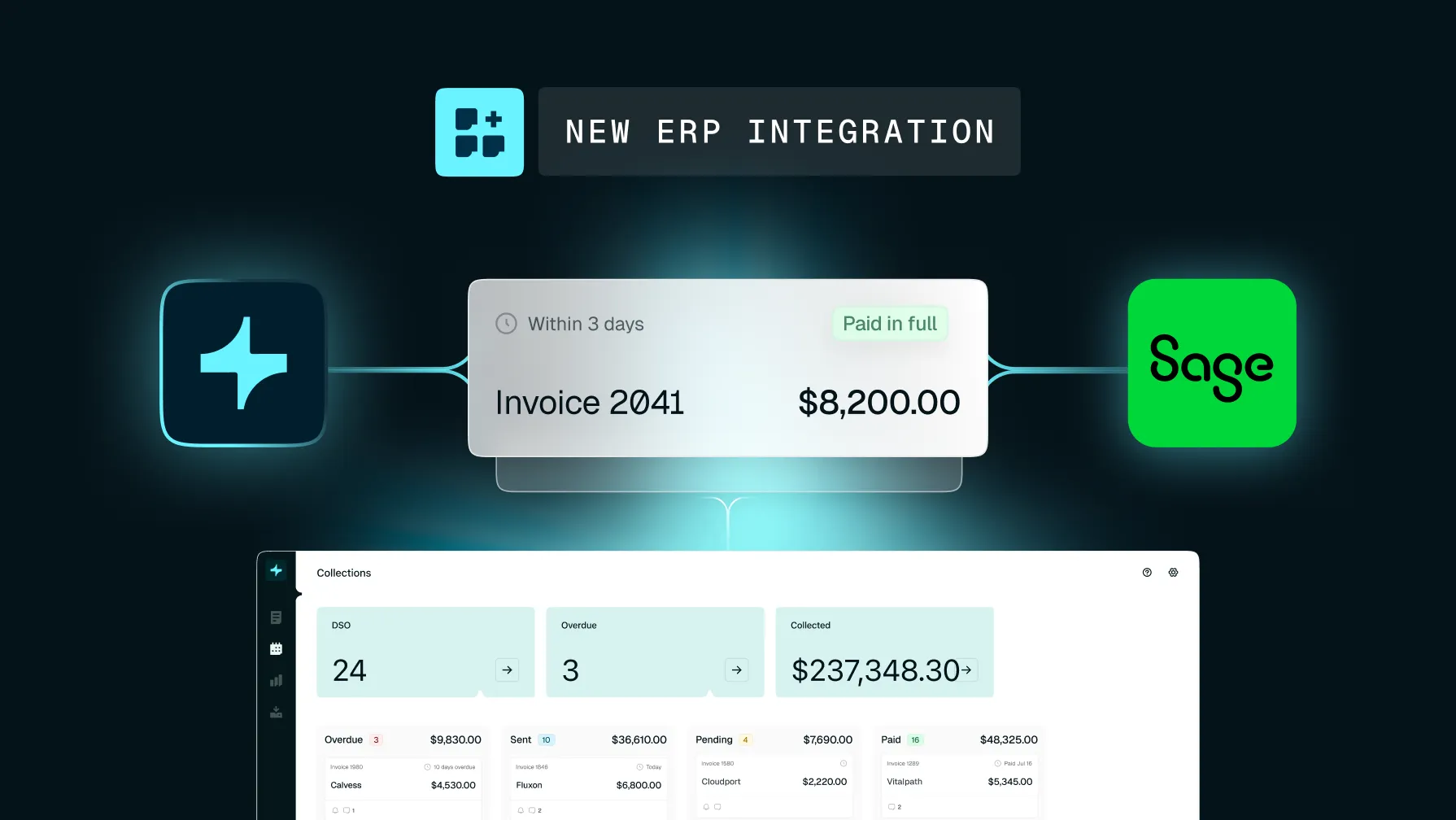
Tabs offers native integrations with major ERPs, including QuickBooks, Oracle NetSuite, and Sage Intacct, plus robust APIs for custom connections. Tabs maintains an audit-grade trail from contract signature through cash collection—every invoice, payment, and adjustment is logged and traceable.
Validation checkpoints for your evaluation:
- Integration depth: Does the tool sync bidirectionally with your ERP and CRM?
- Automation flexibility: Can you customize workflows without engineering support?
- Audit trail completeness: Is every action logged with timestamps and user attribution?
- Implementation timeline: How quickly can you go live with full functionality?
Why it matters: Hands-on validation prevents surprises after you've already committed to a vendor.
FAQ
How do AR collections tools integrate with existing ERP systems?
Most collections platforms offer pre-built connectors for major ERPs like QuickBooks, NetSuite, and Sage Intacct. These integrations sync invoice data, payment status, and customer records bidirectionally—so updates in either system can reflect in the other with minimal manual intervention.
What security certifications should AR collections software have?
At minimum, look for SOC 2 Type II compliance and PCI DSS certification. SOC 2 validates that the vendor has appropriate controls for data security, availability, and confidentiality. PCI DSS is required for any platform handling payment card data.
Can collections management tools handle usage-based billing models?
Yes, but capabilities vary significantly. Some tools only support simple subscription billing. Others—like Tabs—natively support usage-based and hybrid models, automatically calculating amounts owed based on actual consumption data before generating invoices and initiating collections workflows.
How long does implementation typically take for enterprise collections software?
Implementation timelines range from weeks to months, depending on your billing complexity and integration requirements. Tabs is designed to help teams go live in <30 days, depending on billing complexity and integrations, while legacy platforms often require 6–12 months for full deployment.