





ARR is the metric investors, boards, and finance leaders use to measure the health of a subscription business, but calculating it accurately requires clean data and consistent methodology. This guide breaks down the ARR formula, walks through real examples, and shows how modern finance teams can automate ARR tracking without relying on spreadsheets or manual reconciliation.
What is annual recurring revenue (ARR)?
Annual recurring revenue (ARR) is the total value of your recurring subscription revenue, normalized to a single year. That means that if you have customers on monthly, annual, or multi-year contracts, ARR converts them into a consistent annual figure so you can measure your business accurately.
ARR only includes revenue that repeats predictably. One-time fees—like implementation charges, professional services, or hardware sales—don't count. The goal is to capture the revenue you can reasonably expect to collect again next year, assuming nothing changes.
Here's what belongs in your ARR calculation:
- Subscription fees: The core recurring charges customers pay for your product
- Recurring add-ons: Additional modules or features billed on a predictable schedule
- Committed usage minimums: The guaranteed portion of usage-based contracts
And what doesn't:
- One-time implementation fees: Setup or onboarding charges
- Professional services: Consulting, training, or custom development
- Variable overages: Usage charges without committed minimums
Getting this distinction right matters. When contracts, usage data, and billing terms live in disconnected systems, finance teams spend hours manually separating recurring from non-recurring revenue. Tabs automates this by ingesting executed contracts (downstream of your CRM and CPQ) and using trained models to classify terms with commercial context—so recurring subscriptions, committed minimums, and one-time fees are separated without manual tagging.
Why ARR matters for subscription businesses
With 87% of software revenue now from subscriptions, ARR tells you how much predictable revenue your business generates each year. Investors use it to value your company. Your board uses it to track growth. And your finance team uses it to forecast cash flow, plan headcount, and set targets.
Unlike total revenue, ARR filters out the noise. A big professional services deal might spike your quarterly numbers, but it doesn't tell you anything about the health of your recurring business. ARR does.
Three reasons this metric deserves your attention:
- Forecasting: ARR creates a stable baseline for projecting future revenue without seasonal distortion
- Valuation: According to EY, recurring revenue commands higher multiples because it signals predictable cash flow
- Planning: Teams can set realistic growth targets when they understand their recurring base
The challenge is that calculating ARR accurately requires clean data across your entire contract-to-cash process. When billing logic lives in spreadsheets and contract terms are buried in PDFs, your ARR becomes a guess rather than a measurement.
ARR vs MRR
Monthly recurring revenue (MRR) measures your predictable revenue on a 30-day cycle. ARR measures the same thing, but annualized. The relationship seems simple—just multiply MRR by 12—but that only works when all your customers are billed monthly.
If you have annual contracts, multi-year deals, or a mix of billing frequencies, you can't just take MRR × 12 and call it a day. You need to normalize each contract to its annual value first.
There's also contracted annual recurring revenue (CARR) to consider. CARR includes signed deals that haven't started yet, giving you visibility into your pipeline. ARR only counts revenue from active contracts.
| Metric | Best used for | Typical billing context |
|---|---|---|
| MRR | Monthly operational tracking | Month-to-month subscriptions |
| ARR | Annual planning, investor reporting | Annual or multi-year contracts |
| CARR | Pipeline and bookings visibility | Signed but not yet live contracts |
Use MRR for day-to-day operations. Use ARR for board meetings and investor conversations. Use CARR when you need to see what's coming.
ARR formula
The ARR formula depends on how you bill your customers. There are two primary approaches, and you'll likely need both.
For monthly billing: ARR = MRR × 12
For annual or multi-year contracts: ARR = Total Contract Value ÷ Contract Term (in years)
The key is normalization. Every contract must be expressed as an annual rate, regardless of how it's actually billed. A $36,000 three-year contract contributes $12,000 to ARR—not $36,000.
Use MRR times 12 when billing monthly
If a customer pays $1,000 per month, their contribution to ARR is $12,000. Simple multiplication works because the billing cadence already matches a monthly rhythm.
This approach assumes consistent monthly charges. For hybrid billing models with variable usage components, either (a) include only the contractually committed minimum in ARR, or (b) use a consistent trailing average for the variable portion and report it separately from core ARR.
Why it matters: Monthly billing makes ARR calculation straightforward, but only if your billing data is accurate and up to date.
Divide multi-year contracts by term length
A three-year contract worth $36,000 doesn't add $36,000 to your ARR. It adds $12,000—the annualized value.
Finance teams often make mistakes here, especially when contracts span multiple years. The temptation is to count the full contract value, but that overstates your annual run rate and misleads investors.
Why it matters: Normalizing multi-year contracts prevents you from inflating ARR with bookings that won't be recognized for years.
How to calculate ARR
Calculating ARR is a four-step process. You start with your base subscriptions, add expansion, subtract losses, and arrive at your current annual run rate.
Remember: ARR is a point-in-time snapshot. It reflects the current state of all active subscriptions, not historical revenue.
Identify recurring subscriptions
Start by summing all active subscription revenue. Include active contracts with a recurring charge in effect today. Auto-renewal strengthens predictability, but it isn't required for a contract to contribute to ARR while it is active. Exclude trials, one-time purchases, and expired contracts.
What to include:
- Active annual subscriptions
- Monthly subscriptions (annualized)
- Committed usage minimums
- Recurring add-ons and modules
Why it matters: Your base subscription number is the foundation. Errors here compound through every subsequent calculation.
Add expansion revenue
Expansion includes upgrades, additional seats, and upsells that increase a customer's recurring commitment. Add this to your base subscription value.
Only count expansion if it's recurring. A one-time add-on or temporary capacity bump doesn't qualify.
Why it matters: Expansion revenue often delivers higher margins than new acquisition—tracking it separately helps you understand where growth is coming from.
Subtract churn and downgrades
Churn is lost revenue from cancellations. Downgrades are reduced commitments from existing customers—fewer seats, a lower tier. Both must be subtracted.
The complete formula:
ARR = (Base Subscription Revenue + Expansion Revenue) − (Churned Revenue + Downgrade Revenue)
Tracking gross retention versus net retention helps isolate retention performance from new sales—McKinsey research shows top-quartile B2B SaaS companies achieve 113% NRR versus 98% for bottom performers.
Why it matters: You can't grow ARR sustainably if you're losing more than you're adding. This step reveals the health of your customer base.
ARR calculation examples
Seeing the formula in action makes it easier to apply to your own data.
Calculate ARR from MRR
A company has 50 customers, each paying $500 per month. Total MRR is $25,000.
Because all customers share the same billing frequency, the calculation is straightforward:
ARR = $25,000 × 12 = $300,000
Calculate ARR with upgrades and churn
Let's look at a more realistic scenario with movement in the customer base.
| Component | Amount |
|---|---|
| Starting ARR | $500,000 |
| + Expansion | $75,000 |
| − Churn | ($40,000) |
| − Downgrades | ($15,000) |
| Ending ARR | $520,000 |
Net new ARR is $20,000. This waterfall view—sometimes called an ARR bridge—shows exactly where growth came from and where revenue was lost.
Automate ARR from executed contracts
How to increase ARR
Growing ARR requires more than closing new deals. Finance teams control several levers that directly impact this metric.
Optimize customer acquisition
More customers at consistent deal sizes increases your baseline. But acquisition isn't just a sales problem—billing friction during onboarding can delay time-to-value and hurt conversion.
When new customers experience seamless invoicing from day one, they adopt faster and stick around longer.
Drive expansion revenue
Expansion often delivers higher margins than new acquisition. Finance teams can identify opportunities by tracking usage patterns and flagging accounts approaching tier limits.
Automated billing that handles mid-cycle upgrades without manual intervention removes friction. When customers can upgrade seamlessly, they do.
Reduce churn with proactive collections
Involuntary churn from failed payments is often preventable—or at least recoverable—with the right dunning, retry logic, and payment options.
Tabs automates payment reminders and highlights at-risk receivables early—so your team can reduce days sales outstanding (DSO), recover more past-due cash, and prevent avoidable cancellations tied to nonpayment.
Review pricing and packaging
Pricing changes flow directly to ARR. Model the impact of adjustments before they go live. Annual prepay incentives can shift monthly customers to annual contracts, improving predictability and cash flow.
How Tabs automates ARR calculation
Tabs is an AI-powered Revenue Automation platform built for B2B companies navigating complex billing. We believe finance deserves tools that move at the speed of change—not spreadsheets that break when your pricing model evolves.
Tabs doesn't just report ARR. It generates the billing schedules and revenue recognition inputs from executed contract terms—so your ARR is built on the same source data your invoices and close rely on.
Generate invoices from executed contracts
Tabs sits downstream of your CRM and CPQ and ingests executed contracts from your CRM, CPQ, or contract repository. It uses AI to extract billing terms—subscription amounts, billing cadence, renewal dates, and escalation clauses—dramatically reducing manual PDF review.
The difference is commercial context—how terms like ramps, minimums, true-ups, credits, and amendments change what you bill and when. Tabs doesn't just extract fields from contracts. It uses trained models to interpret commercial terms—like annual escalators, committed usage minimums, and mid-term amendments—and translate them into billing schedules and revenue recognition inputs aligned to your policies.
Why it matters: When your billing data is accurate from the start, you never have to reconstruct ARR from spreadsheets after the fact.
Recognize revenue and track ARR in real time
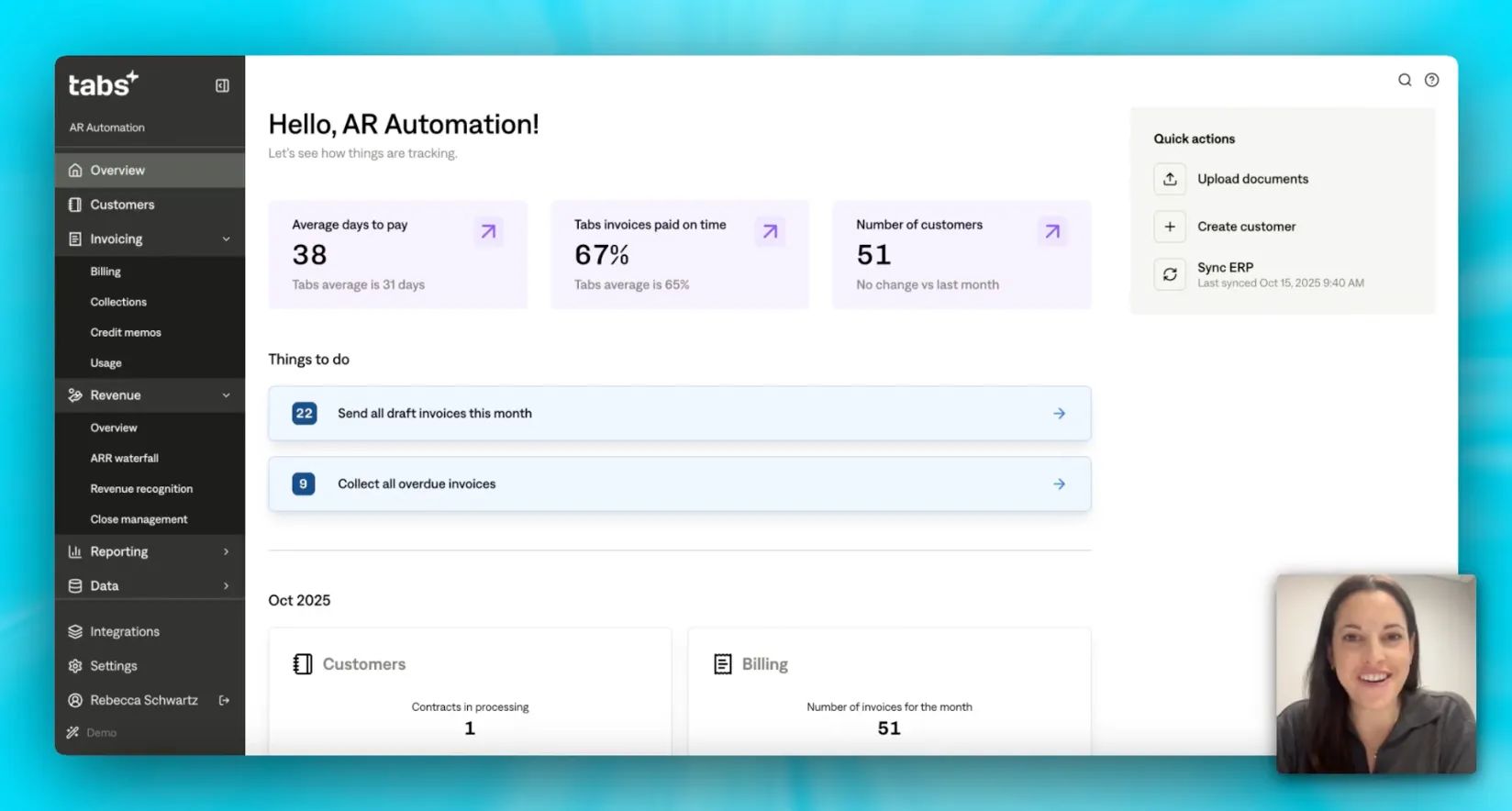
Tabs connects billing to Revenue Recognition, so your dashboards can reflect what's been invoiced, collected, and recognized—not just what was booked as a deal or entered as a forecast.
Real-time visibility means you can answer ARR questions on demand without waiting for month-end reconciliation. Accounting Standards Codification (ASC) 606 compliance is easier to maintain when billing schedules and revenue recognition schedules are generated from the same executed contract data.
- Real-time dashboards: See current ARR without manual aggregation
- Audit-ready records: Every invoice, payment, and recognition event is logged and traceable
- Unified data: Contracts, billing, and revenue recognition in one system
Frequently asked questions
Can you calculate ARR by multiplying MRR by 12?
Yes—but only when all customers are billed monthly and the recurring charge is consistent. For annual or multi-year contracts, you must divide total contract value by the contract term in years—otherwise your ARR will be overstated.
Should ARR include one-time implementation fees?
No. ARR reflects only recurring revenue. Exclude one-time fees and non-recurring services, and treat credits or refunds as adjustments that reduce the underlying recurring run rate when they apply to subscription charges.
Explore how Tabs can help you operationalize signed contracts and automate ARR reporting.