




This guide helps B2B finance teams evaluate billing, collections, and accounts receivable software that actually fits their revenue complexity. You'll learn how modern platforms automate the contract-to-cash cycle, reduce Days Sales Outstanding (DSO), and eliminate the manual work that slows down your close.
What is billing and collections software?
Billing and collections software — also called accounts receivable software or invoice automation software — is a system that automates invoice creation, payment tracking, and Accounts Receivable (AR) follow-up. This means you stop manually generating invoices from contracts and chasing down late payments through email threads.
If the terminology feels confusing, you're not alone. Billing software, collections software, receivables management software, and AR automation tools all address pieces of the same workflow — but most vendors specialize in just one slice. Buyers end up stitching together point solutions that don't share data, creating handoff gaps between invoicing and collections. A contract-to-cash platform unifies these under one roof, so your finance team works from a single source of truth rather than reconciling across three or four disconnected tools.
Tabs supports this shift by using trained models to extract and normalize contract terms, then translate them into accurate billing workflows. Tabs doesn't just pull text from a PDF. It maps contract language — pricing, invoice triggers, acceptance clauses, renewals, and payment terms — into billing workflows and Revenue Recognition schedules from day one. Cortex cut overdue invoices by 50% after switching to Tabs' contract-based approach.
A clear shift is underway. B2B finance teams are moving away from static, rule-based tools toward AI-native platforms that use trained models to classify contract terms and apply billing logic with commercial context — pricing metrics, timing, and obligations — built in. Modern contract-to-cash platforms connect contract data directly to billing logic — automating the full cycle and eliminating the reconciliation gaps that come from stitching together separate tools and spreadsheets.
A modern platform handles each of these steps:
- Invoice generation: Creating accurate bills based directly on executed contract terms
- Payment tracking: Monitoring when invoices are sent, viewed, and paid
- Collections automation: Sending reminders and escalating overdue accounts without manual intervention
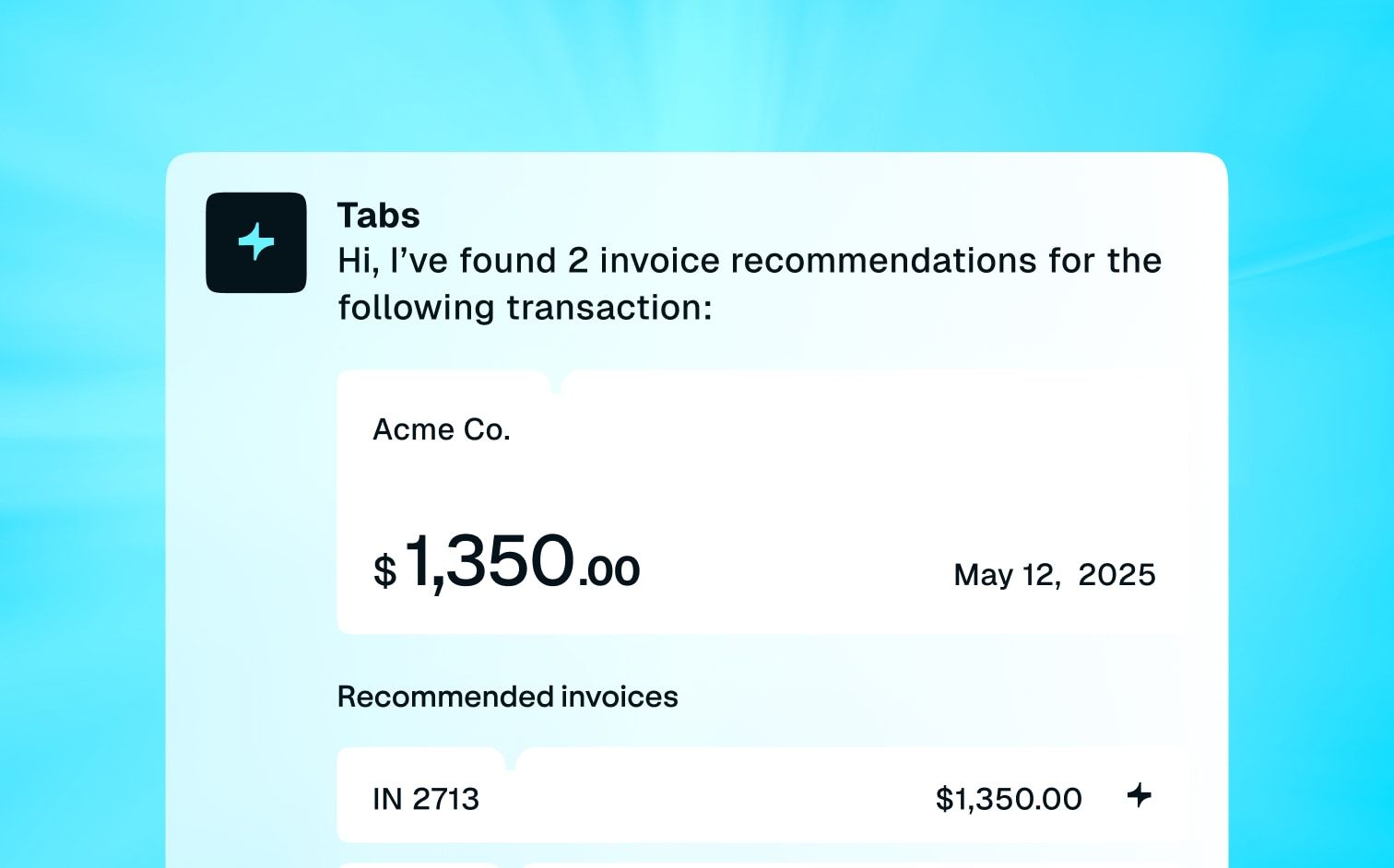
- Cash application: Matching incoming payments to open invoices automatically
How billing and collections software works
The best AR collections software operates as a seamless pipeline from contract signature to bank reconciliation. It sits downstream of your CRM and CPQ, focused entirely on operationalizing signed contracts. And it automates the handoffs between each step to eliminate manual re-keying. Tabs takes this further by applying commercial context — understanding not just what a contract says, but what it means for billing logic, revenue recognition, and collections timing.
Step 1: Capture contract terms
Billing accuracy starts with clean, structured contract data. Modern platforms ingest signed contracts from email, your CRM/CPQ, or a contract repository and extract key terms like pricing, billing frequency, and payment terms.
Tabs uses trained models to automate contract ingestion end to end. It parses complex B2B agreements and structures billing schedules and Revenue Recognition rules automatically. Your finance team doesn't have to manually parse a lengthy PDF to figure out when to send the first invoice.
Eliminates manual contract re-keying and downstream billing errors.
Step 2: Generate accurate invoices
Once the system captures contract terms, modern invoice automation software creates invoices automatically — reducing manual processing time by 40–60% according to PwC. This supports everything from simple subscriptions to complex Usage-Based Billing schedules.
Invoices must reflect exactly what the contract specifies to prevent customer disputes. When your collections workflow runs on executed contract terms, you send clean invoices that get paid faster.
Accurate invoices reduce disputes and accelerate payment cycles.
Step 3: Collect payments and follow up
Automated dunning workflows take over once the invoice goes out. The software sends scheduled reminders, creates escalation paths, and provides embedded payment links.
Effective collections automation reduces your DSO — by 8–12 days with automated reminders — without requiring you to hire more staff. By segmenting customers based on payment history, the system helps your team focus only on high-risk accounts.
Consistent follow-up accelerates cash flow without adding headcount.
Step 4: Apply cash and reconcile
Cash application involves matching incoming bank payments to open invoices. Automation handles partial payments, overpayments, and complex deductions.
This step gives you real-time visibility into your accounts receivable balances. Accurate cash posting ensures your finance leaders can forecast cash flow with confidence.
Real-time AR visibility enables accurate forecasting.
Key features and benefits of billing and collections software
If you're a modern CFO, you evaluate software based on business outcomes — not feature lists. The right platform reduces DSO and eliminates the manual close work that consumes your team's time. It also scales billing capacity without requiring new headcount. Here are the capabilities that matter most and the results they drive.
Contract-based invoicing
Generating invoices directly from executed contract terms eliminates the errors inherent in spreadsheet-based processes. Automated billing software maps what the contract says — pricing, billing cadence, acceptance clauses — into the billing logic and Revenue Recognition treatment your compliance requirements demand. No manual re-keying. No interpretation gaps between sales and finance.
If you can't tie every invoice back to a signed contract in seconds, you're carrying avoidable dispute risk.
The outcome: fewer disputes, faster payment cycles, and audit-ready records that your controller can trust at month-end. Tabs translates complex contract language into billing logic automatically — so every invoice traces back to the terms your customer actually signed.
Collections automation and dunning
Automated dunning workflows ensure consistent follow-up without manual effort. When an invoice becomes past due, collections automation software instantly triggers the appropriate email sequence — with embedded payment links, escalation paths, and multi-channel outreach rules your team can customize without pulling in engineering.
The business impact is measurable. 62% of firms with AR automation report measurable DSO reductions, according to PYMNTS research. Embedded payment links and flexible payment options reduce friction for your customers, improving working capital and reducing reliance on expensive credit facilities.
Intelligent prioritization
Not all late payments require the same level of attention. AI-powered segmentation groups customers by risk profile, payment history, and lifetime value — surfacing the specific accounts that need immediate human intervention rather than dumping raw aging reports on your desk.
Tabs provides context-aware prioritization based on specific contract terms and historical payment behavior, not just aging buckets. Your team focuses on high-risk accounts first, reducing DSO without adding headcount. Contract-aware platforms surface the specific overdue invoices that carry the most commercial risk — not just any aging balance.
Cash application and reconciliation
Automated matching algorithms pair incoming bank payments to the correct open invoices. This handles the complexities of partial payments, overpayments, and short pays — the edge cases that consume hours of manual reconciliation at month-end.
The outcome: real-time visibility into your true AR health, accurate cash forecasting, and a close process that doesn't require your team to spend the first week of every month chasing discrepancies.
Flexible payment options
B2B buyers expect consumer-like payment experiences. Your software must support multiple payment methods, including ACH, wire transfers, and credit cards. The ability to offer structured payment plans for overdue accounts can save a relationship and recover revenue.
Embedded payment links inside invoices and reminder emails remove friction and accelerate collection. The fewer clicks between "invoice received" and "payment submitted," the faster your cash lands.
Analytics and real-time dashboards
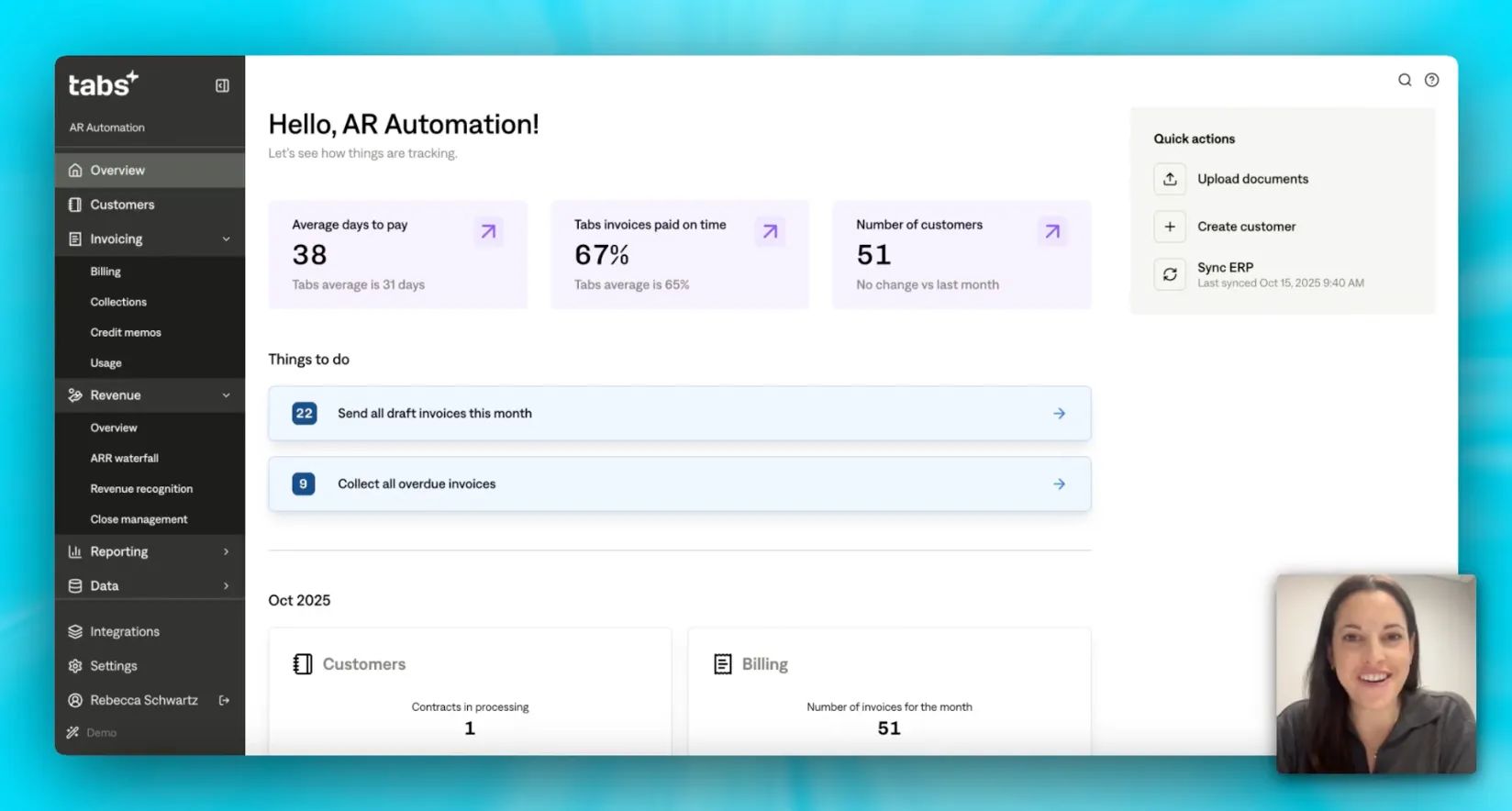
Reporting features provide deep visibility into your DSO, aging buckets, collection rates, and cash flow trends. Real-time dashboards help finance leaders forecast accurately and spot potential cash crunches early.
Modern Revenue Automation platforms don't just show when invoices are due — they forecast when cash will actually land, based on historical payment behavior and contract terms. A forward-looking finance stack tells you when cash will land, not just when invoices are due.
How to choose billing and collections software
The right platform should match your current billing complexity and scale with your business. Choosing based on feature lists alone often leads to tools that don't fit your workflows.
Revenue complexity and scale
Billing and revenue management software differs in its ability to handle complex pricing. Assess whether the platform supports your current models and where your pricing strategy is headed.
Tabs natively supports subscription, seat-based, usage-based, and hybrid billing models without requiring custom logic. This flexibility allows your product teams to launch new offerings without waiting on billing infrastructure updates.
Company size and billing complexity
The right accounts receivable software depends on where your business sits today — and where it's headed. Different maturity levels call for different capabilities:
- Early-stage or simple subscription businesses: Basic invoicing and payment tracking may be all you need. Look for fast setup, low overhead, and the ability to scale when your pricing model evolves. You don't need enterprise-grade contract intelligence yet — but you'll want a platform that can grow with you.
- Mid-market companies with mixed billing models: Subscription plus usage-based pricing, growing invoice volume, and a finance team that can't scale linearly with revenue. This is where contract-to-cash platforms add the most value. Statsig tripled invoice volume without adding headcount after moving to Tabs — because automation handled the complexity their previous tools couldn't.
- Enterprise organizations with multi-entity operations: Multi-currency, hybrid billing models, complex contract terms, and compliance-ready Revenue Recognition. You need contract-level intelligence, robust ERP integrations, and the ability to handle billing logic that would take a spreadsheet 40 columns to replicate.
Match the platform to your complexity. Overpaying for features you don't need is wasteful — but underpaying for a tool that can't handle your receivables management software requirements is more expensive in the long run.
Ease of use for finance teams
Your finance team needs software they can use without IT. Evaluate the day-to-day workflow — how easy is it to generate an invoice, send a reminder, or reconcile a payment?
Platforms requiring heavy IT involvement for routine tasks slow down operations. Your finance team needs full control over billing rules and dunning cadences.
Integration depth and flexibility
An integrated billing and collections platform must connect seamlessly to the systems where your contract data originates and where your financial data lives. Isolated tools create data silos that force your team back into manual data entry. When evaluating, ask these questions:
- ERP integration: Does the platform offer native integrations with your ERP — QuickBooks, Oracle NetSuite, Sage Intacct — or does it require middleware and manual syncs?
- CRM integration: Can it pull closed-won contract data from Salesforce, HubSpot, or your CRM automatically, so billing starts the moment a deal closes?
- Payment gateways: Does it connect securely to Stripe, ACH providers, and other processors your customers already use?
- APIs: Can you extend core functionality or build custom workflows specific to your business without relying on the vendor's roadmap?
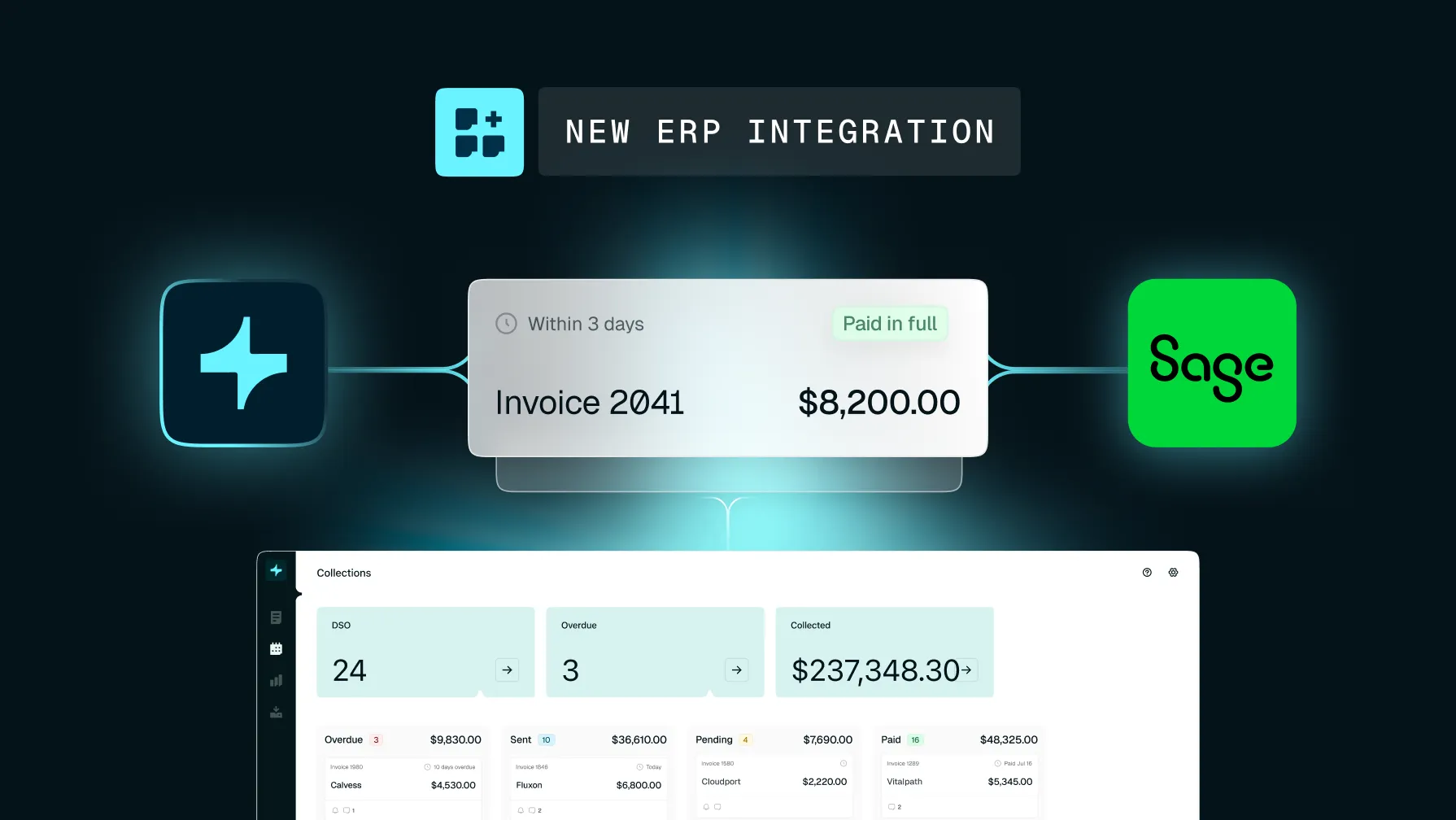
Tabs offers native integrations with QuickBooks, Oracle NetSuite, Sage Intacct, Salesforce, and HubSpot — plus APIs for custom workflows. The platform pulls closed-won data as soon as a contract is signed, eliminating the gap between "deal closed" and "first invoice sent."
Security and compliance requirements
Enterprise-grade security is non-negotiable when handling sensitive financial data. Verify SOC 2 compliance, data encryption standards, and audit-ready controls.
Tabs is SOC 2 compliant, with encryption at rest and in transit and audit-ready access controls.
Pricing and total cost
Vendors use various pricing models: per-invoice fees, per-user licenses, flat fees, or fees based on a percentage of collections. Evaluate total cost of ownership, including implementation, integrations, and ongoing support.
The cheapest upfront option often becomes expensive when you factor in required customizations or manual workarounds. Implementation timeline is another hidden cost — some platforms take months to deploy, which means months of delayed ROI. Factor in what delayed automation costs your team in the meantime.
How billing and collections software compares across approaches
The billing and collections software market includes several distinct types of solutions, and the right fit depends on your billing complexity and where you need automation most. Understanding the differences helps you shortlist faster — and avoid investing in a tool that only covers half the workflow.
Point solutions (invoicing-only or collections-only)
Fast to deploy. Limited scope. You'll need multiple tools to cover the full contract-to-cash cycle, which creates handoff gaps and data silos between invoicing, dunning, and cash application. Best for teams with simple billing that only need to automate one piece of the workflow.
ERP-native AR modules
Already in your finance stack. Familiar interface. But typically rigid — with limited support for complex billing models like usage-based or hybrid pricing. Often require significant customization for anything beyond standard invoicing. Best for companies locked into an ERP ecosystem with simple, predictable billing.
Standalone AR automation platforms
Purpose-built for collections, dunning, and cash application. Strong analytics. But they sit downstream of billing — they don't generate invoices from contracts, so you still need a separate billing tool upstream. Best for enterprise teams that already have billing infrastructure and need to accelerate collections specifically.
Contract-to-cash platforms
Unify contract ingestion, billing, collections, and Revenue Recognition. Use AI to extract commercial context from contracts and automate the full cycle — eliminating the gaps between point solutions. Best for B2B companies with complex or evolving pricing models that need a single platform from contract to cash.
| Dimension | Point solutions | ERP-native modules | Standalone AR automation | Contract-to-cash platforms |
|---|---|---|---|---|
| Billing complexity supported | Basic | Basic to moderate | N/A (collections only) | Complex (subscription, usage, hybrid) |
| Collections automation | Limited or none | Basic | Advanced | Advanced |
| Contract intelligence | None | None | None | AI-powered — extracts terms from signed contracts |
| Implementation speed | Fast (days) | Varies (tied to ERP) | Moderate (weeks) | Fast to moderate (Tabs: <30 days) |
| Best fit | Simple billing, single model | ERP-committed, simple AR | Enterprise collections focus | Complex B2B billing + collections |
The category is converging — more vendors are trying to cover the full cycle. But the depth of contract intelligence and billing flexibility varies widely. If your contracts include usage-based, seat-based, or hybrid pricing, a platform that understands commercial context will outperform one that simply automates invoice delivery.
How Tabs approaches billing and collections
Tabs is the AI-powered Revenue Automation platform built for B2B companies running complex contract-to-cash operations. By replacing fragmented finance stacks with automated workflows, Tabs helps you close the books faster and manage cash flow with confidence.
AI contract ingestion for zero manual setup
Tabs uses AI to capture terms directly from signed contracts — whether PDFs, Word documents, or emails. The platform then automatically generates accurate invoices without manual data entry.
Tabs uses trained models to classify contract language and translate it into billing workflows and collections actions — based on commercial context, not just raw text. It eliminates the tedious contract review process that burdens most finance teams and reduces errors from manual re-keying. Cortex reduced overdue invoices by 50% after switching to Tabs' contract-based billing workflows.
Collections automation that reduces DSO
Tabs automates reminders, embeds payment links, and surfaces actionable insights on overdue balances. The platform prioritizes accounts based on specific contract terms and historical payment behavior — providing commercial context that generic tools miss.
Statsig eliminated 100% of aged receivables and tripled invoice volume without adding headcount — because reminders, prioritization, and cash application run off the same contract data. With Tabs, collections runs off the same contract data as invoicing and prioritization — so your team catches risk early instead of chasing it.
Tabs can go live in under 30 days. Most of that speed comes from AI-powered contract ingestion — the step that typically bottlenecks implementations is handled automatically.
Frequently asked questions
What is the difference between billing software and accounts receivable automation?
Billing software focuses on generating invoices — translating contract terms into accurate bills and delivering them to customers. Accounts receivable automation focuses on what happens after the invoice is sent: dunning, payment tracking, cash application, and collections follow-up. Many teams use separate tools for each, creating handoff gaps and duplicated data.
Modern contract-to-cash platforms like Tabs unify both — plus Revenue Recognition — so there's one source of truth from signed contract to collected cash. You don't need to stitch together point solutions or reconcile data across disconnected systems.
How much does billing and collections software cost?
Pricing varies widely depending on the vendor and model. Common structures include per-invoice fees, per-user licenses, flat monthly fees, or a percentage of collections. Total cost of ownership goes beyond the sticker price — factor in implementation, integrations, training, and ongoing support.
The cheapest option on paper often becomes the most expensive when you add required customizations, middleware for integrations, or the headcount needed to cover gaps the software doesn't address. Evaluate what the platform saves you in manual work and error correction, not just what it charges. For Tabs pricing, see Tabs in action.
How long does it take to implement billing and collections software?
Implementation timelines range widely. Some legacy platforms require six or more months of professional services and custom development before your team processes a single automated invoice. The bottleneck is usually data migration — manually mapping existing contracts, billing schedules, and customer records into the new system.
AI-powered platforms with automated contract ingestion can dramatically shorten this. Tabs can go live in under 30 days because the AI handles the contract data migration that typically stalls implementations. That means faster time to value and less disruption to your finance team's day-to-day operations.
Can billing and collections software handle ASC 606 Revenue Recognition without spreadsheets?
Yes. Modern Revenue Automation platforms like Tabs unify billing, collections, and Revenue Recognition in a single system, reducing spreadsheet-based workarounds. Tabs automates ASC 606-compliant Revenue Recognition using the same contract and billing data that powers invoicing and collections.
Which ERP and CRM integrations matter most for B2B billing and collections?
The most critical integrations are with your CRM where contracts originate, your ERP where financial data lives, and your payment processors. Tabs offers native integrations with Salesforce, QuickBooks, Oracle NetSuite, Sage Intacct, and major payment gateways, plus APIs for custom workflows.