





This guide breaks down the leading AR automation platforms for 2026, helping finance leaders at B2B companies evaluate which solutions handle complex billing models, reduce DSO, and turn the invoice-to-cash cycle into a strategic advantage rather than an operational bottleneck. It covers what AR automation does, how to evaluate vendors, a side-by-side comparison, and the leading platforms by category, company size, and use case.
What is AR automation?
Accounts receivable automation software automates much of the invoice-to-cash cycle, significantly reducing manual intervention. This means the technology generates invoices, delivers them to customers, accepts payments, and matches those payments to the correct open balances—all without your team touching a spreadsheet.
AR automation sits downstream of your CRM and CPQ, after a contract is signed. Once a contract is signed, the software helps you operationalize that agreement into invoices, collections workflows, and ultimately collected cash. The best platforms don't just move documents around faster. They apply commercial context to each contract—using trained models to interpret negotiated pricing, usage thresholds, and payment schedules, and then translate them into accurate billing workflows.
Here's what AR automation actually does (and where revenue automation platforms like Tabs go further by operationalizing signed contracts for contract-to-cash):
- Invoice generation: Creates accurate bills based on contract terms and usage data.
- Delivery: Routes invoices to the correct contacts or payment portals.
- Payment acceptance: Provides embedded links for customers to pay directly.
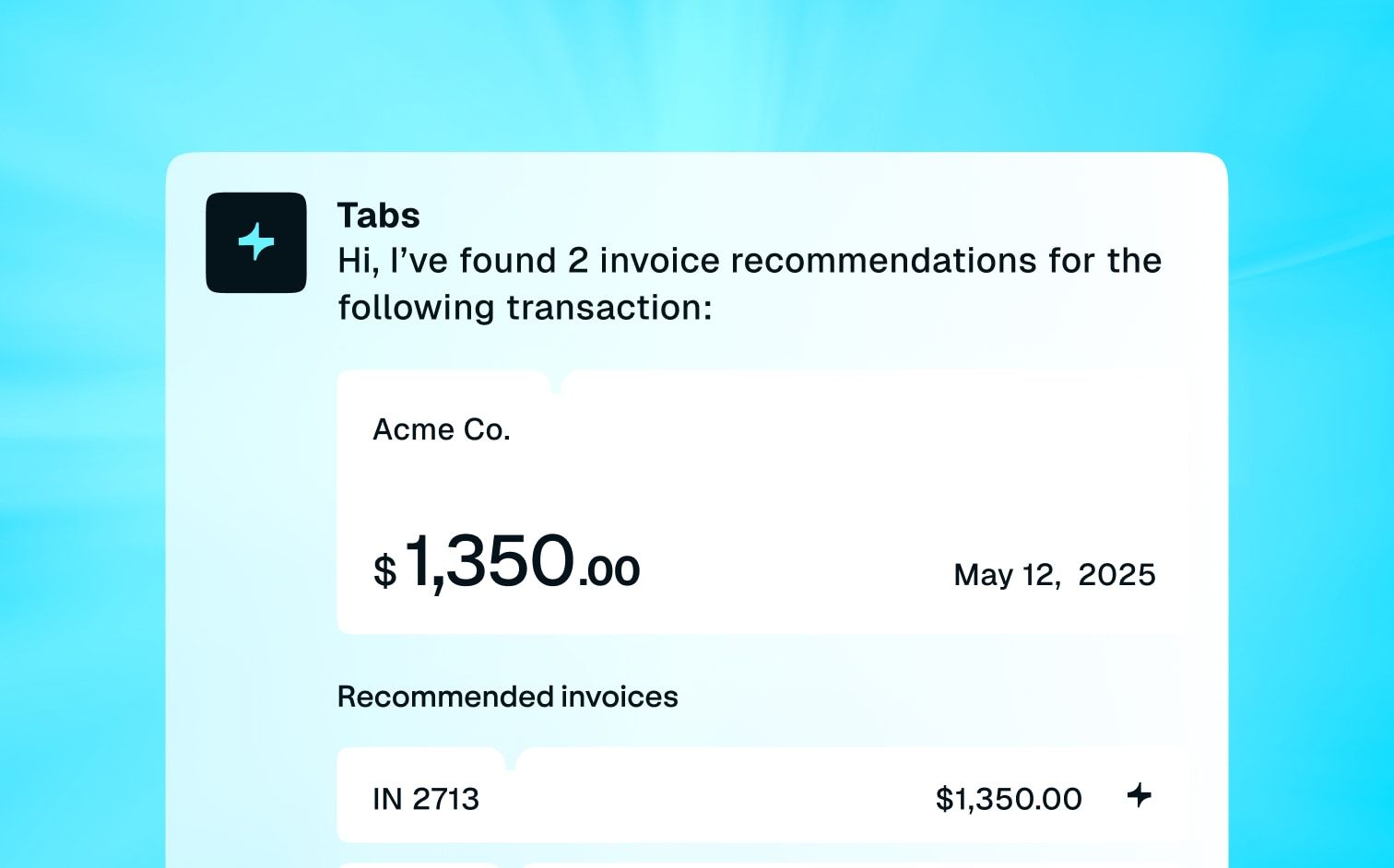
- Cash application: Matches incoming payments to open invoices automatically.
- Collections follow-up: Sends scheduled reminders for overdue balances.
Why AR automation matters for B2B finance
B2B invoicing is inherently more complex than consumer billing. You're dealing with net terms, purchase orders, multi-stakeholder approvals, and contracts that blend subscriptions with usage-based charges. When finance teams manage these variables manually, they create cash flow drag and billing errors that strain customer relationships.
Manual processes create specific problems that limit your ability to scale. Invoices go out days or weeks after a contract is signed. Payments arrive as lump sums that take hours to match against dozens of open invoices. Collections become reactive—you only chase late payments after realizing your cash forecast is short.
AR automation solves this by reducing the manual bottlenecks between a signed contract and collected cash— PwC estimates a 40–60% reduction in handling time—so your team can focus on exceptions, not repetitive follow-up. The result is lower days sales outstanding (DSO)—the average time it takes to collect payment—more working capital, and a finance team that can focus on strategic work instead of data entry.
AR automation trends shaping invoice-to-cash
The landscape is shifting in 2026 as AI models move beyond basic text extraction toward understanding business context— according to KPMG, up to 80% of finance activities will be automated and AI-enabled. Finance teams no longer accept tools that just read text on a page. They require systems that can classify contract language and map it to billing schedules, collections triggers, and Revenue Recognition inputs that affect cash flow.
Several trends are driving this shift:
Why it matters: If your billing model changes faster than your spreadsheets and rules can keep up, your cash forecast and Revenue Recognition outputs will drift—quietly—until the month-end close.
- AI-powered cash application: Machine learning models match payments to invoices automatically, even when remittance details are incomplete.
- Embedded finance: Payment portals are built directly into invoicing workflows, letting customers pay with one click.
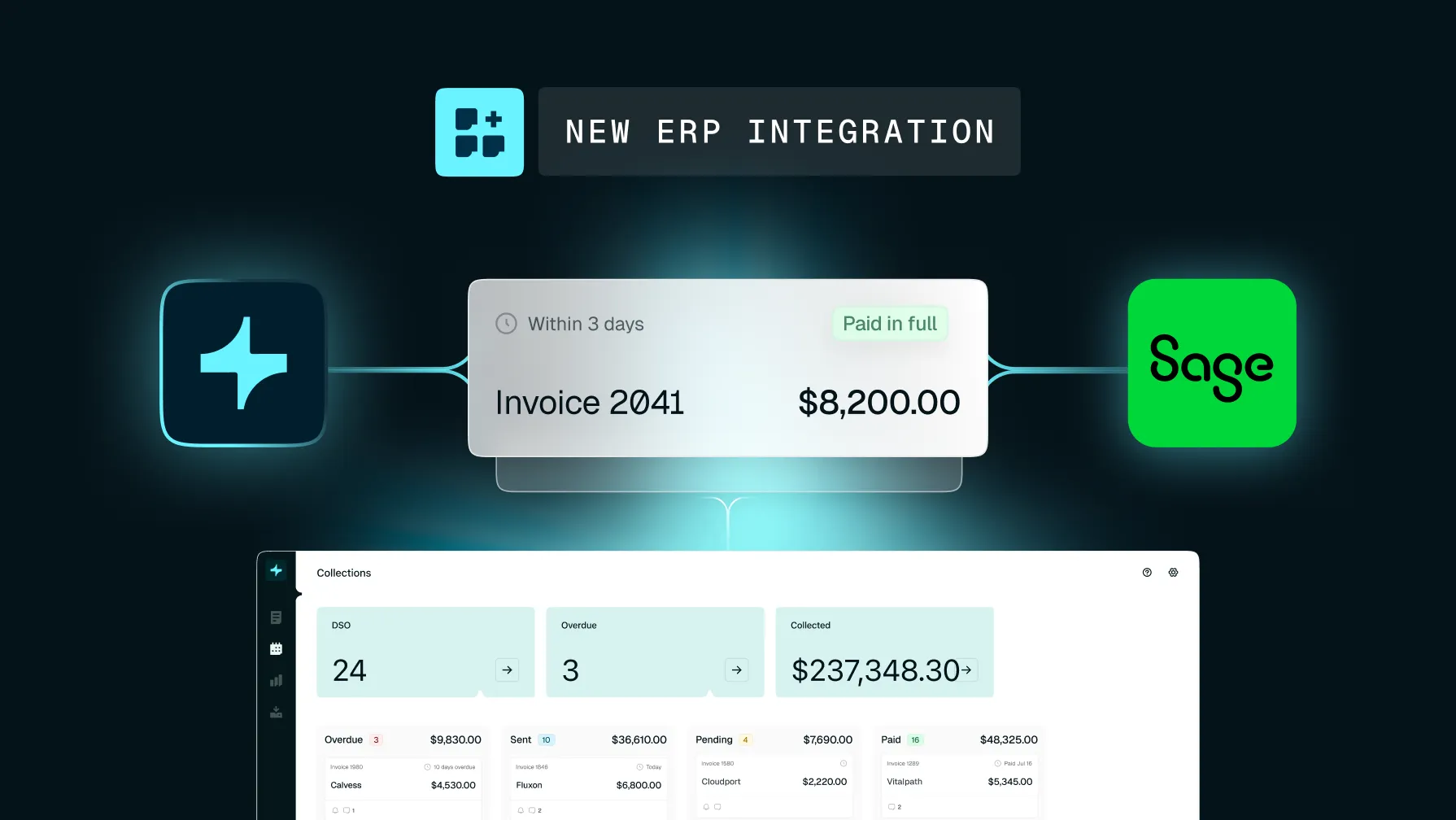
- API-first architectures: Modern platforms sync data in near real time across your finance stack through robust APIs.
- Predictive analytics: Systems forecast when customers will actually pay based on historical behavior, not just stated terms.
How to evaluate AR automation companies
Choosing the right AR automation software requires a structured approach that maps to your specific billing complexity. You need to look beyond feature lists to understand how a platform will actually function within your existing finance stack.
Assess integration depth
Your automation is only as effective as its connection to your ERP, CRM, and payment gateways. You need platforms with native connectors rather than fragile middleware that breaks when systems update.
Ask vendors how they handle bidirectional sync—does the platform push and pull data in real time, or rely on nightly batch updates? Understand which system acts as the source of truth for customer data and how conflicts get resolved.
Validate AR coverage
Determine whether the platform handles your full scope of needs. Some tools specialize strictly in collections, while others provide end-to-end coverage from invoice creation through reconciliation.
Check whether the system can generate complex invoices or only delivers invoices created in your ERP. Ask about dispute management workflows and how they pause dunning sequences. Confirm the system can reconcile bank deposits to ledger entries automatically.
Confirm AI capabilities
You must distinguish between simple rules-based automation and true AI-powered intelligence. Rules-based systems break the moment a customer deviates from the standard process.
Tabs uses AI models trained on B2B revenue patterns. Tabs extracts contract terms, identifies clause types (for example, usage overages vs. milestone payments), and then generates the correct invoice schedules, dunning triggers, and Revenue Recognition-ready data based on those terms. This ability to apply commercial context—not just extract fields—is what separates modern systems from legacy tools.
Model cash flow impact
Require vendors to help you model expected financial impact based on your current metrics. Calculate how many days the platform will shave off your average collection period. Factor in the revenue saved by catching delinquent accounts before they become uncollectible.
Estimate time to value
Implementation timelines vary dramatically. Ask exactly what's required from your team and when you'll see measurable results. Beware of platforms that require extensive custom development before you can send your first invoice.
Cut DSO with contract-to-cash automation
AR automation software at a glance
Use this table to scan how the platforms named below compare on AR coverage, support for complex billing, and the company size they typically fit.
| Platform | Best for | AR coverage | Complex/usage-based billing | Typical company size |
|---|---|---|---|---|
| Tabs | Operationalizing signed contracts into cash | End-to-end contract-to-cash | Native usage-based and hybrid billing from signed contracts | Startup to enterprise |
| HighRadius | Global enterprises with complex credit management | End-to-end invoice-to-cash | Configurable for high-volume, multi-entity billing | Enterprise |
| Billtrust | High-volume B2B invoice delivery and payments | End-to-end invoice-to-cash | Subscription and volume-based billing | Enterprise |
| Versapay | Buyer-seller collaboration on payments | Invoicing and collections | Limited | Mid-market |
| Quadient AR | Predictive collections for mid-sized teams | Collections and analytics | Limited | Mid-market |
| Invoiced | Automated dunning and payment reminders | Invoicing and collections | Moderate | SMB to mid-market |
| Younium | B2B SaaS subscription management | Subscription billing and AR | Subscription and renewals | SMB to mid-market |
| BILL | SMB accounts receivable and payable | Basic invoicing and payments | Basic | SMB |
| Zoho Books | SMB accounting and invoicing | Basic invoicing and payment collection | Basic | SMB |
| FreshBooks | Freelancers and small agencies | Basic invoicing | Basic | SMB |
| Gaviti | Analytics-driven collections | Collections add-on | Not applicable | Mid-market |
| Tesorio | Cash flow forecasting and collections | Collections add-on | Not applicable | Mid-market |
AR automation companies by category
The market divides into distinct segments built for different company sizes and operational needs. Understanding these categories helps you quickly identify which solutions fit your specific billing complexity.
Enterprise AR suites
These platforms serve massive organizations with global operations and complex credit management needs. They handle millions of transactions and sophisticated chargeback scenarios but require significant implementation investment.
HighRadius offers complex cash application and credit risk scoring across multiple global entities—best for enterprises standardizing AR across regions. Billtrust excels at B2B payment network orchestration and high-volume invoice delivery—best for high-volume billers driving electronic payment adoption. Both are built for scale, though usage-based and hybrid pricing often require heavy configuration.
Mid-market collaboration platforms
These solutions emphasize buyer-seller collaboration through self-service payment portals. They focus on improving customer experience and reducing friction in the payment process.
Versapay combines digital invoicing with a collaborative portal where buyers and sellers resolve disputes directly—best for teams prioritizing customer self-service. Quadient AR (formerly YayPay) offers predictive analytics and automated workflows for mid-sized finance teams—best for collections forecasting. These platforms strengthen collections, but complex usage-based billing typically still originates upstream.
Billing-led automation
These platforms recognize that AR issues usually start upstream at the contract level. They automate the entire process by generating invoices directly from signed agreements, which makes them a strong fit for complex, usage-based, and hybrid billing.
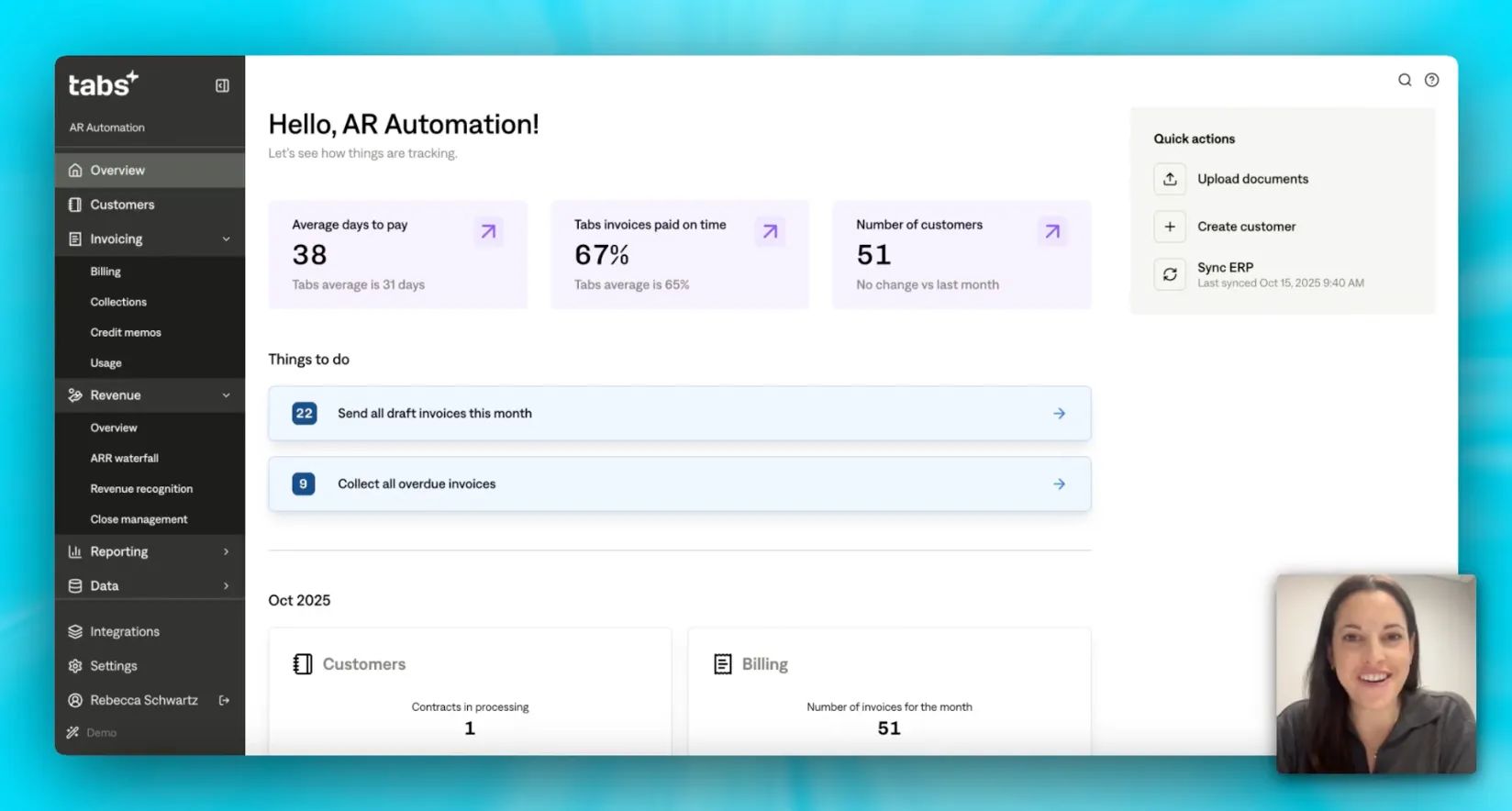
Tabs starts with the signed contract and uses AI to interpret terms, generate accurate invoices, and automate collections workflows aligned to the agreement. Teams use Tabs to reduce billing disputes and shrink aged receivables by keeping invoicing and follow-up tied to contract language and usage data—best for B2B companies running usage-based or hybrid pricing. Invoiced handles automated dunning and payment reminders for B2B operations—best for teams focused on collections follow-up. Younium specializes in B2B SaaS companies managing complex subscription renewals—best for subscription-led billing.
SMB invoicing tools
These lightweight tools suit smaller teams with straightforward billing needs. They prioritize ease of use over complex workflow configuration.
BILL simplifies basic accounts receivable and payable processes—best for SMBs unifying AR and AP. Zoho Books includes basic invoicing and payment collection features—best for SMBs already in the Zoho ecosystem. FreshBooks serves freelancers and small agencies with user-friendly invoicing—best for solo operators and small teams.
Collections add-ons
These point solutions focus specifically on collections automation rather than the full invoice-to-cash cycle. They integrate with existing billing systems to add advanced dunning sequences.
Gaviti emphasizes analytics-driven collections and tailored follow-up playbooks—best for data-led collections teams. Tesorio connects to your ERP to automate collections and forecast cash inflows—best for cash flow forecasting.
AR automation by company size and use case
Different company stages require entirely different capabilities. You must map your current operational bottlenecks to the right solution type. If your pricing spans usage-based or hybrid models, prioritize billing-led platforms that generate invoices from signed contracts and manage the full invoice-to-cash cycle.
Enterprise scale recommendations
Large corporations with multi-entity structures need heavy-duty infrastructure. Speed is table stakes. Cleanliness is the differentiator.
Look for deep ERP integration, multi-currency support, and advanced credit risk modeling. Enterprise AR suites handle the transaction volume and complexity these organizations require.
Mid-market team recommendations
Growing companies often find finance teams stretched thin as transaction volumes increase. You need automation that reduces manual work without requiring a dedicated systems administrator.
Billing-led automation platforms bridge the gap between CRM data and accounting ledgers. Configurable dunning workflows and automated cash application free your team for higher-value work.
SMB team recommendations
Small businesses prioritize simplicity and speed above all else. You need tools that get invoices out quickly so you can get paid.
Lightweight invoicing tools require zero technical expertise. Look for intuitive interfaces, out-of-the-box payment links, and quick deployment.
Implementation, integration, and security requirements
Moving beyond the sales pitch requires understanding what happens after you sign the contract. You must evaluate deployment realities, system connections, and data security.
Implementation phases and timeline
A successful deployment follows a structured path. Discovery and configuration map your current processes. Data migration transfers historical invoice and customer data. Testing in a sandbox environment precedes the switch to live production.
Phased rollouts reduce risk and let your team adapt gradually. Deployment typically takes two to four weeks for mid-market platforms with native integrations, while enterprise suites can take six to nine months.
Security and compliance certifications
Financial data is the most sensitive information your company holds— 79% of organizations experienced payments fraud attempts in 2024. You cannot compromise on security when evaluating cloud-based finance tools.
Tabs is SOC 2 Type II compliant and supports controls like single sign-on, role-based permissions, and audit logs designed for audit readiness. Look for platforms that support single sign-on, role-based permissions, and tamper-evident audit trails that log actions from invoice creation through payment application.
Pricing models and expected ROI
Understanding how vendors structure pricing helps you build an accurate business case. Look at total cost of ownership, not just the monthly subscription fee.
SaaS subscription cost drivers
Pricing typically scales based on invoice volume, seat-based licensing, or both. Some platforms charge separately for implementation and ongoing support. Make sure you understand what triggers a price increase as your company grows.
ROI expectations and payback period
Your return comes from accelerated cash flow and reduced operational costs. Calculate the value of shifting your team from manual data entry to strategic analysis. Factor in revenue saved by catching delinquent accounts early.
Teams with highly manual processes often see the fastest returns—especially when cash application and collections follow-up still rely on inbox triage and spreadsheet-based reconciliation. The business case strengthens when you quantify hours saved, DSO reduction, and bad debt avoided.
Frequently asked questions
How do I automate the accounts receivable process?
Connect your CRM or ERP, then let the platform generate invoices directly from signed contract terms and automate delivery, cash application, and collections follow-up. Your team shifts from processing every invoice by hand to managing the exceptions the software flags.
Can AR automation handle usage-based and hybrid billing models?
Modern platforms support complex pricing structures, though capabilities vary widely. Billing-led platforms like Tabs are purpose-built to calculate usage-based charges for Usage-Based Billing and hybrid models directly from signed contract terms and usage data—so you don't have to build custom billing logic to get invoices out.
How long does AR automation take to deploy with NetSuite or QuickBooks?
Deployment typically takes two to four weeks for mid-market platforms with native integrations. Platforms with pre-built ERP connectors accelerate this timeline by eliminating custom API development.