







Key takeaways
- Annual Recurring Revenue (ARR) is the annualized value of recurring subscription revenue, calculated as: total annual subscription revenue + expansion revenue - contraction revenue - churned revenue.
- Growth benchmarks vary by stage: early-stage companies target 100%+ year-over-year growth, growth-stage companies aim for 40–100%, and mature businesses sustain 15–30%.
- Tabs automates ARR tracking with real-time ARR waterfalls, AI-powered contract extraction, and renewal forecasting — so finance leaders can focus on strategy instead of spreadsheets.
What is annual recurring revenue (ARR)?
Annual Recurring Revenue (ARR) is the annualized value of your recurring subscription revenue. It tells you how much predictable income your business can expect over the next 12 months — and it's one of the most important metrics for forecasting, investor reporting, and company valuation.
ARR includes revenue from subscriptions, recurring add-ons, and upgrades. It excludes one-time fees, setup charges, professional services, and variable overages. This focused view lets you assess the health of your subscription model independently from other revenue streams.
Why does that matter? Because ARR is the metric investors look at first. It's the foundation for revenue forecasting, board reporting, and strategic planning. A clear, accurate ARR gives your finance team the confidence to make decisions about hiring, product investment, and growth targets.
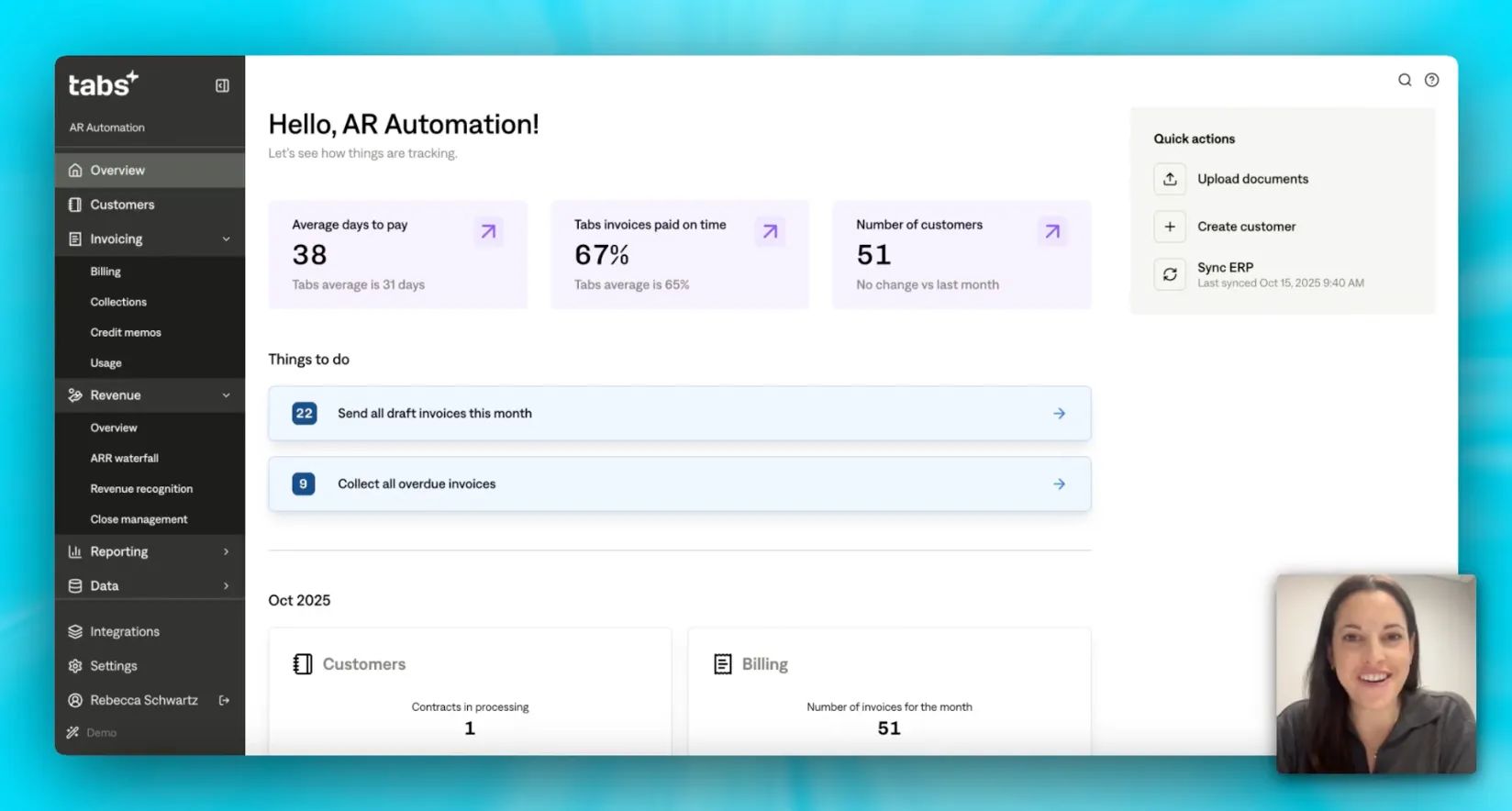
Tabs provides real-time ARR waterfalls and automated tracking that update as contracts are signed, renewed, or modified — eliminating the lag between what's happening in your business and what your dashboards show. Instead of reconciling spreadsheets at month-end, your ARR stays current by default.
How to calculate ARR
The ARR formula
The standard ARR formula accounts for every component of your recurring revenue:
ARR = total annual subscription revenue + expansion revenue - contraction revenue - churned revenue
For a quick estimate using monthly figures, see the ARR vs MRR conversion in the comparison section below. Use the full formula when you have mixed billing terms, expansion, or churn to account for.
Worked examples
Example 1 — simple annual subscriptions: You have 50 customers, each paying $1,200 per year. Your ARR is 50 x $1,200 = $60,000.
Example 2 — mixed billing terms: You have 30 annual customers at $1,200 per year and 40 monthly customers at $150 per month. Annual revenue from yearly customers: $36,000. Annual revenue from monthly customers: $150 x 40 x 12 = $72,000. Total ARR: $36,000 + $72,000 = $108,000.
Example 3 — with expansion and churn: Your starting ARR is $500,000. Over the year, you add $80,000 in new subscriptions, $30,000 in expansion revenue from upgrades, lose $15,000 to contraction (downgrades), and $25,000 to churn (cancellations). Your new ARR: $500,000 + $80,000 + $30,000 - $15,000 - $25,000 = $570,000.
Committed annual recurring revenue (CARR)
Committed Annual Recurring Revenue (CARR) is a more conservative metric that counts only the recurring revenue locked in from signed, active contracts. It excludes pipeline, potential renewals, and unsigned expansions.
CARR = ARR from currently active contracts only
CARR is especially useful for financial planning and board reporting because it reflects the revenue you can count on — not what you hope to close. If a customer signed a two-year contract and one year remains, you include only that remaining year's value in CARR.
Common calculation mistakes
- Confusing ARR with cash flow. ARR measures recurring subscription value. Cash flow includes all cash transactions — one-time purchases, expenses, and investments. Keep them separate.
- Forgetting to normalize subscription terms. A customer paying $200 every 6 months contributes $400 in ARR. Always annualize all subscription terms to a 12-month period.
- Mishandling discounts. Your ARR should reflect the contracted value of the subscription, not the discounted price. One-time sign-up discounts don't reduce ARR. Recurring discounts should be factored in for the discount period only.
- Delaying contract change updates. When a customer upgrades or downgrades, update your ARR immediately. Waiting until the next billing cycle creates inaccurate snapshots.
Tabs handles these nuances automatically — normalizing terms, accounting for mid-cycle changes, and breaking down ARR into its components: new customers, renewals, upgrades, downgrades, and churn.
ARR vs MRR and total revenue
ARR vs MRR
Monthly Recurring Revenue (MRR) and ARR both measure recurring subscription revenue, but they serve different purposes. MRR provides a month-to-month snapshot — ideal for tracking short-term performance and making operational adjustments. ARR offers an annual view — better suited for strategic planning, investor reporting, and company valuation.
The conversion is straightforward: ARR = MRR x 12. An MRR of $5,000 translates to $60,000 ARR. Use MRR for tactical decisions and ARR for long-term planning.
Regardless of individual subscription lengths — monthly, quarterly, or annual — ARR standardizes everything to a 12-month view. A $10 monthly subscription and a $120 annual subscription both contribute $120 in ARR. This standardization makes it possible to compare performance across different pricing models, as the Corporate Finance Institute explains in its ARR breakdown.
ARR vs total revenue
Total revenue includes all income sources: one-time sales, professional services, hardware, and recurring subscriptions. ARR isolates only the recurring portion. This distinction matters because it lets you assess the health of your subscription model separately from other business activities.
One important nuance: ARR is not a Generally Accepted Accounting Principles (GAAP) metric. It's a management and investor metric used for planning and valuation — not something that appears on your audited financial statements. Your total revenue, recognized under Accounting Standards Codification Topic 606 (ASC 606) or other accounting standards, may differ significantly from your ARR figure.
What is a good ARR growth rate?
Growth benchmarks by stage
What counts as "good" ARR growth depends on your company's stage:
- Early-stage (pre-Series A): 100–300% year-over-year. The focus is proving product-market fit and capturing initial market share. Growth at this stage is less about efficiency and more about velocity.
- Growth-stage (Series A–C): 40–100% year-over-year. You're scaling your sales engine, expanding your customer base, and moving from founder-led sales to repeatable processes.
- Mature ($50M+ ARR, post-Series C): 15–30% year-over-year. Efficiency and retention become the primary growth drivers. Net revenue retention above 120% is a strong signal at this stage.
These benchmarks are guideposts, not rules. Your target should reflect your specific market, competitive position, and growth strategy.
How to calculate your ARR growth rate
The ARR growth rate formula is simple:
ARR growth rate = ((current ARR - previous ARR) / previous ARR) x 100
Track this quarterly and annually. Consistent growth signals a healthy business model. Declining or stagnant ARR signals a need to examine churn, pricing, or acquisition efficiency.
One framework worth knowing: T2D3 — triple, triple, double, double, double. It describes the ideal ARR growth trajectory for venture-backed SaaS companies over their first 5 years of scaling. While few companies hit these exact multiples, it's a useful benchmark for setting ambitious yet structured targets.
The $1 million ARR milestone
Reaching $1 million ARR is a defining moment for any SaaS business. As Bessemer Venture Partners points out, it marks the transition from a promising idea to a revenue-generating business. (For more on how ARR compares to ACV, see our breakdown.) Hitting this milestone signals that you've likely found product-market fit, can acquire and retain customers, and are ready to scale. It's often a prerequisite for Series A funding — and it unlocks new growth opportunities that validate the effort invested in building your business.
How to grow your ARR
Reduce churn
Churn is the largest drag on ARR growth. Every lost customer erases acquisition spend and reduces the compounding effect of your recurring revenue base.
Practical steps to reduce churn: monitor leading indicators like product usage drops and support ticket spikes, invest in onboarding so customers realize value quickly, and act on renewal risk signals before contracts lapse. Tabs uses AI to predict churn and renewal risk through its Renewals AI capabilities — giving finance and customer success leaders early warning to intervene.
Forbes offers helpful guidance on improving customer satisfaction and retention — and the core principle holds: retaining existing customers is almost always more cost-effective than acquiring new ones.
Expand existing accounts
Upselling and cross-selling increase ARR without the cost of new customer acquisition. Offer existing customers additional features, higher-tier plans, or complementary products that increase their lifetime value.
Usage-based pricing creates natural expansion paths — as customers grow, their spending grows with them. Over 30% of Tabs customers adopted usage-based models in under 30 days, compared to 9–12 months with traditional billing solutions. That speed matters because faster adoption means faster expansion revenue.
Optimize pricing
Value-based pricing aligns your price to the value your customers actually receive. Tiered pricing captures different segments at different price points. Both strategies can meaningfully increase ARR without changing your product.
Review your pricing regularly. Are you charging what your product is worth? Are there segments you're underserving — or overcharging? Small pricing adjustments, applied across your customer base, can compound into significant ARR gains.
Acquire efficiently
New logos drive ARR, but Customer Acquisition Cost (CAC) payback matters. A customer who costs $10,000 to acquire and pays $1,000 per year in ARR has a 10-year payback — that's not sustainable growth. Focus on channels and motions that bring in customers with strong unit economics and a clear path to expansion.
How Tabs automates ARR tracking
As contract volume grows and billing terms get more complex, real-time ARR accuracy requires infrastructure that moves with the business. Tabs builds automated ARR tracking directly into the billing workflow — updating as contracts are signed, renewed, or modified:
- AI-powered contract extraction reads contracts and translates terms — pricing, billing frequency, renewal dates, usage thresholds — into accurate billing workflows. No manual data entry.
- Automated invoicing across any payment type — subscriptions, usage-based, hybrid, milestone-based — with the flexibility to handle complex billing terms without custom engineering.
- Real-time ARR waterfalls and reporting that break down your ARR into new, expansion, contraction, and churned components. Your finance team sees what's changing and why — without waiting for month-end reconciliation.
- Revenue recognition that's ASC 606-compliant out of the box, automating revenue schedules and deferred revenue tracking alongside your ARR reporting.
- Renewals AI that predicts churn and renewal risk, giving your team time to act before revenue is lost.
Statsig handled 3x their invoice volume without adding headcount after implementing Tabs. Cortex achieved a 50% reduction in overdue invoices. Both outcomes reflect finance leaders scaling their capacity without adding headcount — because the platform absorbs the operational complexity.
Your ARR is only as reliable as the infrastructure behind it. As contract complexity grows — usage-based pricing, hybrid models, mid-cycle changes — the gap between your actual revenue and what your spreadsheets show gets wider. That gap costs you in forecasting accuracy, investor confidence, and close-cycle speed.
You don't need to rebuild your finance stack from scratch. You need a platform that handles the operational complexity so your team can focus on what matters: turning revenue data into strategic decisions.
Frequently asked questions
How do you calculate ARR?
ARR = total annual subscription revenue + expansion revenue - contraction revenue - churned revenue. Or multiply MRR by 12 for a quick estimate. See the worked examples above for step-by-step calculations.
What is the difference between ARR and MRR?
MRR tracks recurring revenue monthly — useful for operations. ARR annualizes it — better for strategic planning, investor reporting, and valuation.
What is a good ARR growth rate?
It varies by stage. See the benchmarks section above for specifics by early-stage, growth-stage, and mature companies.
What is CARR (committed annual recurring revenue)?
CARR counts only revenue from signed, active contracts — excluding pipeline and unsigned expansions. It's a more conservative measure for financial planning.