




For finance teams at B2B companies managing complex billing models, AI billing agents represent a fundamental shift in how revenue operations work. This guide explains what AI billing agents are, how they automate invoice processing from contract to cash, and why purpose-built solutions outperform generic automation for subscription, usage-based, and hybrid billing workflows.
What are AI billing agents?
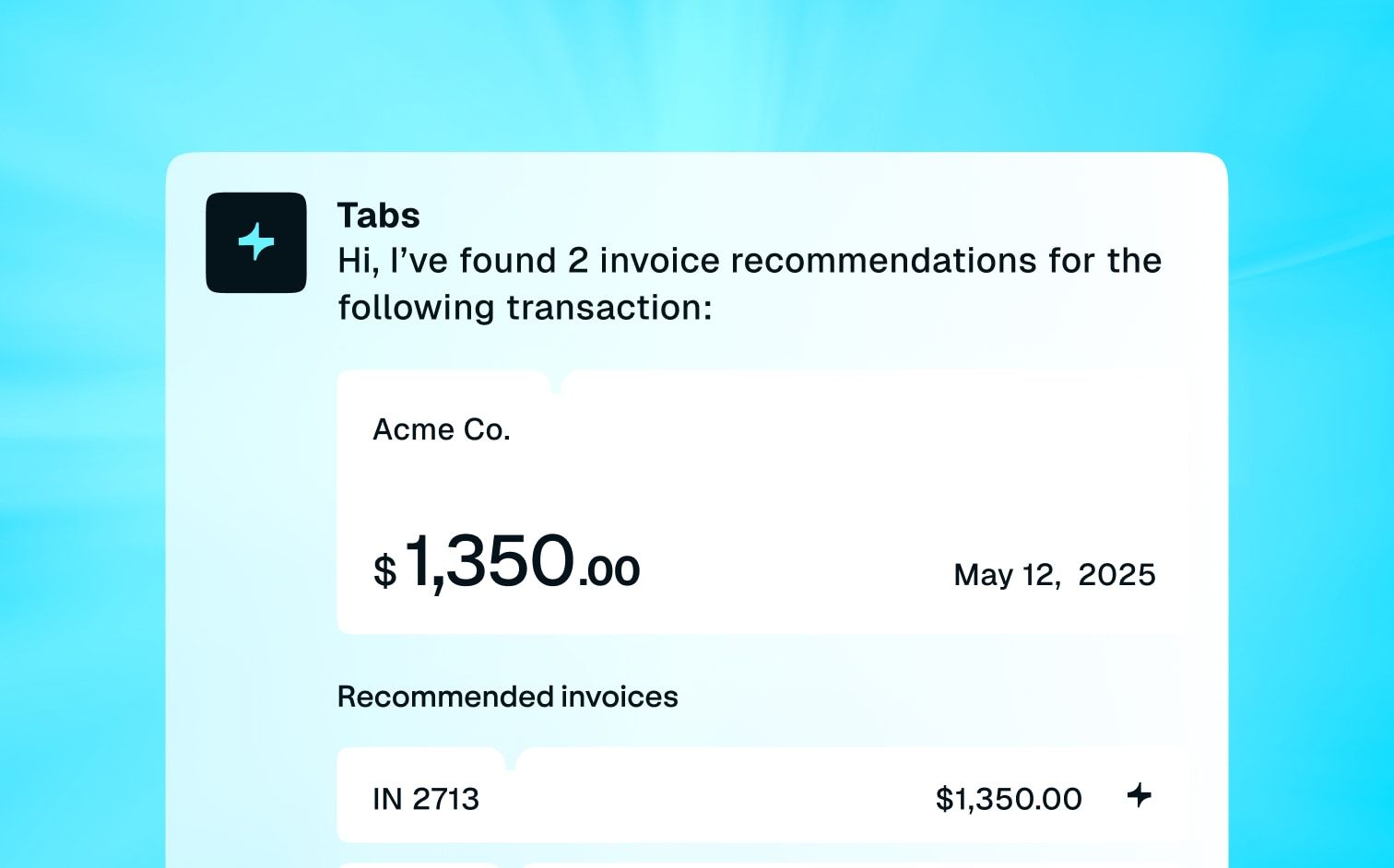
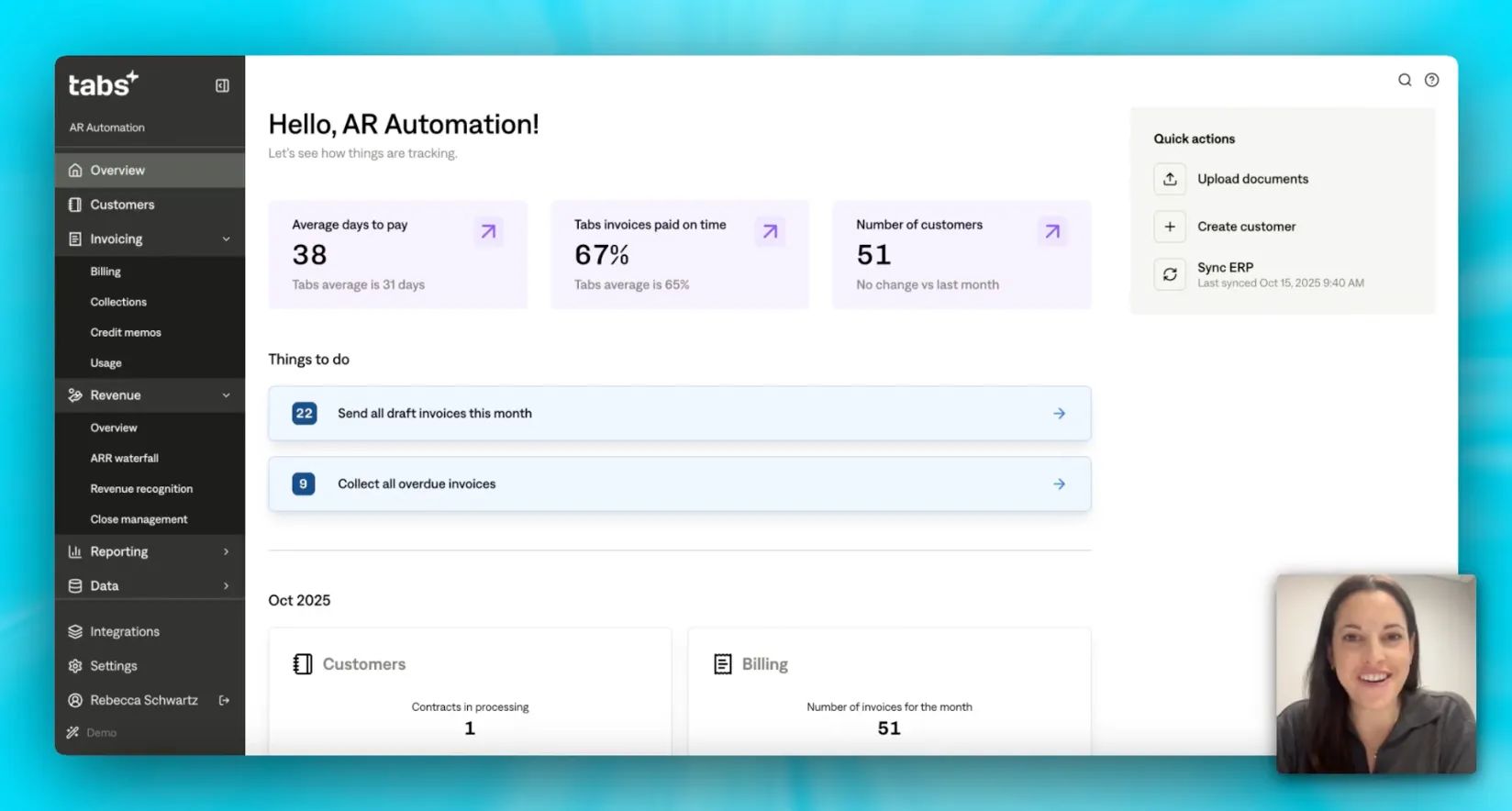
AI billing agents are AI-powered workflows that extract, validate, and route billing and payment tasks with human review on exceptions. In a revenue context, platforms like Tabs sit downstream of your CRM and CPQ to operationalize signed contracts into invoices, collections workflows, and Revenue Recognition—not just document automation.
Unlike traditional rule-based automation, these agents use trained models to classify documents and extract fields, then apply your policy and contract logic to validate outcomes—routing only exceptions for review.
For B2B companies with complex revenue models—whether subscription, seat-based, or usage-driven—this distinction matters enormously. Generic automation tools weren't built to handle subscription billing, usage-based pricing, or hybrid models that combine multiple approaches. Purpose-built, AI-powered billing captures commercial context from contract terms and translates it into accurate billing workflows and Revenue Recognition—not just data extraction, but contract-aware logic applied automatically.
Types of AI billing agents and core capabilities
AI billing agents aren't a single tool. They're a set of specialized functions that work together across your billing lifecycle—from contract ingestion to invoicing, cash application, and exceptions.
Document classification agents
These agents sort every incoming document into the correct category automatically. They distinguish between invoices, credit memos, and supporting documentation in near real time—preventing the bottleneck of a cluttered shared inbox.
- Recognize formats: Identify document type whether it arrives as a PDF, image, or email attachment
- Route by source: Direct documents to the right queue based on customer, entity, or business unit
- Detect duplicates: Flag potential duplicate submissions before processing begins
Data extraction agents
Data extraction agents use optical character recognition (OCR) combined with natural language processing (NLP) to turn unstructured documents into structured data. Instead of someone typing numbers into a spreadsheet, the agent reads the invoice and populates your system fields automatically.
Modern extraction doesn't rely on templates. It uses OCR and language models to map varied labels (for example, "Total Due" vs. "Amount Payable") to the correct fields. The agent assigns confidence scores to estimate extraction accuracy and routes low-confidence fields for human review.
Validation and matching agents
Validation agents verify that what you're invoicing aligns with what the customer bought and used. They automate invoice-to-contract and invoice-to-usage matching—comparing invoice lines to signed terms, entitlements, proration rules, and metered usage.
This is where AI-powered invoice reconciliation delivers outsized value. Instead of relying only on static rules, AI flags discrepancies by comparing invoice lines to contract terms and pricing logic—for example, proration, tier thresholds, discounts, or out-of-contract fees—then routes exceptions with the supporting evidence.
Approval workflow agents
Once validated, approval agents manage internal routing to get invoices authorized for payment. They reference your company's delegation-of-authority matrix and enforce compliance without manual email chains.
- Route dynamically: Send invoices to the right approvers based on amount, customer, entity, or cost center
- Escalate automatically: Alert managers when approvals stall beyond defined timeframes
- Approve anywhere: Enable approvers to act from any device with full context
Integration and posting agents
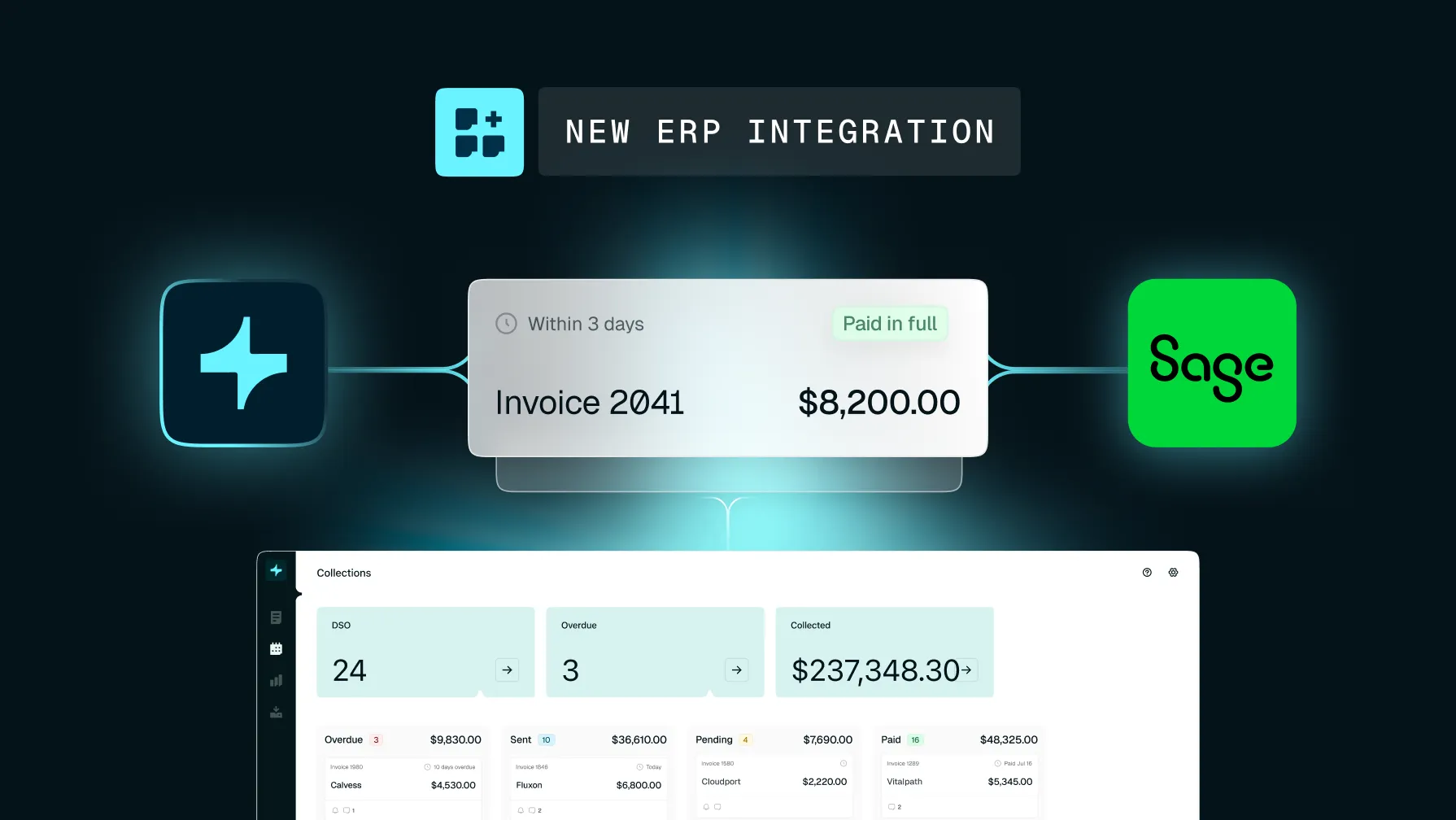
The final step is recording transactions in your financial system. Integration agents sync validated data directly to your ERP, ensuring your general ledger stays current without batch uploads or manual entry at month-end.
How AI billing agents automate invoice processing step by step
Understanding the workflow helps you see where AI eliminates manual touchpoints.
Step 1: Invoice capture
Billing inputs arrive through multiple channels—signed contracts from CRM/CPQ, usage events from your data warehouse or product telemetry, and adjustments via API. AI agents monitor these channels continuously, ensuring no document gets lost in a spam folder or personal inbox.
Step 2: Data interpretation
The billing workflow uses OCR and language models to extract key fields and classify the document contents. Unlike older systems that looked for text in specific coordinates, modern models use surrounding labels and structure to map values to the correct fields. They extract data and assign confidence scores to verify accuracy.
Step 3: Contextual validation
The workflow checks extracted data against your internal records. It looks up the customer, validates the invoice against the signed contract, and verifies that pricing aligns with terms like discounts, proration rules, and usage tiers. AI applies business logic—not just static rules—to flag genuine exceptions.
Step 4: Workflow routing
If data is accurate, the agent determines who needs to approve payment. It references your approval policies and routes accordingly. For invoices that match the contract schedule and usage records within defined tolerances, the workflow can auto-approve and route only exceptions to your team.
Step 5: System posting and resolution
Finally, the workflow pushes transaction data into your ERP to book the invoice, update accounts receivable, and schedule collections or payment processing (depending on your flow). It updates invoice status, syncs the latest state across systems, and records a complete audit trail for audit purposes.
Automate contract-to-cash with Tabs
Integrations and data sources for AI billing agents
For AI billing agents to deliver value, they must connect seamlessly with your existing finance stack.
ERP integrations
Your ERP is the source of truth for financial data—and nearly half of AI investors (47%) also invest in ERP, according to Deloitte, underscoring its role as the backbone for AI integration. Billing agents must sync bi-directionally—pulling vendor and PO data out, pushing invoice and payment data back in. Native integrations with NetSuite, SAP, Oracle, QuickBooks, and Sage Intacct ensure data integrity without custom development.
Data sources
Billing data originates from multiple sources. Agents connect to email, ingest contract data from CRM/CPQ, pull usage events from your data warehouse, and accept structured feeds via EDI when needed. Multi-channel capture ensures you have complete visibility into liabilities regardless of how vendors choose to bill you.
API and webhook options
For custom workflows, APIs let you trigger downstream actions—like creating a dispute case, updating customer status, or notifying RevOps—based on billing events. Webhooks notify other systems in real-time when invoices are approved or payments fail. This extensibility lets technical teams automate unique processes that standard software doesn't cover.
Benefits of AI billing agents
The value goes beyond time savings. AI billing agents fundamentally change how finance teams manage cash and risk.
Lower operational costs
Automation reduces cost per invoice by eliminating manual data entry and routing. According to McKinsey, finance professionals using AI spend 20 to 30 percent less time on data processing. Teams handle higher volumes without adding headcount—decoupling company growth from back-office staffing requirements.
Shorter processing time and DSO
Removing manual bottlenecks means customer invoices go out faster and with fewer errors—so you get paid sooner. And when invoices match the contract the first time, you reduce disputes, shorten Days Sales Outstanding (DSO), and improve cash predictability.
Higher data accuracy
Humans make mistakes when typing hundreds of data lines. AI agents reduce keying errors, duplicate invoices, and incorrect general ledger (GL) coding that disrupts month-end reporting.
Greater throughput capacity
AI agents don't get tired or overwhelmed during month-end close. They provide elastic capacity that scales to handle volume spikes—without forcing your team into overtime during close.
Audit trails and compliance support
Every decision is recorded, time-stamped, and linked to the policy, approval step, or user action that authorized it—creating audit-grade transparency. This creates an automatic audit trail that simplifies compliance with frameworks like SOC 2.
Use cases by industry for AI billing agents
Different industries face unique billing challenges that AI agents address specifically.
Retail
Retailers manage complex customer billing scenarios—promotions, returns, partial shipments, and multi-entity contracts. AI helps reconcile invoices to contract terms and order data so you bill accurately and reduce disputes.
Finance and shared services
Large organizations use AI to manage billing across multiple subsidiaries and currencies. Agents route invoices to the correct legal entity and handle intercompany reconciliation automatically.
Manufacturing
Manufacturers often use milestone-based contracts and progress billing. AI helps translate signed milestones, acceptance criteria, and change orders into billing schedules and Revenue Recognition—reducing manual reconciliations at month-end.
Healthcare
Healthcare organizations navigate strict compliance requirements and complex contract terms. AI can reconcile invoices against contracted rates and required documentation, and flag gaps before invoices go out.
Logistics
Logistics companies bill customers for accessorial charges and surcharges that change by lane and contract. AI can reconcile billed charges to rate cards and contracted terms, and flag likely misbills before they create disputes.
Challenges with AI billing agents adoption
Understanding obstacles upfront helps teams plan for smoother implementation.
ERP and system integration
Connecting modern AI tools to legacy ERP systems can be technically complex. EY's Financial Services CTO Survey found 68% of CTOs cited legacy systems as the most significant obstacle to AI adoption. While pre-built connectors exist, custom fields and unique workflows often require additional configuration. Allocate IT resources accordingly.
Inconsistent invoice formats
Highly unstructured or handwritten invoices can still pose challenges. Some initial configuration and feedback cycles may be required to improve extraction and matching for specific document formats and edge cases. The system learns over time, but the ramp-up period requires patience.
Stakeholder trust
Finance teams are trained to be skeptical. Relying on automation to approve invoices or release invoices for sending requires change management and clear exception policies. Building trust means transparency—the AI must clearly show its work and confidence levels.
Team enablement and workflow change
Moving to automated workflows changes daily routines. Effective change management involves training teams to manage exceptions rather than process routine tasks.
How to get started with AI billing agents
A phased approach validates value quickly while minimizing disruption.
Step 1: Audit current invoice workflows
Before automating, understand your current process in detail. Map where invoices come from, who approves them, and where bottlenecks occur. Baseline metrics let you measure ROI later.
Step 2: Identify high-volume use cases
Start with invoice types that consume the most time but require the least complex decision-making. High-volume, low-dollar invoices are often the best candidates for early automation.
Step 3: Pilot with prebuilt configurations
Avoid building custom workflows from scratch. Start with proven, preconfigured patterns for standard use cases, then customize once the basics are stable.
Step 4: Track key performance metrics
Monitor touchless rate, average cycle time, and exception rate. These numbers reveal where AI performs well and where it needs tuning.
Step 5: Scale across functions or regions
Once the pilot succeeds, expand to other departments, subsidiaries, or invoice types. Use lessons learned to smooth the rollout.
Why Tabs fits B2B billing complexity
For B2B companies, generic automation often fails because it lacks deep understanding of commercial agreements. Tabs is built specifically for this environment.
Contract ingestion and schedules
Tabs uses AI to capture terms from signed contracts—typically synced downstream from CRM and CPQ—whether they arrive as PDFs, Word docs, or email attachments. Unlike basic OCR, Tabs maps extracted terms to their operational implications—payment schedules, renewal dates, discount logic, proration rules, and billing triggers. It generates billing schedules automatically, reducing manual handoffs from CRM/CPQ into your ERP and finance workflows.
Usage-based and hybrid billing
Modern B2B models often combine subscriptions with usage fees. Tabs supports hybrid models by applying signed terms to metering, proration, and overage calculations—without custom code. Product teams can launch new pricing models without waiting for finance to update spreadsheets.
Bi-directional ERP sync
Tabs is a system of intelligence downstream of your CRM and CPQ that operationalizes signed contracts into your ERP—keeping customer, contract, invoice, and cash data consistent in both directions. Native integrations with NetSuite, QuickBooks, Sage Intacct, and Oracle keep revenue data consistent across your entire finance stack.
Commercial Graph and context
At the heart of Tabs is the Commercial Graph—a unified customer record linking contracts, usage data, payments, and terms. This context supports accurate billing and Revenue Recognition workflows that isolated tools struggle to automate reliably.
Developer APIs for extensibility
Tabs provides robust APIs that let engineering teams extend billing workflows—like ingesting usage events, creating invoices, or syncing ERP status—inside internal systems or customer-facing admin experiences. This developer-friendly approach ensures Tabs adapts as your business scales.